
Portsmouth Square: Concentrated Hotel Exposure and Financial Pressures in a Single Asset
Portsmouth Square’s future is bound to the performance and operational resilience of its sole asset—the Hilton San Francisco Financial District. With mounting losses, heavy unionization, and a need for ongoing capital investment, the company’s ability to navigate local market dynamics and manage its financial obligations will determine its long-term viability.
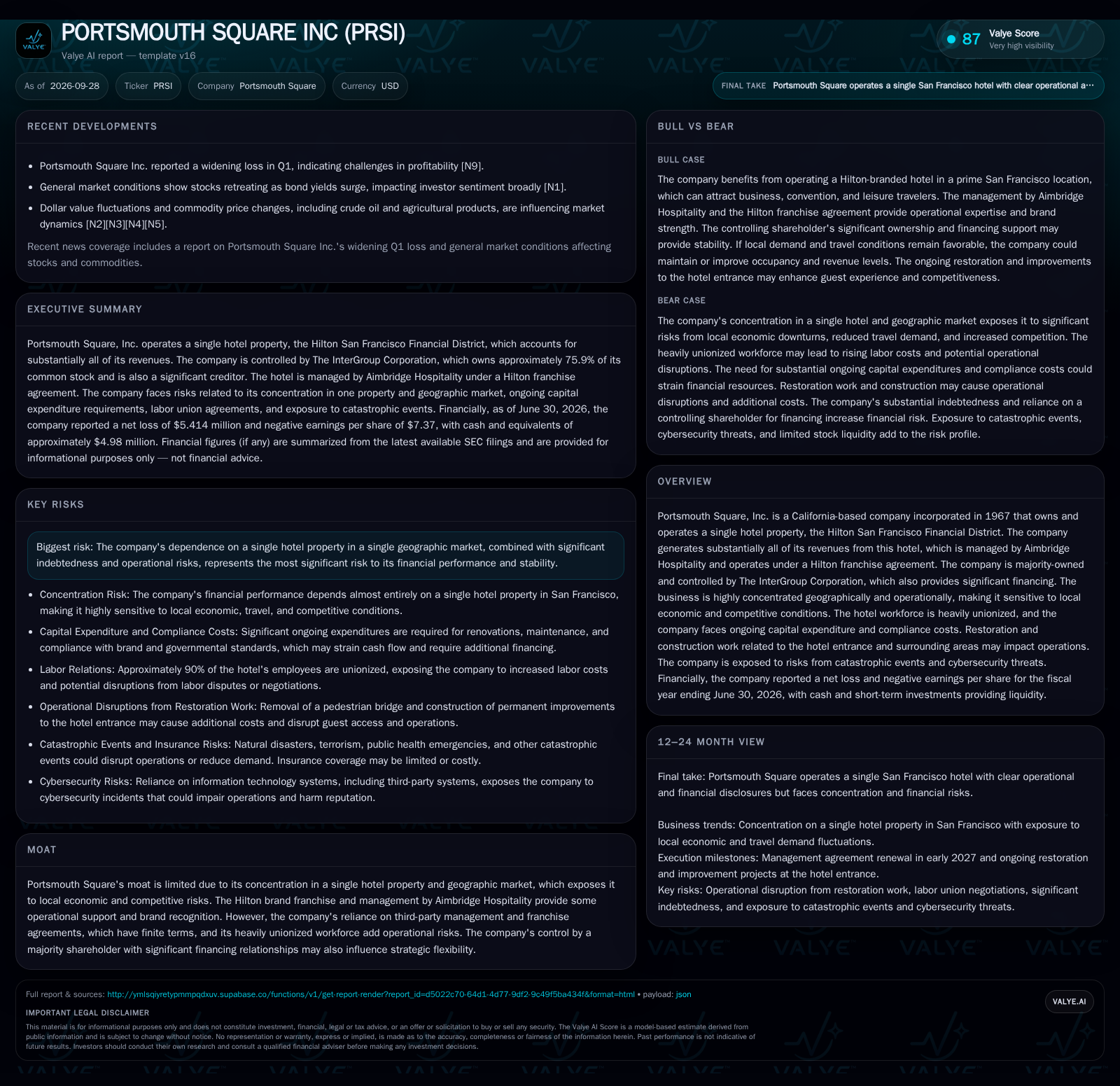
Portsmouth Square operates only one hotel—the Hilton San Francisco Financial District—making it acutely sensitive to local economic, labor, and operational disruptions. As of June 2026, it reported a net loss of $5.4 million and relies heavily on financing from its controlling shareholder. The path forward depends on managing capital needs, unionized labor costs, and the success of property improvements while contending with significant concentration and financial risks. [S1]
Portsmouth Square, Inc. is the quintessential single-asset hotel company: its fortunes are directly tied to the performance of the Hilton San Francisco Financial District. With the hotel serving as its sole source of revenue, Portsmouth faces a high-stakes game of local economic roulette. Recent financials show a deepening net loss and reliance on a controlling shareholder for both capital and operational support. The coming years will test whether the company can balance union-driven labor costs, mandatory capital investments, and operational disruptions from property improvements—all while depending on a single, highly competitive urban hospitality market to deliver returns.
Performance Trends Highlight Risks of Single-Hotel Focus
Portsmouth Square reported a net loss of $5.414 million for the fiscal year ending June 30, 2026, with basic and diluted EPS of -$7.37. The company’s liquidity position includes $4.982 million in cash and equivalents and $138,000 in short-term investments. The business is entirely anchored to one property, the Hilton San Francisco Financial District, which is managed by Aimbridge Hospitality under a Hilton franchise agreement. Approximately 90% of the hotel’s 187 employees are unionized, with collective bargaining agreements in place. Portsmouth’s capital structure is heavily reliant on The InterGroup Corporation, which owns about 75.9% of its shares and is the primary lender via a $38.108 million unsecured revolving credit facility. Ongoing restoration and construction work at the hotel entrance, as well as requirements for continual property upgrades, are expected to generate additional costs and operational friction. [S1]
Revenue Generation and Capital Needs of an Urban Hotel
Portsmouth Square’s revenue model is straightforward: income is generated almost exclusively from room bookings, food and beverage sales, and ancillary services at its sole Hilton-branded hotel. Pricing power is closely tied to San Francisco’s local demand drivers—such as business travel, conventions, and tourism—while occupancy and average daily rate (ADR) determine topline outcomes. However, with a single asset, the company lacks diversification, making its cash flows volatile and highly sensitive to local shocks.
Variable costs include labor (heavily unionized and subject to collective bargaining), utilities, and franchise/management fees. Fixed costs are dominated by property taxes, debt service, and mandatory capital expenditures required both by the Hilton brand and local regulatory standards. The high fixed-cost base creates significant operating leverage: small swings in occupancy or ADR can have an outsized impact on profitability. Capex needs are persistent, as brand standards and urban hospitality regulations demand regular renovations and upgrades. The company’s financial structure, reliant on a large related-party credit facility, adds interest expense and limits potential financial flexibility. If the hotel underperforms or faces major disruptions, Portsmouth may require further outside capital or concessions from its controlling shareholder.
Brand Partnership and Management: Navigating a Competitive Landscape
Portsmouth Square benefits from the global recognition and reservation system of the Hilton brand, which can attract business and leisure travelers seeking reliability and loyalty program benefits. Its downtown San Francisco location is a potential draw, particularly for business and convention guests. Management by Aimbridge Hospitality provides operational expertise, but this is a standard third-party arrangement and does not confer a unique competitive advantage.
However, the company faces intense competition from other branded and independent hotels in the San Francisco Financial District, as well as from alternative lodging options such as short-term rentals and boutique hotels. The property is not unique in its offering, and switching costs for guests are low. The company’s moat is further limited by its dependence on the franchise and management agreements, which have finite durations and could be subject to unfavorable renewal terms. Additionally, heavy unionization may constrain operational agility compared to non-union peers.
Potential Gains from Increased Local Demand or Renovation Success
The most plausible upside scenario is driven by a rebound in San Francisco’s business and convention travel, coupled with successful completion of restoration work that enhances the hotel’s curb appeal and guest experience. If local economic conditions improve—such as a tech-sector rebound, increased tourism, or the return of major conferences—the hotel could see higher occupancy rates and better pricing power. This would drive operating leverage, potentially swinging the company back toward profitability.
Operationally, if the restoration and capital improvements are completed on time and within budget, and if they result in positive guest reviews or higher ratings, Portsmouth could see a step-up in both occupancy and average daily rate. Favorable renegotiation or extension of the Aimbridge management and Hilton franchise agreements could also provide continuity and reduce operational transition risk.
Evidence to confirm this scenario would include rising revenue per available room (RevPAR), improved occupancy and ADR metrics (if disclosed), and a return to positive operating cash flow. Announcements of major new corporate bookings or convention business returning to San Francisco would further support the upside case.
Maintaining Stability Despite Persistent Operational Challenges
The most likely outcome is that Portsmouth Square continues to operate under a tight margin environment, with modest improvement or stabilization in local demand partially offset by ongoing cost pressures. Labor costs are likely to remain elevated due to union agreements, and mandatory capital expenditures for renovations and compliance will continue to weigh on cash flows. The property may see incremental gains from restoration work, but any benefit could be muted by competitive pricing and the slow recovery of urban travel demand.
The company remains reliant on the support of its controlling shareholder for financing and operational stability. The management and franchise agreements are renewed or extended without major disruption, but the business remains highly sensitive to local shocks and competitive pressures. Confirmation of this scenario would be a continuation of modest losses or break-even performance, stable or slightly improving occupancy rates, and no major changes in capital structure or ownership. Evidence to the contrary would include a sharp deterioration in cash flow, inability to meet debt obligations, or a breakdown in management/franchise relationships.
Risks from Local Disruptions and Operational Setbacks
The primary risk is that a local economic downturn, significant labor dispute, or major operational disruption (such as prolonged construction delays at the hotel entrance) leads to a sharp decline in occupancy and revenue. Given the company’s high fixed costs and leveraged balance sheet, even a moderate downturn could result in severe cash burn. If the controlling shareholder reduces or withdraws financial support, Portsmouth could face liquidity stress or covenant breaches.
Other downside triggers include a catastrophic event—such as an earthquake or major cyberattack—that disrupts hotel operations or leads to uninsured losses. Adverse changes in the terms or renewal of the management or franchise agreements could also increase costs or reduce brand value. Confirmation of the downside case would be a rapid deterioration in liquidity, missed debt payments, or the announcement of a distressed asset sale or bankruptcy process. Evidence would include further widening of losses, declining cash balances, and negative occupancy or ADR trends (if disclosed).
Critical Developments Influencing Portsmouth Square’s Future
Renewal or renegotiation of the Aimbridge management agreement in early 2027—terms and continuity will have a direct impact on operational stability.
Progress and cost control of restoration work at the hotel entrance: delays, budget overruns, or guest disruption could materially affect cash flow and reputation.
Occupancy rates, average daily rate (ADR), and revenue per available room (RevPAR)—if disclosed—will indicate the hotel’s ability to compete and capture demand.
Labor cost trends and outcomes of union contract negotiations: any material increase in wages or benefits could pressure margins.
Cash flow from operations and changes in cash and equivalents: a declining trend would signal rising financial stress.
Any amendments, draws, or changes to the $38.108 million revolving credit facility with InterGroup—especially if it signals liquidity risk or changing shareholder support.
Renewal status and terms of the Hilton franchise agreement, which expires in January 2030: brand continuity is critical for demand and pricing.
Incidents of operational disruption, catastrophic events, or cybersecurity breaches, and the adequacy of insurance coverage in response.
Disclaimer: This is research-only, informational analysis and not investment advice. It may include AI-generated interpretation and general industry context. Always verify important details using primary sources.

Comments