
MOVING iMAGE TECHNOLOGIES INC.: DCS Audio Momentum, Margin Leverage Potential, and Execution Watchpoints
MOVING iMAGE TECHNOLOGIES INC. (MITQ) is narrowing its losses and achieving sales growth in its DCS Audio segment, supported by a reported liquidity position. The company's ability to convert product traction into sustainable profitability and defend its niche against broader industry competition will be critical to its long-term value realization.
The core question is whether DCS Audio growth and technology refreshes can drive consistent profitability amid ongoing market and execution risks.
MOVING iMAGE TECHNOLOGIES INC. (MITQ), a Delaware-based technology firm trading on NYSE American, is incrementally improving its financial performance. With net losses narrowing to $297,000 in FY2026 and recent quarters showing sales traction—particularly in its DCS Audio product line—the company is signaling operational progress.
Recent Results Highlight DCS Audio Growth and Improved Loss Profile
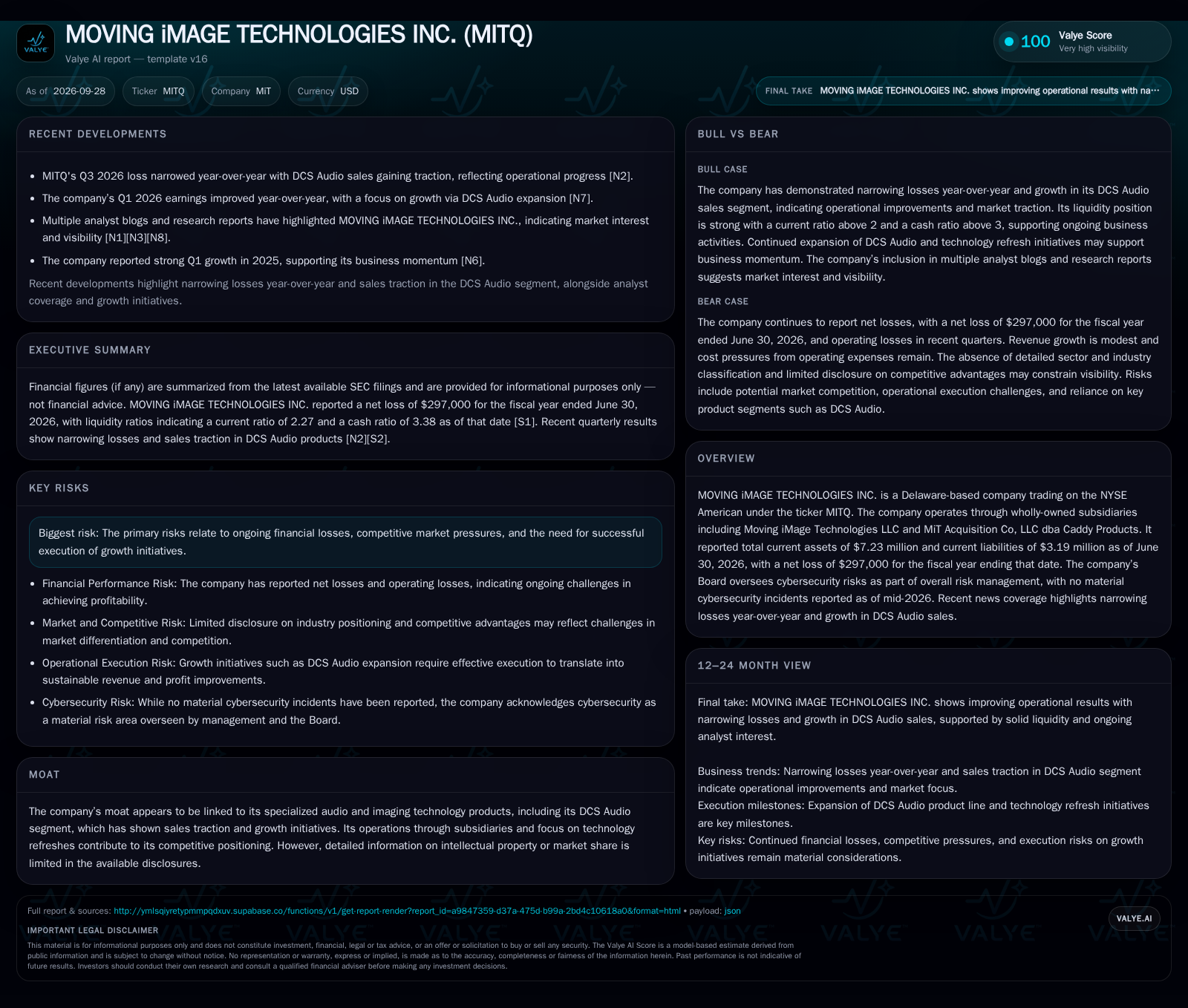
MITQ reported a net loss of $297,000 for the fiscal year ended June 30, 2026, a narrowing loss profile compared to prior periods. This was accompanied by quarterly results showing $3.4 million in net sales and a gross profit of $1.18 million in Q3 2026, with operating losses reduced to $134,000 and net losses at $122,000 [S1] [S2]. DCS Audio sales gained notable traction during these periods, suggesting a product-level growth driver [N2]. The company reported a current ratio of 2.27 and a cash ratio of 3.38 as of June 30, 2026 [S1]. These figures indicate MITQ’s financial resources at the reporting date and demonstrate operational improvements, but persistent net losses and reliance on key product segments still frame the core risk.
The timing and predictability of cash inflows from DCS Audio sales are critical, as uneven revenue streams could pressure working capital despite seemingly robust ratios. Additionally, the concentration of revenue in a single product segment increases exposure to market fluctuations or technological shifts, underscoring the importance of diversification or innovation to mitigate concentration risk. Understanding the cadence of product sales and any seasonality effects would further clarify the stability of the company’s near-term cash flow profile.
How DCS Audio and Technology Refreshes Could Drive Unit Economics
MITQ’s primary revenue appears to stem from specialized audio and imaging technology products, with DCS Audio as a leading segment. The business likely combines hardware sales with integrated technology refreshes, potentially creating periodic upgrade cycles and opportunities for higher-margin sales if adoption broadens. Fixed costs—especially in R&D and G&A—are significant, as shown by persistent operating losses despite gross profit generation. Variable costs are likely tied to hardware production and distribution, while selling and marketing expenses—reported at $484,000 in Q3 2026—suggest a need to sustain customer acquisition and product rollout [S2]. If DCS Audio achieves wider adoption, MITQ may benefit from operating leverage, as incremental sales could dilute fixed costs and improve margin structure. However, the path to positive operating income depends on both volume growth and the company’s ability to control its cost base.
The interplay between fixed and variable costs in MITQ’s business model suggests that scalability hinges on achieving a critical sales volume threshold. Should DCS Audio adoption accelerate, the dilution of fixed costs such as R&D and G&A over a larger revenue base could drive meaningful margin expansion. However, this assumes that incremental sales do not require proportionate increases in selling and marketing spend, which historically can escalate in early growth phases to capture market share. Moreover, the potential for technology refresh cycles to generate recurring revenue depends on customer willingness to upgrade, which may be influenced by perceived product differentiation and total cost of ownership. Thus, sustaining unit economics improvement requires balancing growth investments with disciplined cost management.
Niche Specialization Versus Broader Industry Competition
MITQ’s competitive position is rooted in its specialized technology offerings, particularly DCS Audio, which may serve differentiated needs within cinema or professional AV markets. In practice, the company faces competition from larger audio-visual hardware suppliers and technology integrators—many of whom can bundle solutions or leverage broader distribution. While MITQ’s focus on technology refreshes and proprietary products could provide a defensible niche, the lack of disclosed information about intellectual property, exclusive partnerships, or switching costs leaves its moat unproven. The risk is that larger players could commoditize core offerings or outspend MITQ in R&D and sales, eroding potential pricing power. Analyst attention and recent sales traction suggest some differentiation, but the company’s long-term advantage will depend on sustained product innovation and its ability to lock in customer relationships.
MITQ’s niche specialization offers both opportunities and vulnerabilities in the context of competitive dynamics. While focusing on proprietary audio technology can create barriers to entry, the absence of clear intellectual property protections or exclusive partnerships may limit defensibility. Larger competitors with broader portfolios might leverage economies of scale to undercut pricing or bundle offerings, challenging MITQ’s market positioning. Additionally, the pace of technological innovation in audio and imaging sectors necessitates continuous product development to maintain relevance. Therefore, MITQ’s ability to secure customer loyalty and could increase switching costs through superior performance or integrated solutions will be pivotal in sustaining its competitive moat against industry incumbents.
If DCS Audio Adoption Accelerates, Margin Expansion Could Follow
A favorable scenario would see DCS Audio become a standard or preferred solution within its target market, driving sustained double-digit sales growth and higher recurring or repeat upgrade revenues. If MITQ can leverage its available financial resources to expand sales and marketing reach—without a commensurate rise in fixed costs—operating leverage could turn narrowing losses into consistent profitability. Margin expansion could also result from a richer product mix, especially if the company introduces higher-value or software-enabled offerings. Evidence that would confirm this scenario includes consistent quarter-over-quarter sales growth in DCS Audio, a move to positive operating income, and new customer wins or partnership announcements. Falsification would occur if DCS Audio sales plateau or if operating expenses rise faster than gross profit, stalling margin improvement.
Incremental Progress with Persistent Execution Risks
The most plausible middle path is that MITQ continues to incrementally grow its DCS Audio segment, translating into modest top-line gains and further narrowing of net losses. However, operating profitability remains elusive due to ongoing R&D, sales, and administrative costs needed to support growth. Confirming evidence would be a continued trend of reduced losses and stable or slightly growing sales without a marked inflection into profitability. Conversely, a reversal—such as shrinking DCS Audio sales or a spike in costs—would challenge this scenario.
Stalled DCS Audio Growth and Rising Costs Threaten Sustainability
The downside scenario sees DCS Audio sales losing momentum, either from heightened competition, technological obsolescence, or market saturation. Fixed costs—particularly in R&D and administration—remain high, leading to widening operating losses as sales stagnate or decline. The company’s reported liquidity could be depleted over time if negative cash flow persists, potentially forcing cost cuts or external capital raises on less favorable terms. Evidence supporting this scenario would be consecutive quarters of declining revenue, expanding net losses, and diminished analyst coverage or customer engagement. A sustained inability to achieve positive operating cash flow would further validate downside risk.
Milestones and Metrics That Will Reveal Whether MITQ Can Transition to Profitability
Quarterly DCS Audio segment sales growth, if disclosed, will indicate whether product traction is accelerating or stalling.
Gross margin trends across product lines would help test whether higher-value offerings are improving overall profitability.
Operating expense trajectory—especially in selling, marketing, and R&D—will reveal whether the company is achieving scale efficiencies.
Progression toward positive operating income or cash flow on a quarterly basis is a critical inflection point for business sustainability.
Customer acquisition and retention metrics, if disclosed, would clarify whether MITQ is building recurring or repeat business.
Announcements of new partnerships, major contracts, or technology refresh cycles would signal market validation and expansion opportunities.
Updates on liquidity and cash burn rates, especially if sales momentum slows, will show how much financial cushion remains for execution.
Disclaimer: This is research-only, informational analysis and not investment advice. It may include AI-generated interpretation and general industry context. Always verify important details using primary sources.

Comments