
NETSOL Technologies: Platform Expansion, Margin Volatility, and the Economics of Automotive Finance Software
NETSOL Technologies reported record annual revenues in fiscal 2026, driven by expansion in digital finance and automotive leasing software, but recent quarters have exposed margin pressure and profit declines. The company’s ability to translate revenue growth into sustainable earnings, scale its SaaS-based platforms, and defend its position against intensifying competition will define its trajectory.
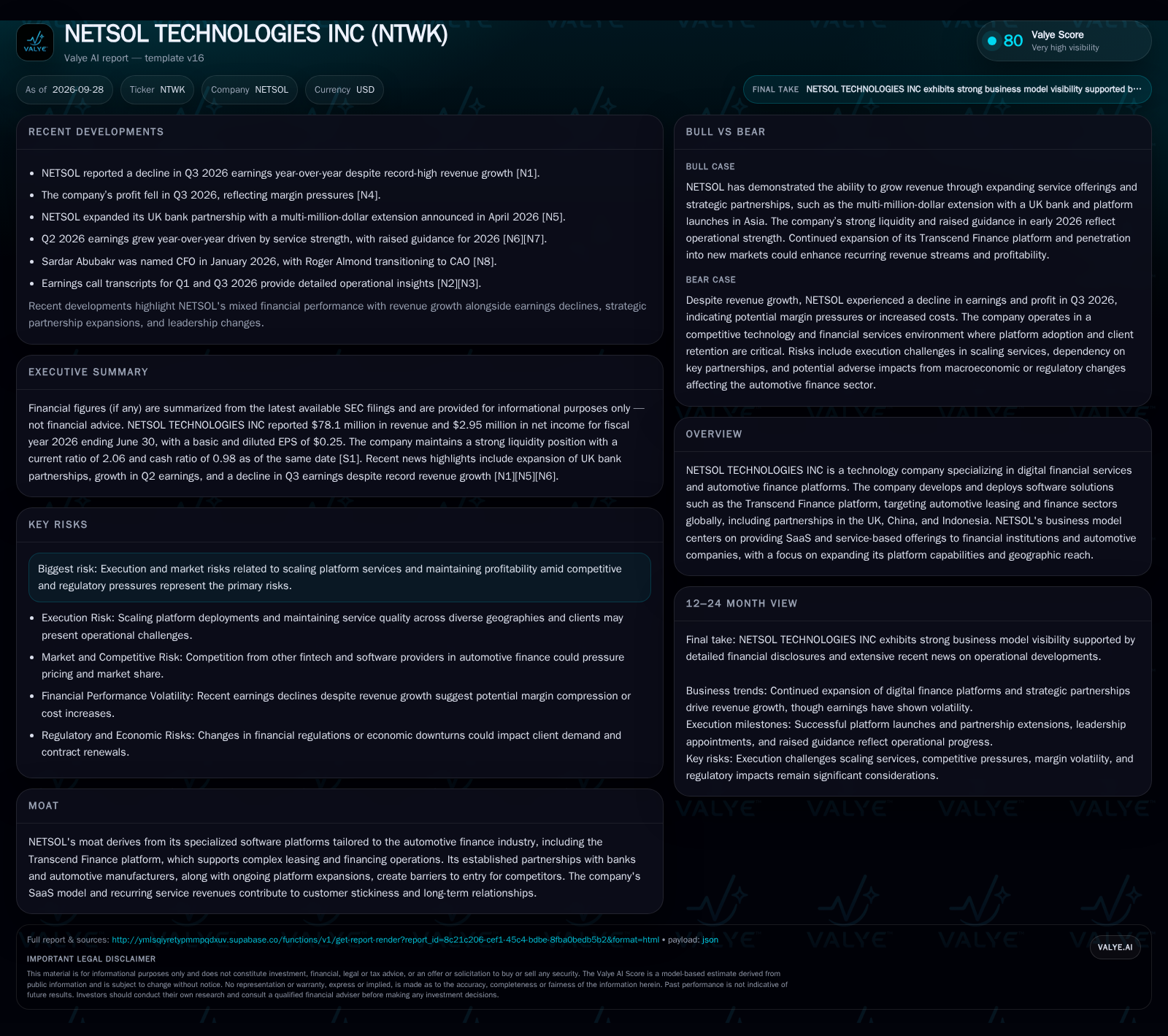
NETSOL Technologies posted $78.1 million in revenue and $2.95 million in net income for fiscal 2026, yet Q3 saw profit and earnings decline despite top-line growth [S1] [N1] [N4]. Expansion of its digital automotive finance platform—highlighted by a multi-million-dollar UK partnership extension [N5]—suggests growth potential, but margin compression and competitive risks remain central challenges.
NETSOL Technologies, a specialist in digital financial services and automotive finance software, has reported record revenue for the 2026 fiscal year but faces the duality of rising top-line growth and declining quarterly profit. The company’s latest results reveal both the promise and complexity of scaling SaaS platforms in a competitive, margin-sensitive sector. As NETSOL expands its strategic partnerships and platform capabilities, its next phase will likely depend on the economics of recurring software revenue, the sustainability of its cost base, and its ability to defend market share against increasingly sophisticated rivals.
Record Revenue Growth Meets Margin Compression: What the Numbers Reveal
In fiscal year 2026, NETSOL Technologies achieved revenue of $78.1 million and net income of $2.95 million, translating to basic and diluted EPS of $0.25 [S1]. However, this strong annual performance masks a notable decline in profit during Q3 2026, when earnings fell year-over-year despite record revenue growth [N1] [N4]. The company reported a current ratio of 2.06 and a cash ratio of 0.98 at June 30, 2026, reflecting a reported liquidity position [S1]. Operationally, NETSOL expanded a major UK bank partnership with a multi-million-dollar contract extension in April 2026, reinforcing its commercial relevance in the automotive finance sector [N5]. The appointment of Sardar Abubakr as CFO in January 2026, with the prior CFO moving to CAO, suggests a potential shift in financial strategy and operational oversight [N8].
Decoding the Economics of Automotive Finance SaaS
NETSOL’s business model centers on providing SaaS and service-based digital platforms for automotive leasing and finance institutions. The core economics of this model rely on a combination of recurring subscription fees, implementation and customization charges, and ongoing service/support revenues. SaaS models typically offer attractive gross margins once scale is achieved, as software delivery costs are largely fixed while incremental users or contracts can be onboarded with modest variable expense. However, in the automotive finance vertical, extensive integration, compliance, and localization requirements can inflate upfront costs and compress margins, especially during periods of rapid expansion.
The company’s recent margin pressure—evidenced by profit declines despite revenue growth—may reflect a mix-shift toward lower-margin services, elevated implementation costs, or increased competition forcing pricing concessions. NETSOL’s ability to balance upfront customization and integration expenses with the long-term, high-margin annuity of SaaS contracts will be central to its economic model. If the company can increase the proportion of recurring revenue and reduce reliance on lumpy service or implementation projects, operating leverage could improve, supporting more stable earnings growth. Capital needs are moderate for a software business, but heavy investment in R&D and client onboarding can create near-term cash flow volatility.
Defending Share in a Crowded and Evolving Fintech Arena
NETSOL operates in a highly competitive environment, facing both established enterprise software providers and new entrants targeting the automotive finance and leasing niche. Its potential advantages stem from deep domain expertise, a tailored platform (Transcend Finance), and a track record of securing large institutional clients such as banks and automotive OEMs. These relationships may create switching frictions due to integration complexity and the mission-critical nature of finance platforms.
However, the sector is characterized by rapid technological evolution, with competitors investing aggressively in cloud-native platforms, AI-driven credit assessment, and embedded finance solutions. Barriers to entry are moderate: while regulatory compliance and integration know-how are significant, software modularity and API-driven architectures lower the cost for new entrants to challenge incumbents. NETSOL’s ability to maintain product differentiation—through continuous innovation, regulatory agility, and deepening ecosystem integrations—will determine its ability to command premium pricing and limit churn.
How Platform Scaling and Recurring Revenue Could Unlock Earnings Power
If NETSOL successfully accelerates adoption of its Transcend Finance and related platforms, the company could transition to a higher mix of recurring revenue from SaaS contracts. This would likely drive operating leverage, as incremental platform users generate high-margin revenue with limited incremental cost. The multi-million-dollar UK bank extension provides a template for landing and expanding major institutional clients [N5]. Additional wins in new geographies or verticals could reinforce momentum.
Confirmation of this scenario would come from reported increases in the proportion of recurring subscription revenue, evidence of improved gross and operating margins, and new multi-year client deals in earnings disclosures. Faster client onboarding, reduced implementation timelines, and lower churn rates (if disclosed) would further validate the thesis. If NETSOL can demonstrate that recent margin pressure is transitional—due to upfront investment rather than persistent pricing or cost issues—the business could scale profitably and command a higher valuation multiple.
Balancing Growth and Margin Recovery in a Competitive Market
The most plausible scenario is that NETSOL continues to grow revenue through incremental platform expansion and cross-selling to existing clients, but faces ongoing margin volatility as it invests in new capabilities and navigates competitive pricing. Over time, operating leverage should improve as a greater share of revenue comes from recurring SaaS contracts, but the transition may be uneven due to client-specific implementation cycles and competitive dynamics.
Evidence confirming this scenario would include steady, if modest, revenue growth, periodic margin fluctuations, and continued announcements of partnership extensions or new client wins. Signs of persistent margin pressure, high client acquisition costs, or increasing customer churn would challenge the case for eventual margin recovery and sustainable earnings growth.
When Revenue Growth Fails to Translate: Persistent Margin Erosion and Execution Risk
A negative scenario would see NETSOL’s revenue growth offset by chronic margin compression, driven by rising service costs, discounting in the face of competition, or failure to scale SaaS contracts profitably. If new platform launches require significant customization or client support, the company could remain trapped in a cycle of high-cost, low-margin project work. Reliance on a concentrated set of large clients, such as the UK bank, may also expose the business to renewal risk or pricing concessions.
Confirmation would come from continued year-over-year declines in quarterly profit and earnings, shrinking gross margins, and limited improvement in cash flow despite revenue growth. Signs of execution challenges—such as delayed client go-lives, cost overruns, or elevated R&D spend without corresponding revenue—would reinforce the downside thesis. Regulatory or macroeconomic shocks affecting automotive lending demand could exacerbate these pressures.
Milestones and Metrics That Will Shape NETSOL’s Next Chapter
Quarterly gross and operating margin trends—sustained improvement would support the upside, while further compression would validate downside concerns.
Disclosed mix of recurring versus project/service revenue; a rising share of SaaS/subscription revenue would be a positive signal.
Size, duration, and renewal rates of new and existing contracts—especially large institutional partnerships (if disclosed).
Client churn or retention rates, particularly among major banking and automotive clients (a useful metric if reported).
Implementation timelines and cost overruns for new platform deployments, as discussed in earnings calls or filings.
R&D and SG&A expense trends as a percentage of revenue, indicating whether investment is driving scalable growth or eroding profitability.
Competitive win/loss disclosures or references to pricing pressure in management commentary.
Any regulatory or macroeconomic developments affecting automotive finance demand in core markets.
Disclaimer: This is research-only, informational analysis and not investment advice. It may include AI-generated interpretation and general industry context. Always verify important details using primary sources.

Comments