
Precision Optics Corporation: Order Backlog Growth and Platform Innovation Confront Profitability Hurdles
Precision Optics is expanding its presence in defense, aerospace, and medical imaging through new platform launches and record order backlogs, but persistent net losses and customer concentration expose the company to execution and demand risks.
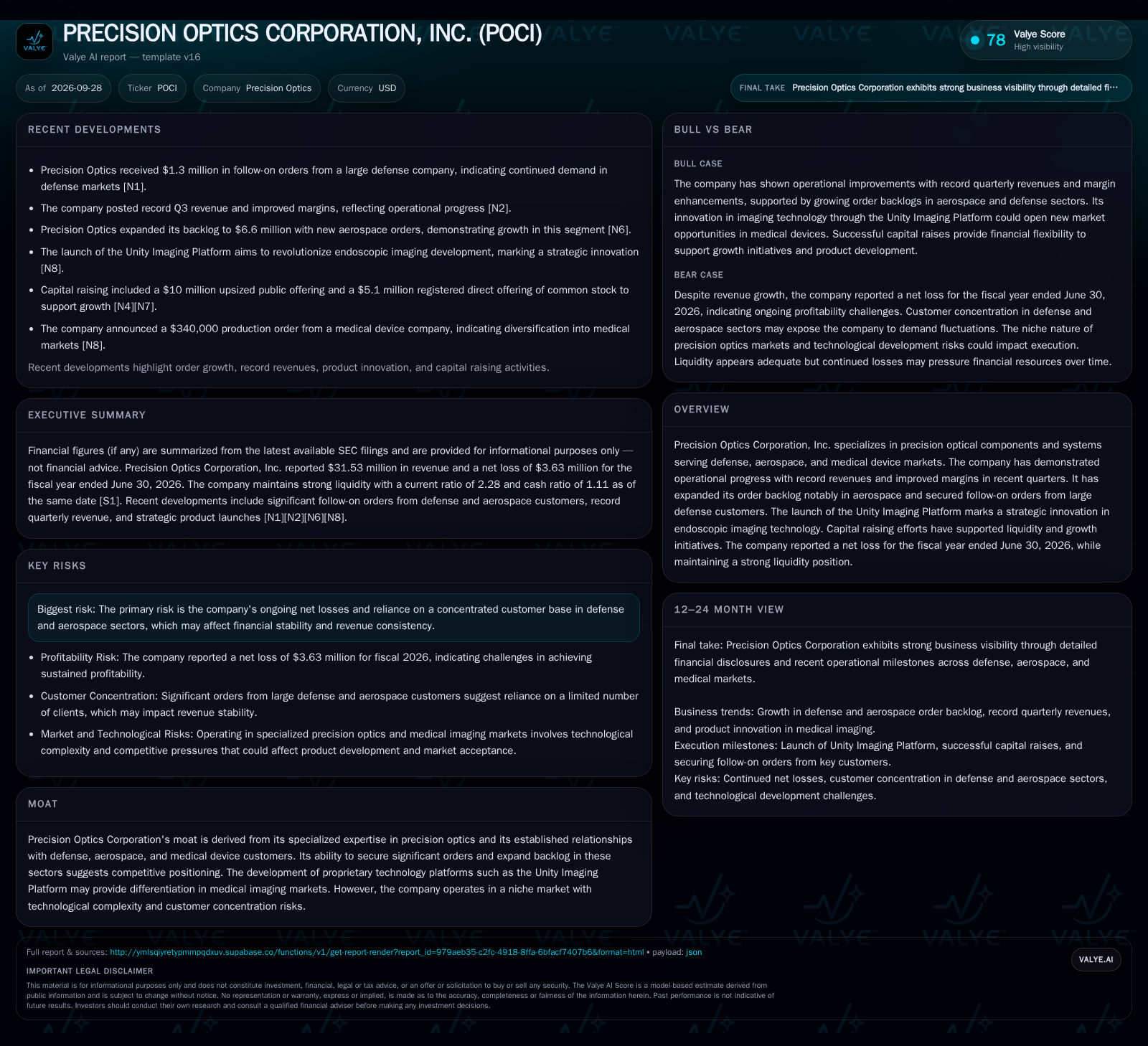
Precision Optics Corporation posted record annual revenue of $31.53 million in fiscal 2026, driven by growth in defense and aerospace orders and the launch of its Unity Imaging Platform. However, a net loss of $3.63 million underscores ongoing profitability challenges. Order backlog expansion and recent capital raises provide growth visibility, but continued reliance on a handful of large customers and technological complexity remain material risks. The next phase hinges on converting backlog into sustainable profits and broadening the customer base beyond defense and aerospace verticals. [S1] [N1] [N2] [N6] [N8]
Precision Optics Corporation is demonstrating momentum in its core defense and aerospace markets, evidenced by a record order backlog and continued follow-on orders from major industry players. The company is also leveraging its technical expertise to diversify into medical imaging, highlighted by the launch of the Unity Imaging Platform. Despite these operational advances and reported liquidity position from recent capital raises, Precision Optics continues to report net losses, leaving the durability of its growth uncertain. The critical question for investors is whether the company's innovation pipeline and backlog can translate into sustainable profitability while reducing reliance on a concentrated set of large customers. [S1] [N1] [N6] [N8]
Recent Order Wins and Platform Launch Define 2026 Operating Landscape
Precision Optics reported $31.53 million in revenue for the fiscal year ended June 30, 2026, but remained unprofitable with a net loss of $3.63 million. The company’s order backlog expanded to $6.6 million, driven by new aerospace deals, and it received $1.3 million in follow-on orders from a major defense customer. The launch of the Unity Imaging Platform marks a strategic push into medical imaging technology, while recent capital raises of $10 million and $5.1 million have strengthened the balance sheet. These developments signal a mix of growth potential and persistent financial challenges. [S1] [N1] [N4] [N6] [N7] [N8]
Revenue Streams, Cost Structure, and the Path to Margin Expansion
Precision Optics’ revenue model is centered on supplying high-specification optical components and systems to defense, aerospace, and medical device OEMs. Revenue is likely a mix of project-based contracts, production orders, and potentially recurring service/support agreements, though contract structure is not fully disclosed. The company’s cost base is characterized by high R&D and engineering spend, given the technical complexity and customization required, which can depress margins and delay operating leverage.
Recent record quarterly revenues and margin improvements suggest some scale benefits or improved product mix, but the company remains loss-making on an annual basis. The capital intensity of manufacturing precision optics, coupled with long sales cycles and customer-driven engineering requirements, means that fixed costs are significant, and gross margins may be highly sensitive to product mix and order timing. If the Unity Imaging Platform allows for more standardized or higher-margin offerings in medical imaging, this could improve margin structure and reduce reliance on lumpy project revenue. However, sustained profitability will likely require both continued backlog conversion and a shift toward higher-margin, repeatable product lines. [S1] [N2] [N8]
An important consideration in Precision Optics’ path to margin expansion lies in the scalability of its manufacturing processes. Given the precision and customization inherent in its products, transitioning from bespoke project-based work to more standardized production runs could enhance operational efficiency. However, this shift depends on the company’s ability to forecast demand accurately and invest in flexible manufacturing technologies that balance customization with repeatability. If the Unity Imaging Platform can be modularized or adapted across multiple medical device applications, it may enable economies of scale that reduce per-unit costs and improve gross margins over time.
Another critical factor influencing profitability is the company's pricing power relative to customers. In defense and aerospace sectors, pricing is often subject to rigorous negotiation and long procurement cycles, which can constrain margin expansion despite technical differentiation. Conversely, medical imaging markets might offer more pricing flexibility if the Unity Imaging Platform delivers unique clinical benefits or cost savings to OEMs. The ability to command premium pricing or establish value-based contracts in medical imaging could materially improve the revenue mix and offset margin pressures from traditional sectors. However, this outcome hinges on successful market penetration and demonstrable product advantages.
Specialization in Precision Optics: Differentiators and Structural Exposures
Precision Optics derives its competitive positioning from deep expertise in designing and manufacturing specialized optical systems for demanding applications in defense, aerospace, and medical devices. The company’s ability to secure follow-on orders from major defense clients and to expand its aerospace backlog signals technical credibility and established customer relationships.
However, the precision optics sector is fragmented, with competition from both large diversified OEMs and smaller niche players. Barriers to entry are meaningful due to the need for specialized manufacturing capabilities and engineering know-how, but switching costs for large customers may not be high if competitors offer similar quality and price. The launch of proprietary platforms like Unity Imaging can provide product differentiation, but market adoption and competitive response from incumbent medical imaging suppliers remain open questions. Customer concentration, especially in defense and aerospace, creates risk if large contracts are delayed or not renewed.
Pipeline Conversion and Platform Adoption Could Drive a Profitable Growth Cycle
The most optimistic scenario would see Precision Optics converting its $6.6 million backlog into revenue at improved margins, leveraging recent operational momentum and product innovation. If the Unity Imaging Platform gains traction with medical device OEMs, this could open new verticals with repeatable, higher-margin sales, reducing the company’s dependence on defense and aerospace cycles.
Confirming evidence for this scenario would include: sequential revenue growth exceeding backlog burn rates, sustained gross margin expansion, new multi-customer adoption of the Unity platform, and a broader mix of production orders from medical and industrial clients. Announcements of multi-year contracts or recurring revenue streams in medical imaging would be particularly bullish. Falsification would come from persistent losses, stalled platform adoption, or a reversal in backlog growth.
Incremental Backlog Conversion Offsets Losses, but Core Risks Persist
The most plausible near-term path is that Precision Optics continues to convert backlog into revenue, posting modest top-line growth and incremental margin improvements while remaining exposed to customer concentration and profitability risks. The company may see lumpy quarterly results as large defense or aerospace orders are recognized, and medical imaging contributions ramp only gradually.
This base case would be confirmed by continued backlog stability or growth, steady revenue from core customers, and incremental expansion of the medical device segment. However, the company may remain near break-even or modestly loss-making if fixed costs and R&D requirements remain high relative to revenue. Any delay in platform adoption or reduction in follow-on defense orders would challenge this middle path.
Demand Shocks or Execution Missteps Could Widen Losses and Pressure Liquidity
A negative scenario could unfold if a major defense or aerospace customer reduces orders, delays projects, or shifts to a competitor, exposing Precision Optics’ revenue to sharp declines. Simultaneously, if the Unity Imaging Platform fails to gain commercial traction in medical markets, diversification efforts would stall.
Evidence for this scenario would include a shrinking backlog, missed revenue targets, widening losses, or a need for additional dilutive capital raises. The downside would be further amplified if the company is forced to cut R&D or delay product launches to conserve cash, undermining its competitive position over time.
Thesis-Testing Milestones for Precision Optics’ Transition to Profitable Growth
Quarterly backlog growth or contraction, especially in the defense and aerospace segments, will signal demand visibility and revenue pipeline health.
Gross margin trends, if disclosed, will help test whether product mix and platform innovation are improving underlying economics.
Adoption rates and customer wins for the Unity Imaging Platform—especially new medical device OEM contracts—would indicate success in diversification.
Revenue concentration metrics, if disclosed, would clarify the company’s exposure to single large customers or end markets.
R&D and SG&A expense trends as a percentage of revenue will reflect operating leverage and scalability.
Cash burn rate and operating cash flow, if provided, will be critical in assessing the sustainability of current liquidity.
Announcements of multi-year or recurring contracts, particularly outside defense and aerospace, would support the thesis of reduced cyclicality.
Any further capital raises or changes in working capital that suggest pressure on liquidity or the need for additional funding would be a red flag.
Disclaimer: This is research-only, informational analysis and not investment advice. It may include AI-generated interpretation and general industry context. Always verify important details using primary sources.

Comments