
VIP Play, Inc.: High-Stakes Transition from Sportsbook to AI Under Intense Liquidity Pressure
VIP Play, Inc. has exited online sportsbook operations to pursue proprietary AI software and intellectual property, but faces significant going concern risk, heavy reliance on related-party financing, and escalating execution hurdles as it seeks relevance in the competitive AI technology landscape.
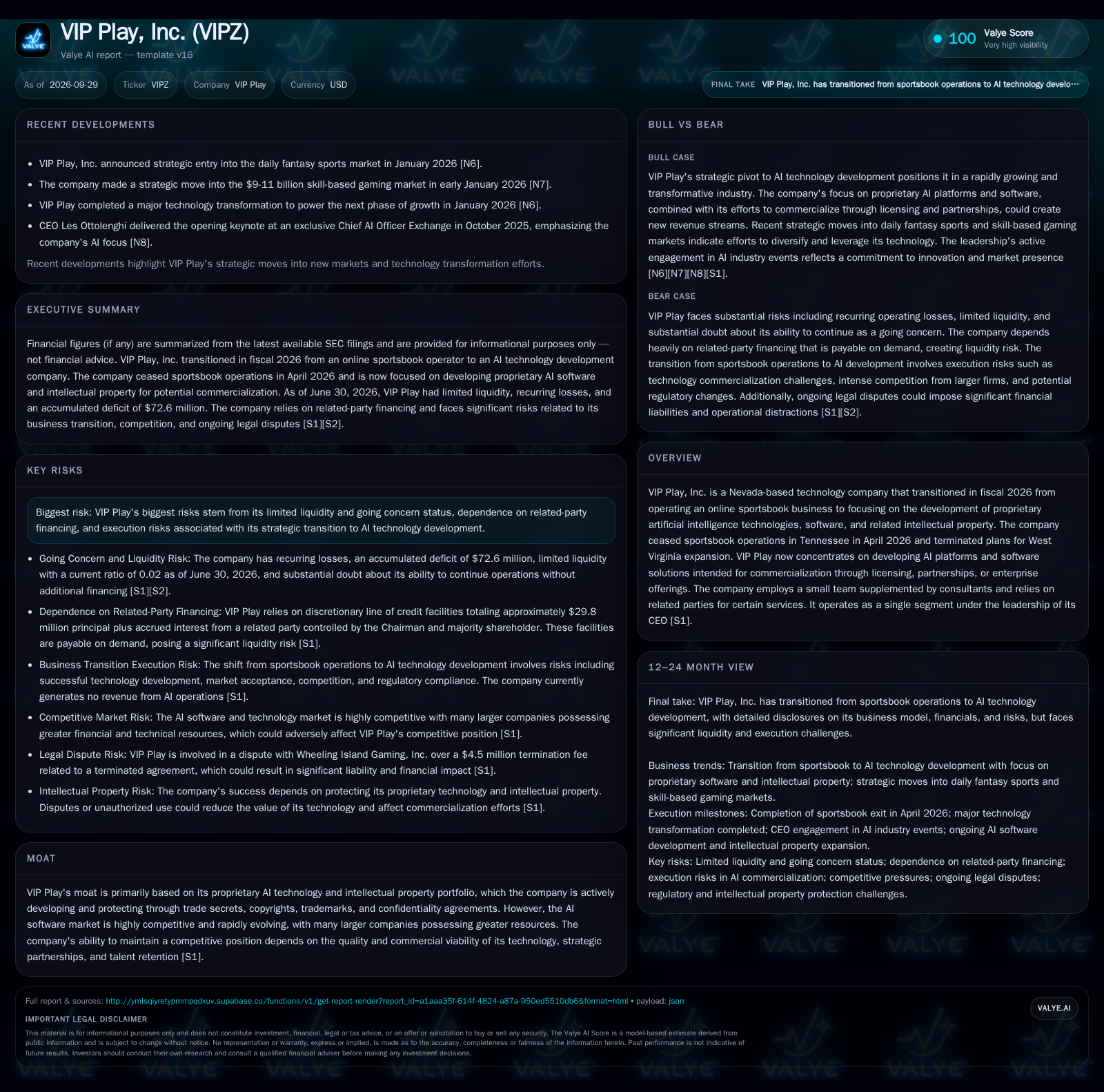
VIP Play, Inc. has completely exited its sportsbook business, shifting to a high-risk, high-reward focus on developing AI platforms and software. With minimal cash, a $72.6 million accumulated deficit, and reliance on on-demand financing from its Chairman, the company’s survival depends on rapidly proving commercial value for its AI assets while contending with legal disputes and much larger competitors. Recent forays into daily fantasy sports and skill-based gaming signal attempts to carve out new markets, but the path to sustainable revenue and operational stability remains highly uncertain. [S1] [S2] [N6] [N7]
VIP Play, Inc. is attempting one of the most dramatic pivots in the small-cap tech sector: abandoning its legacy online sportsbook operations to reinvent itself as a developer of proprietary artificial intelligence software and platforms. This reinvention comes amid acute financial distress, with a negligible cash position, a large accumulated deficit, and heavy reliance on related-party credit that can be called at any time.
VIP Play’s Turning Point: Shifting from Sportsbook to AI Amid Financial Strain
The most material recent development is VIP Play’s complete exit from its sportsbook operations in April 2026, marking a full transition to an AI technology development focus [S1]. This shift fundamentally alters the company’s risk profile and revenue prospects, as it abandons a regulated, albeit challenged, sector for a highly competitive and capital-intensive one without proven revenue streams.
Compounding the uncertainty is the company’s dire balance sheet: as of June 30, 2026, VIP Play reported just $65,854 in cash and equivalents versus $42.2 million in current liabilities, resulting in a current ratio of 0.02 and a cash ratio of effectively zero [S2]. These figures are well below sustainable operating levels and signal an urgent need for external capital or immediate commercial traction.
VIP Play’s only available liquidity is a discretionary line of credit with a $29.8 million principal (plus $4.8 million accrued interest) extended by its Chairman and majority shareholder, payable on demand [S1]. While this related-party funding has enabled operations to continue, its discretionary and callable nature introduces existential risk if withdrawn or reduced.
Amid these financial and strategic pressures, VIP Play has announced new initiatives in the daily fantasy sports and skill-based gaming markets, signaling attempts to identify high-potential verticals for its AI technology [N6] [N7]. However, these are at the strategy and announcement stage, with no confirmed revenue or commercial traction to date.
Monetization and Expenses: AI Platform Ambitions Meet Cash Burn Challenges
VIP Play’s new business model depends on developing proprietary AI platforms and software solutions, with intended commercialization through licensing, partnerships, or direct enterprise offerings [S1]. In theory, AI software can offer high gross margins and operating leverage if successful, especially if deployed as a platform or in verticals like gaming or workflow automation.
However, the present economic reality is stark: in the most recent fiscal year, VIP Play generated just $184,000 in revenue versus a net loss of $9.5 million [S2]. Most expenses appear to be fixed, including personnel, consulting, and technology development costs, while revenue is negligible and non-recurring. This creates a structurally negative cash flow profile that cannot be sustained without external capital.
The company’s ability to scale depends on successfully developing differentiated AI intellectual property that can command premium licensing terms or attract acquisition interest. Until such milestones are reached, VIP Play remains dependent on related-party loans for basic operations, with no evidence of near-term positive operating leverage or sustainable funding from operations.
Capital needs are significant and ongoing: AI software development and commercialization require investment in R&D, talent, cloud infrastructure, and go-to-market activities. VIP Play’s current five-employee team is augmented by consultants, but limited resources may constrain the pace and quality of development compared to better-capitalized rivals.
Navigating AI Competition: Limited Resources, IP Strategies, and Market Entry Moves
VIP Play faces intense competition from large, established public and private technology companies with deep R&D budgets, established distribution, and brand credibility [S1]. Its primary potential advantage lies in proprietary AI intellectual property, which the company seeks to protect through trade secrets, copyrights, and trademarks. However, the efficacy and commercial appeal of its technology remain unproven.
The company’s announced entry into daily fantasy sports and skill-based gaming may reflect an effort to target niche or emerging segments where incumbents are less entrenched and AI-driven differentiation could be more impactful [N6] [N7]. In these markets, the ability to offer unique algorithms, real-time personalization, or anti-fraud capabilities could create a wedge—but only if VIP Play can deliver tangible, superior outcomes.
VIP Play’s limited scale, lack of operating history in AI, and heavy reliance on related-party support reduce its negotiating power with potential partners and clients. Larger AI and gaming companies are likely to view VIP Play as a minor player unless it demonstrates breakthrough technology or achieves notable customer wins.
Switching frictions for enterprise or gaming clients are generally high only if the software is deeply integrated or mission-critical; at this stage, VIP Play’s solutions are unlikely to create such lock-in. IP transfer arrangements, such as the June 2026 transfer of early-stage AI IP to FuzeBox AI, Inc., may further complicate the company’s ability to assert unique ownership or control over key technology assets [S1].
Potential Breakthrough: A Niche AI Success Could Reshape VIP Play’s Future
A plausible positive scenario sees VIP Play successfully deploying its AI technology in a high-growth, underserved segment—such as daily fantasy sports or skill-based gaming—where its proprietary algorithms deliver measurable improvements in user engagement, game integrity, or platform profitability. Early licensing deals or partnerships with gaming operators would serve as external validation and could drive rapid revenue growth with modest incremental costs, leveraging the scalable economics of software.
Confirmation of this upside would come from public announcements of signed licensing agreements, material new revenue lines attributable to AI offerings (as opposed to legacy sportsbook activities), or third-party endorsements of the company’s technology. Additional evidence would include hiring or partnerships that expand VIP Play’s go-to-market capabilities, and disclosures of customer adoption or renewals.
The scenario would be falsified if, over the next 12-18 months, VIP Play fails to report any meaningful commercial traction, or if the technology does not distinguish itself in competitive evaluations or customer pilots.
Survival Prospects: Outcomes Without New Capital or Customer Validation
The most probable trajectory, based on current evidence, is that VIP Play continues to operate in survival mode—sustaining minimal operations through related-party credit while pursuing technology development and commercial pilots with limited resources. In this scenario, the company may announce partnerships, proofs-of-concept, or pilot programs, but revenue remains modest and losses persist.
This outcome would be confirmed by continued disclosures of recurring net losses, negligible cash balances, and a lack of major commercial contracts or revenue inflection. Incremental technology development may be offset by talent constraints and the inability to scale customer outreach or product support.
The scenario would be challenged if VIP Play secures substantial third-party investment, wins a high-profile customer contract, or is able to refinance its liabilities on non-demand terms—none of which are currently evident.
Risk of Collapse: Funding Shortfalls and Legal Issues Threaten Viability
A severe downside would be triggered if the discretionary credit facility is withdrawn, reduced, or otherwise becomes unavailable—leaving VIP Play unable to meet payroll, vendor, or regulatory obligations. This could quickly result in operational shutdown, asset sales, or bankruptcy.
Another acute risk is an adverse outcome in the ongoing legal dispute with Wheeling Island Gaming, Inc., where a $4.5 million termination fee is in question [S1]. If VIP Play is required to pay this liability, it could further drain already depleted resources and precipitate creditor actions.
Confirmation of this negative scenario would include disclosures of credit facility termination, default notices, or formal bankruptcy proceedings. Legal judgments or settlements materially in excess of available liquidity would also serve as clear evidence.
The scenario would be partially mitigated if VIP Play is able to secure bridge financing, settle legal disputes on favorable terms, or find a buyer for its technology assets.
Critical Milestones Shaping VIP Play’s AI Transition Outcome
Any announcement of material third-party licensing or commercial partnerships for AI software, especially in daily fantasy sports or skill-based gaming, would be a critical indicator of commercial traction.
Disclosure of new revenue streams attributable specifically to AI products or platforms, rather than legacy sportsbook operations, would help gauge the success of the business pivot.
Updates on the status, terms, or renewal of the related-party credit facility—especially any move from on-demand to term-based funding—would directly affect going concern risk.
Resolution of the Wheeling Island Gaming, Inc. legal dispute, including any settlement amount or court decision, will impact both liquidity and operational distraction.
Evidence of successful recruitment or retention of technical talent, or expansion of the internal development team, would indicate capacity to execute on AI ambitions.
If disclosed, customer adoption metrics, renewal rates, or case studies demonstrating measurable value from VIP Play’s AI solutions would provide external validation.
Regulatory developments or changes in AI, gaming, or data privacy laws that could materially affect the company’s go-to-market strategy or compliance costs should be monitored.
Disclaimer: This is research-only, informational analysis and not investment advice. It may include AI-generated interpretation and general industry context. Always verify important details using primary sources.

Comments