
Uranium Energy Corp: ISR Mining, Physical Inventory, and Project Breadth Fuel Growth in a Renewed Uranium Market
Uranium Energy Corp is positioned to capitalize on a structurally improved uranium market through its North American ISR mining focus, robust physical uranium inventory, and active project pipeline—yet faces margin, execution, and regulatory risks as it ramps development and navigates persistent industry volatility.
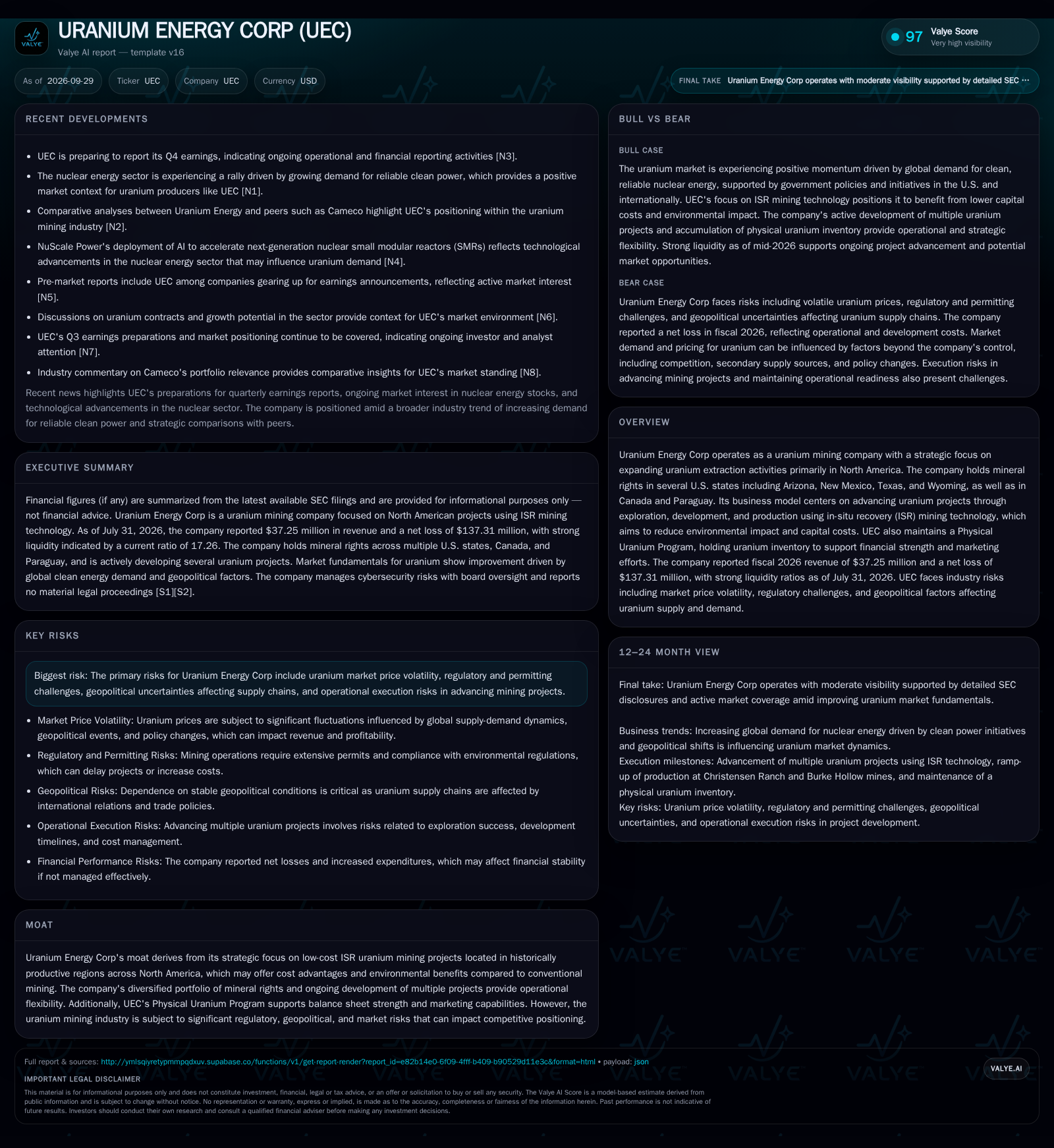
Uranium Energy Corp (UEC) holds a sizable pipeline of North American uranium projects, leverages in-situ recovery (ISR) mining to target lower costs, and maintains a substantial uranium inventory. Despite a reported liquidity position as of July 2026, UEC reported a significant net loss amid rising development and G&A expenses. The company’s prospects hinge on uranium price durability, timely project advancement, and its ability to convert inventory and assets into profitable, recurring cash flow amid regulatory and geopolitical uncertainties. [S1] [S2]
Uranium Energy Corp (UEC) stands at the intersection of a resurgent uranium market and a renewed global push for clean energy, backed by a diversified portfolio of North American mining rights and a reported liquidity position. With its focus on in-situ recovery (ISR) mining and a significant holding of physical uranium, UEC seeks to exploit a period of elevated uranium prices and tightening supply. However, the company’s ability to deliver sustainable margins and growth will depend on navigating persistent industry volatility, regulatory complexities, and the operational challenge of transforming development-stage assets into profitable production. [S1] [S2]
2026 Project Pipeline Growth Reflects Reported Liquidity Position and Market Momentum
As of July 31, 2026, Uranium Energy Corp reported $37.25 million in revenue and a net loss of $137.31 million, reflecting the capital-intensive nature of advancing multiple uranium projects and increased general and administrative costs. The company’s cash and equivalents totaled $495.46 million, with current liabilities of just $5.81 million—resulting in a current ratio of 17.26 and a cash ratio of 14.83. This liquidity underpins active development across projects such as Christensen Ranch, Burke Hollow, Roughrider, Ludeman, and Sweetwater, while the company’s Physical Uranium Program included 1,456,000 pounds of inventory as of April 30, 2026. Uranium prices, which climbed above $100/lb earlier in 2026, provide a favorable backdrop, but recent consolidation highlights ongoing volatility. [S1] [S2]
Economics of ISR Mining and Physical Inventory Support Project Scaling
UEC’s business model relies on ISR mining technology, which typically offers lower upfront capital requirements, reduced environmental remediation costs, and greater operational flexibility compared to conventional open-pit or underground mining. This approach could enable faster scaling and variable cost management, especially important given uranium price volatility. However, ISR projects still require significant permitting, infrastructure development, and ongoing operational expenditures. The company’s physical uranium inventory serves as both a balance-sheet asset and a marketing lever—enabling UEC to potentially capture spot market upside or fulfill customer commitments while ramping its own production.
Revenue generation is currently modest relative to the scale of investment and G&A outlays, with losses reflecting the pre-production or early-stage status of several projects. As more mines come online, operating leverage could improve, provided uranium prices remain elevated and UEC executes on cost and schedule. The capital intensity of project development, combined with inflationary pressures on labor and materials, means that converting assets into profitable cash flow is neither automatic nor risk-free.
Strategic Advantages in ISR Cost Efficiency and Diverse Project Portfolio
UEC’s competitive position is shaped by its North American ISR mining focus, a diversified project pipeline, and the strategic holding of physical uranium. The company’s mineral rights span historically productive uranium regions, which may reduce exploration risk and facilitate permitting relative to greenfield projects. The use of ISR confers a potential cost advantage over conventional miners, but this advantage is contingent on the successful execution of development, effective regulatory navigation, and the technical suitability of each deposit for ISR.
Peer comparisons often cite Cameco and other established uranium producers, but UEC’s mix of development-stage and ramping assets means its risk/reward profile differs from pure-play incumbents. Competitive threats include both global uranium suppliers, who may benefit from lower costs or state backing, and secondary supply sources that could cap price spikes. Technology substitution risk remains low in the near term, as nuclear energy is structurally favored in many clean energy transition scenarios, but longer-term shifts in energy policy or alternative fuels could erode demand.
Elevated Uranium Prices and Project Success Could Boost Margins
A constructive scenario for UEC sees uranium prices remaining above incentive levels—supported by global nuclear buildouts, persistent supply underinvestment, and geopolitical disruptions limiting secondary supply. In this environment, UEC’s ISR projects could advance on schedule, enabling the company to ramp production at Christensen Ranch, Burke Hollow, and other sites while monetizing physical inventory at attractive prices. Margin expansion would follow from higher realized sales prices, increased volumes, and improved cost absorption as fixed costs are spread across larger output.
Confirmation of this scenario would require evidence of timely project commissioning, rising production volumes, and sales contracts or spot market transactions at or above current price levels. A narrowing net loss, or a swing to positive operating cash flow as new mines come online, would further validate the bullish case. Upside could be amplified if UEC’s inventory strategy allows opportunistic sales during market spikes or supports long-term supply agreements with utilities.
Development Advances Tempered by Volatility and Execution Challenges
The most plausible near-term scenario involves continued advancement of UEC’s project pipeline, punctuated by the typical delays and cost overruns associated with permitting, ramp-up, and regulatory compliance in uranium mining. Uranium prices may consolidate above prior cycle lows but remain volatile, with periodic retracements driven by macroeconomic or policy shifts.
Validation of this scenario would be ongoing project updates showing incremental milestones (e.g., permits secured, construction completed, first production achieved) alongside continued net losses or cash burn. The market may reward UEC with a valuation premium for optionality and inventory, but sustained re-rating likely requires proof of operating leverage and cost discipline as development projects transition to production status.
Risks from Project Delays, Rising Costs, and Uranium Price Corrections
A negative scenario could unfold if uranium prices retreat toward marginal cost levels due to unexpected secondary supply, slower nuclear buildout, or policy reversals. In this case, UEC’s development projects may face delays from permitting bottlenecks, technical issues, or cost inflation, eroding the economics of new production. Rising G&A and project expenditures, without offsetting revenue growth, could deplete the company’s liquidity cushion over time—even if current ratios remain high in the short run.
Evidence of this downside would include repeated project delays, escalating development costs, slower-than-expected production ramp, or a failure to monetize inventory at profitable levels. A persistently wide net loss, coupled with negative operating cash flow and no clear path to break-even, would signal that UEC’s capital and asset base are not translating into sustainable returns.
Project Execution, Cost Control, and Market Dynamics Define Outlook
Production ramp-up rates at Christensen Ranch, Burke Hollow, and other near-term projects—actual pounds produced and sold versus prior guidance, if disclosed.
Average realized uranium sales price relative to spot and contract benchmarks, and the proportion of sales captured through long-term agreements versus opportunistic inventory sales, if disclosed.
Updates on permitting status, regulatory milestones, and any material delays or cost overruns in project development.
Quarterly cash flow from operations—whether operating cash flow is narrowing the gap to break-even as projects advance.
Levels and turnover of physical uranium inventory—are pounds being monetized at favorable prices, or is inventory building without commensurate sales?
General and administrative expense trends, especially in the context of inflation and organizational growth.
Macro uranium price movements and indicators of sustained demand from utility contracting cycles or new nuclear facility announcements.
Disclosure of new offtake or supply agreements with utilities or other end-users, which would indicate commercial traction and revenue visibility.
Disclaimer: This is research-only, informational analysis and not investment advice. It may include AI-generated interpretation and general industry context. Always verify important details using primary sources.

Comments