
AAR CORP: Acquisitions, MRO Expansion, and the Economics of Aviation Aftermarket Scale
AAR CORP’s recent growth has been fueled by strategic acquisitions, facility expansions, and a push into aviation software, but execution risks and market cyclicality remain central to the company’s outlook as it manages the wind-down of legacy programs.
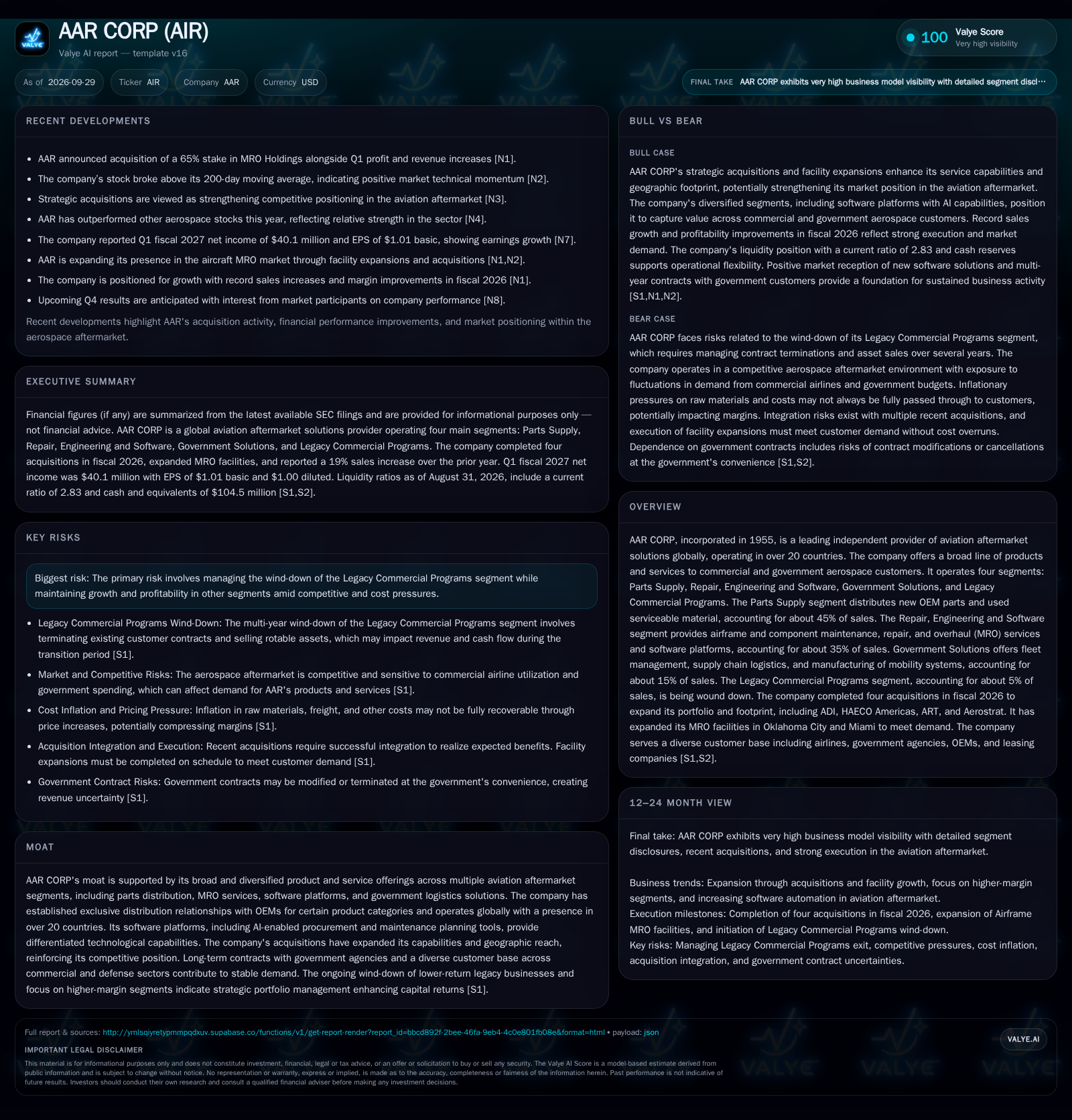
AAR CORP reported a 19% sales increase in fiscal 2026, driven by commercial demand and four acquisitions, while expanding MRO capacity and growing its software offerings. The company’s multi-segment model—anchored in parts supply, MRO services, and government logistics—offers resilience, but integration risks, cost inflation, and the wind-down of legacy programs present ongoing challenges. Monitoring acquisition integration, MRO utilization, and software adoption will be crucial to assessing the sustainability of recent momentum. [S1] [S2]
AAR CORP’s business model is at a strategic inflection point, blending scale-driven parts supply, MRO, and emerging software solutions with a disciplined exit from legacy commercial programs. Fiscal 2026 marked a transformative period, as the company executed four acquisitions, expanded key facilities, and captured strong commercial aviation demand. Yet, as AAR seeks to consolidate its leadership in the global aviation aftermarket, the integration of new businesses, inflationary headwinds, and the managed wind-down of legacy segments will test the company’s ability to sustain growth and margin improvement through the next cycle.
Recent Growth Drivers: Acquisitions, MRO Expansion, and Segment Shifts
AAR CORP reported a 19% year-over-year increase in consolidated sales for fiscal 2026, amounting to a $527.5 million increase, largely attributed to commercial customer demand and the impact of four completed acquisitions: American Distributors Holding Co. (ADI), HAECO Americas, Aircraft Reconfig Technologies (ART), and Aerostrat Corp. [S1]. The Parts Supply segment remained the largest contributor (45% of sales), with Repair, Engineering, and Software accounting for 35%. The company expanded its Airframe MRO facilities in Oklahoma City and Miami in response to rising customer demand, signaling confidence in continued aftermarket growth. Meanwhile, the Legacy Commercial Programs segment, representing 5% of sales, is being systematically wound down over the next 3-4 years, which will affect both revenue mix and capital allocation priorities. [S1] [S2]
How AAR’s Aftermarket Model Scales—and Where Margin Compression Lurks
AAR’s business model is fundamentally tied to the global aviation aftermarket, where scale and operational efficiency can drive incremental margin. The company generates the bulk of its revenue from the sale and distribution of aircraft parts (both new OEM and used serviceable material) and from MRO (maintenance, repair, and overhaul) services. These segments typically offer higher incremental margins due to the ability to leverage fixed infrastructure—such as distribution networks and MRO facilities—across a broad and variable customer base. As utilization rates of commercial fleets rise, so does demand for parts and MRO, providing volume leverage.
Acquisitions like ADI and HAECO Americas expand AAR’s product breadth and facility footprint, which could enhance purchasing power with suppliers and offer cross-selling opportunities across customer segments. However, integration costs and the risk of overcapacity in MRO must be managed, especially if commercial aviation cycles soften. The company’s software offerings, including AI-enabled procurement automation and maintenance planning, represent higher-margin, lower-capital-intensity revenue streams if adoption grows, although software’s contribution remains a smaller portion of total sales at present.
Cost inflation—particularly for raw materials and freight—poses a risk, as not all increases may be passed through to customers, potentially compressing margins. The winding down of Legacy Commercial Programs will free up capital but could also cause near-term revenue and margin drag as contracts are exited and assets are sold over several years. [S1] [S2]
Defending Share in a Fragmented and Competitive Aftermarket Landscape
AAR operates in a competitive and highly fragmented global aviation aftermarket, facing pressure from OEMs (who are increasingly aggressive in aftermarket capture), other independent parts and MRO providers, and technology-driven upstarts. The company’s competitive advantages stem from its broad service and product portfolio, global reach (over 20 countries), and exclusive distribution relationships with select OEMs. Its diversified customer base—including commercial airlines, government agencies, lessors, and MRO peers—reduces dependence on any single end-market.
Recent acquisitions have bolstered AAR’s ability to deliver integrated solutions spanning parts, MRO, and software, which may enhance customer retention and wallet share. The push into AI-enabled platforms and maintenance automation could provide a modest technological edge, especially as airlines seek to optimize operational costs. However, OEMs’ direct-to-operator strategies, pricing pressure from airlines, and new digital entrants remain persistent threats. The wind-down of legacy programs may narrow the company’s competitive focus, but also removes lower-return activities, potentially sharpening its value proposition.
If Integration Succeeds and Software Gains Traction: Margin Expansion and Share Gains
In a favorable scenario, AAR successfully integrates its four recent acquisitions, realizing operational synergies and expanding its global customer footprint. The expanded MRO facilities in Oklahoma City and Miami operate near capacity, leveraging fixed costs and driving operating margin improvement. Adoption of proprietary software platforms—especially AI-driven procurement and maintenance planning—accelerates, allowing AAR to upsell higher-margin services to airlines and lessors facing cost and reliability pressures.
Commercial aviation demand remains robust, and the company further penetrates government logistics and fleet management contracts, offsetting the wind-down of legacy commercial programs. This scenario would be confirmed by continued double-digit sales growth, rising segment margins, strong recurring revenue from software and services, and evidence of cross-selling between acquired entities. Falsification could come from stalled integration, underutilized MRO capacity, or lackluster software uptake.
Most Likely Trajectory: Solid Growth, Integration Hurdles, and Cyclical Exposure
The most plausible outcome is that AAR delivers moderate growth as commercial aviation activity remains stable and recent acquisitions incrementally expand revenue and capability. Integration efforts yield some cost and revenue synergies, but not all are realized due to cultural or operational friction. MRO facilities operate at healthy but not peak utilization, and software adoption grows but remains a small percentage of overall sales.
The wind-down of the Legacy Commercial Programs segment acts as a modest drag on reported growth and margins, though capital redeployment to higher-return businesses partially offsets this effect. Inflationary cost pressures are managed but not entirely passed through, resulting in some margin compression. Confirmation would come from steady mid-single-digit sales growth, stable operating margins, and incremental improvement in software/service mix. Falsification would be signaled by acquisition integration setbacks, unexpected revenue or margin declines, or signs of cyclical downturn in commercial aviation.
Adverse Outcomes: Integration Missteps, Demand Shocks, and Margin Squeeze
In a negative scenario, AAR struggles to integrate its acquisitions, leading to operational disruption, customer attrition, and greater-than-expected integration costs. MRO facility expansions outpace actual demand, resulting in underutilization and margin drag. Inflation in raw materials, labor, and freight is not offset by pricing power, squeezing profitability. The wind-down of Legacy Commercial Programs proves more disruptive than anticipated, with contract terminations and asset sales impacting cash flow.
Further, a downturn in commercial airline utilization or a pullback in government spending could sharply reduce demand for AAR’s core parts and MRO services. OEMs or digital competitors may capture share in key segments. These outcomes would be confirmed by revenue or margin declines, rising integration costs, underutilized assets, or negative free cash flow. Mitigating factors could include cost control, divestitures, or new customer wins, but the thesis would be challenged if operational execution falters.
What Will Test AAR’s Thesis in the Next Cycle?
Integration progress and realized synergies from the ADI, HAECO Americas, ART, and Aerostrat acquisitions (if disclosed) would help test whether AAR is capturing intended value.
Utilization rates and profitability of the expanded Oklahoma City and Miami MRO facilities will indicate whether demand is meeting capacity expansion.
Software platform adoption rates (Trax, Aerostrat, Airvoyant, Airinmar) and their contribution to recurring revenue—if disclosed—would clarify the impact of digital expansion.
Margin trends in the Parts Supply and Repair, Engineering, and Software segments, particularly in the face of input cost inflation, will test pricing power and cost management.
Progress on the wind-down of the Legacy Commercial Programs segment, including contract exits and asset sales, should be tracked for timing and financial impact.
Revenue concentration by customer segment and the mix between commercial and government business will affect resilience to sector cycles.
Any signs of increased direct competition from OEMs or digital disruptors encroaching on AAR’s core aftermarket segments would signal competitive intensity.
Disclaimer: This is research-only, informational analysis and not investment advice. It may include AI-generated interpretation and general industry context. Always verify important details using primary sources.

Comments