
Celularity’s Regenerative Medicine Ambitions Collide with Liquidity Strain and Commercial Realignment
The company’s future now hinges on clinical progress, regulatory clarity, and its ability to monetize manufacturing capabilities and partnerships.
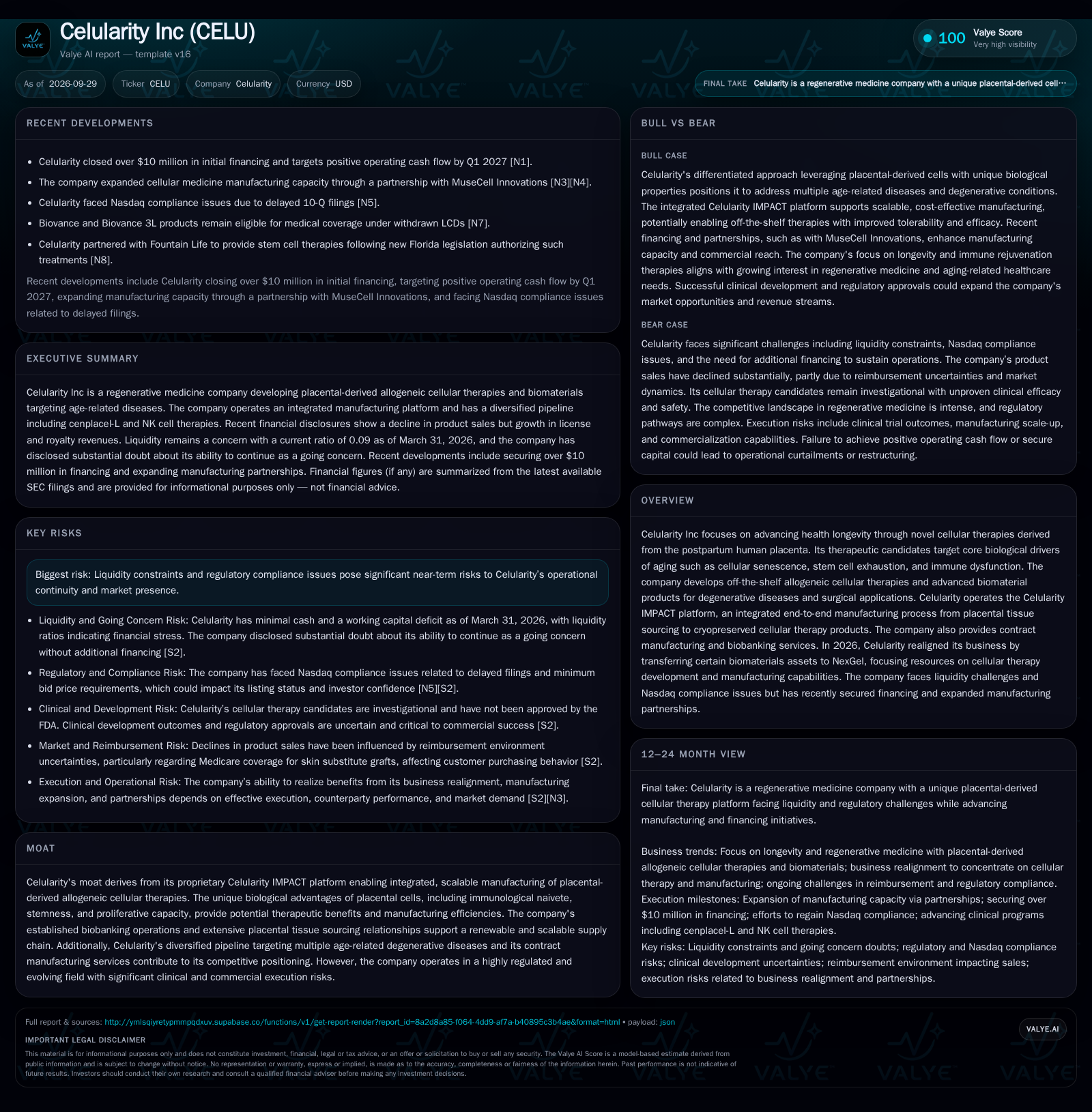
A recent $10 million financing provides temporary relief, but the company’s ongoing viability depends on successful execution of its pipeline, regulatory approvals, and the ramp-up of contract manufacturing and licensing revenues. The evolving reimbursement environment and operational execution will determine whether Celularity can transition from distress to sustainable growth. [S2] [N1]
The company’s $10 million financing provides immediate relief, but fundamental questions remain about its ability to execute on its clinical pipeline, scale manufacturing partnerships, and navigate a turbulent reimbursement environment. The next few quarters will reveal whether Celularity can convert its platform and partnerships into sustainable revenue, or if restructuring pressures will force a more radical transformation.
Liquidity Crisis and Commercial Reset Define Celularity’s Near-Term Outlook
Celularity’s Q1 2026 results revealed a dramatic 66% year-over-year revenue decline, primarily due to a 90% drop in product sales of Biovance 3L and Rebound after shifts in the insurance reimbursement landscape. [S2] This contraction prompted a strategic realignment: the company transferred certain biomaterial assets and commercialization responsibilities to NexGel, retaining only contractual rights and future economic participation. [S2] The liquidity situation is acute—$368,000 in cash against $70.6 million in current liabilities, with a current ratio of just 0.09 and a cash ratio of 0.01, leading management to disclose substantial doubt about the company’s ability to continue as a going concern. [S2] In September 2026, Celularity closed a $10 million financing round and set a target of positive operating cash flow by Q1 2027, providing short-term relief but not yet resolving underlying structural challenges. [N1]
How the Integrated Platform and Asset-Light Shift Could Reshape Celularity’s Economics
Celularity’s business model now revolves around three intertwined activities: development of placental-derived allogeneic cellular therapies, contract manufacturing and development services, and biobanking through LifebankUSA. The pivot away from direct biomaterial commercialization reduces working capital requirements and inventory risk, but also narrows immediate revenue streams. The core economics of cellular therapies rely on successful clinical progress and ultimately regulatory approval, given that these products are not yet on the market and remain in the investigational stage.
Contract manufacturing and licensing revenues—up 73% year-over-year to $1.7 million in Q1 2026—offer a potentially less capital-intensive source of cash flow, provided that Celularity can attract and retain external partners at scale. [S2] The integrated Celularity IMPACT platform is designed for end-to-end manufacturing, which could enable fixed-cost leverage if volumes increase, but also exposes the company to high fixed costs if capacity remains underutilized. Biobanking services are likely to contribute modestly to recurring revenue but are not sufficient to offset the loss of legacy product sales.
The company’s recent partnerships, such as with MuseCell Innovations and Fountain Life, may allow Celularity to monetize manufacturing expertise and facilities, especially as regulatory and legislative changes expand the addressable market for cellular therapies. [N3] [N8] However, the economics of these arrangements—margin structure, contract duration, and customer concentration—are not disclosed, making it difficult to assess their contribution to long-term profitability.
Competitive Levers and Structural Headwinds in Regenerative Medicine
Celularity’s platform is differentiated by its focus on placental-derived allogeneic therapies, which offer immunological naivete and proliferative capacity that could confer clinical and manufacturing advantages if efficacy and safety are demonstrated. The company’s integrated manufacturing and tissue sourcing infrastructure may provide supply chain resiliency and cost advantages compared to competitors that rely on third-party sourcing or contract manufacturing.
However, the regenerative medicine and cell therapy landscape is intensely competitive, with established players and well-funded startups pursuing autologous, allogeneic, and gene-edited cell therapies. The clinical and regulatory bar is high, and reimbursement for novel therapies remains uncertain. Celularity’s move away from direct biomaterial commercialization may reduce near-term competitive exposure, but also cedes market share to other wound-care and biomaterial providers.
The company’s ability to attract external manufacturing and development partners will depend on its reputation for quality, speed, regulatory compliance, and cost-effectiveness. The recent Nasdaq compliance issues and going concern disclosure may undermine confidence among potential partners and customers, at least in the near term. [N5] [S2]
A Pathway to Regeneration: What Could Unlock Sustainable Growth
Celularity’s most favorable scenario is predicated on a combination of clinical success, regulatory approvals, and the scaling of contract manufacturing and licensing revenues. If flagship candidates such as cenplacel-L and CYNK-001 demonstrate compelling safety and efficacy in clinical trials, the company could secure FDA approval and tap into high-value markets for age-related degenerative diseases and immune disorders. The unique properties of placental-derived cells may confer competitive advantages in tolerability and scalability, supporting premium pricing or broader market access.
On the commercial front, successful execution of manufacturing partnerships—evidenced by multi-year contracts, increasing partner count, and meaningful revenue growth—would validate the asset-light model and provide recurring, higher-margin cash flow. Legislative changes, such as Florida’s new stem cell therapy law, could accelerate adoption in certain geographies and create regulatory tailwinds. [N8]
Evidence that would confirm the upside scenario includes: robust clinical data from late-stage trials, new long-term manufacturing agreements, consistent upward trends in licensing and royalty revenues, and a sustained return to positive operating cash flow as targeted by Q1 2027. [N1]
Stabilization Hinges on Reimbursement, Execution, and Partner Ramp-Up
The most plausible middle-ground outlook for Celularity is a period of operational stabilization, driven by incremental growth in contract manufacturing and licensing revenues, moderate progress in clinical development, and gradual resolution of reimbursement uncertainties for legacy biomaterials. The company may maintain a limited presence in the biomaterials market through contractual rights and royalties, but direct product sales are unlikely to rebound to prior levels unless reimbursement conditions improve or new indications are secured.
The asset-light pivot reduces cash burn but leaves Celularity highly dependent on external financing and partner execution. Manufacturing utilization rates and partner adoption will be critical levers: underutilization of the IMPACT platform would prolong losses, while steady partner ramp-up could drive operating leverage. Regulatory and Nasdaq compliance issues may be resolved, but reputational damage could linger, affecting new business development.
Confirmation of the base scenario would come from steady, if unspectacular, growth in non-product revenues, modest improvement in liquidity ratios, and progress toward the stated goal of positive cash flow by Q1 2027, even if clinical milestones remain several quarters away. Persistent shortfalls in partner revenue or further reimbursement erosion would challenge this outlook.
Adverse Outcomes: Financing Shortfall and Operational Contraction
The adverse scenario for Celularity is characterized by the failure to secure additional financing, continued underperformance of manufacturing and licensing revenues, and lack of clinical progress. If the $10 million financing proves insufficient to bridge to positive cash flow or clinical inflection points, the company could face insolvency, delisting from Nasdaq, or forced asset sales and restructuring. [S2] [N5]
Further declines in reimbursement for legacy biomaterial products or loss of coverage eligibility could eliminate remaining royalty streams and contractual income. If manufacturing partnerships do not scale, fixed costs associated with the IMPACT platform would deepen losses. The company’s ability to retain and attract key talent, already challenged by CFO turnover, may deteriorate further.
Confirmation of this scenario would be seen in persistent negative cash flow, failure to announce new or expanded manufacturing agreements, additional Nasdaq compliance failures, or public disclosure of restructuring or asset sale plans.
Milestones and Metrics That Will Determine Celularity’s Trajectory
Quarterly trends in licensing, royalty, and contract manufacturing revenues, which will indicate whether the asset-light pivot is gaining commercial traction.
Updates on clinical progress and regulatory submissions for cenplacel-L, CYNK-001, and other pipeline assets—milestone disclosures, trial initiations, or top-line data would be critical.
Disclosure of new or expanded manufacturing partnerships, including contract terms, duration, and revenue commitments (if disclosed).
Liquidity updates: cash balance, current ratio, and any additional financing or capital raises beyond the recent $10 million infusion.
Nasdaq compliance status, specifically regarding timely SEC filings and minimum bid price requirements.
Reimbursement trends for Biovance and Biovance 3L, including any changes in Medicare or private payer coverage that could affect contractual revenues.
Management turnover or changes in leadership structure, particularly CFO or CEO transitions, which could signal operational instability or strategic shifts.
If disclosed, platform utilization rates or manufacturing capacity metrics that would provide insight into fixed cost leverage and partner adoption.
Disclaimer: This is research-only, informational analysis and not investment advice. It may include AI-generated interpretation and general industry context. Always verify important details using primary sources.

Comments