
AngioDynamics’ Med Tech Pivot: Growth Ambition Confronts Margin Compression and Sector Headwinds
With Med Tech platforms poised to become AngioDynamics’ primary revenue engine in 2027, the company’s strategy leans on innovation and higher-margin product mix—but persistent net losses, inflationary pressure, and sector competition complicate the path to sustainable profitability.
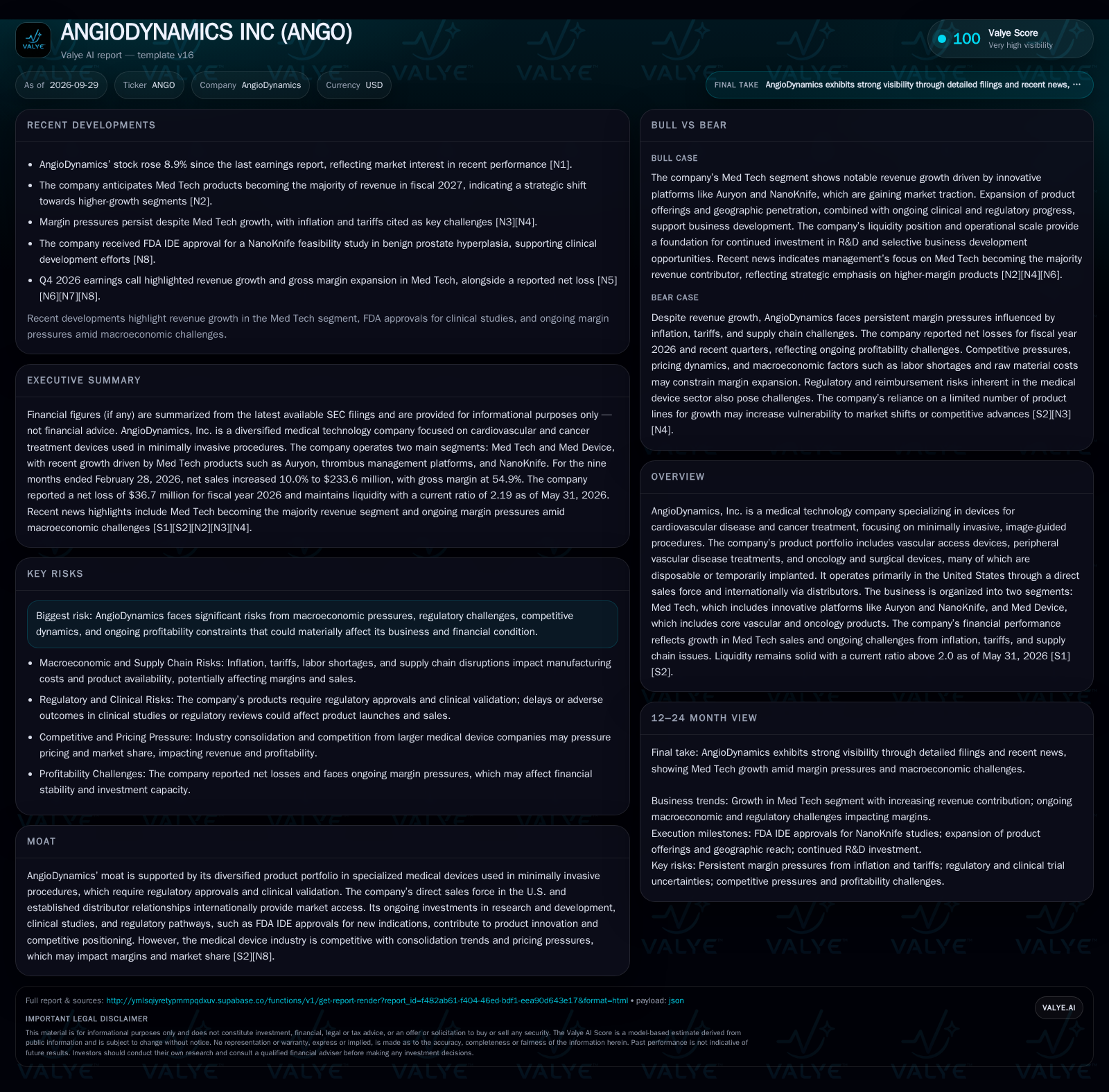
AngioDynamics is evolving from a diversified medical device provider toward a Med Tech-centric model, with platforms like Auryon and NanoKnife driving robust segment growth and gross margin outperformance. Yet, the company remains loss-making, as inflation and tariffs erode gains and sector competition intensifies. The pivot’s success will hinge on the Med Tech segment’s ability to scale, maintain pricing, and offset macro and regulatory risks as it becomes the core revenue driver in fiscal 2027. [S1] [S2] [N2] [N3] [N4]
AngioDynamics sits at a strategic inflection point: its Med Tech segment—home to advanced platforms like Auryon and NanoKnife—is growing rapidly and projected to become the majority of company revenue in fiscal 2027. This shift promises a richer product mix and higher gross margins, yet the company continues to post net losses amid inflation, tariffs, and sector competition. The next phase will test whether segment growth can translate into sustainable profitability, or whether persistent cost pressures and industry headwinds will keep AngioDynamics in a margin squeeze.
Pivot to Med Tech Gains Momentum, But Profitability Remains Out of Reach
AngioDynamics reported net sales of $233.6 million for the nine months ended February 28, 2026—a 10.0% increase year-over-year, with Med Tech segment sales rising 19.1% and Med Device growing just 3.2%. Med Tech’s gross margin (63.3%) substantially outperformed Med Device (47.6%), supporting the company’s strategic emphasis on this segment. However, AngioDynamics posted a net loss of $36.7 million for fiscal 2026, highlighting persistent challenges in achieving profitability. Liquidity metrics remain solid with $53.9 million in cash and equivalents and a current ratio of 2.19 as of May 31, 2026. Management and news sources now anticipate Med Tech will become the majority of revenue in fiscal 2027, cementing the pivot toward innovation-driven growth but amid ongoing margin pressure from inflation and tariffs. [S1] [S2] [N2] [N3] [N4]
Segment Economics: Disposable Devices, Innovation Premiums, and Operating Leverage
AngioDynamics’ revenue model is anchored in the sale of disposable or temporarily implanted medical devices for minimally invasive procedures. The economics of this model typically benefit from recurring procedure-driven demand, especially for consumable components. Med Tech products like Auryon (laser atherectomy), AlphaVac/AngioVac (thrombus management), and NanoKnife (IRE for tumors) are positioned at higher price points and command premium gross margins due to clinical differentiation and regulatory barriers.
The Med Device segment, by contrast, comprises more commoditized core vascular and oncology products, facing greater pricing pressure and lower margins. The company’s fixed cost base—R&D, regulatory, and direct sales infrastructure—means that scaling Med Tech volumes could create operating leverage if gross margin expansion offsets overhead. However, persistent net losses suggest that either Med Tech volumes have not reached critical scale, or that inflationary inputs, tariffs, and investment requirements are consuming incremental margin. Capital needs are ongoing, as innovation and regulatory clearance are essential for pipeline renewal and competitive positioning.
The disposable nature of many Med Tech devices creates a recurring revenue stream that can enhance predictability and customer lifetime value, provided clinical adoption stabilizes. However, the reliance on consumables also necessitates sustained investment in customer education and post-sale support to ensure consistent usage patterns. Additionally, the capital intensity of R&D and regulatory compliance means that upfront costs can be substantial before volume-driven operating leverage materializes. The balance between investing for innovation and achieving scale economies is therefore delicate; if product launches or clinical trials face delays, the time to profitability could extend, increasing financial strain. Monitoring the ratio of R&D spend to incremental revenue growth would help assess efficiency in this scaling phase.
Innovation as Differentiator—But Sector Dynamics Constrain Moat and Pricing Power
AngioDynamics competes in the global medical device sector, where market leaders benefit from scale, established hospital relationships, and comprehensive product portfolios. The company’s focus on minimally invasive, image-guided procedures provides exposure to high-growth clinical niches, but also exposes it to competition from diversified device giants and specialized upstarts alike.
Regulatory approval and clinical evidence requirements create barriers to entry, but also slow product cycles and increase compliance costs. AngioDynamics’ direct sales force in the U.S. and distributor networks abroad enable market access, yet the industry’s consolidation trend and hospital purchasing power can compress prices. Product innovation remains the company’s primary lever for differentiation—platforms like NanoKnife and Auryon offer unique clinical benefits—but competitors with larger R&D budgets or broader service offerings could erode share or force price competition. The risk is that clinical and commercial wins in Med Tech may be offset by pricing and margin pressure across the broader portfolio.
While innovation is a critical differentiator, the Med Tech market’s competitive dynamics often favor incumbents with broad portfolios and deep integration into hospital systems. AngioDynamics’ narrower focus on specific platforms may limit cross-selling opportunities and bargaining power with large healthcare providers. Moreover, reimbursement policies and hospital budget constraints can blunt pricing power, especially if competitors offer bundled solutions or service contracts that reduce device costs. The company’s ability to demonstrate clear clinical and economic value—such as reduced procedure times or improved patient outcomes—will be pivotal in negotiating favorable contracts and preserving margins. Failure to do so could result in commoditization pressures similar to those seen in the Med Device segment.
If Med Tech Achieves Scale and Clinical Adoption, Margin Expansion Could Follow
In a favorable scenario, Med Tech products such as Auryon and NanoKnife gain broader clinical adoption, supported by positive trial data, expanded indications, and growing acceptance among interventional specialists. As procedure volumes increase, recurring demand for disposable components would drive higher revenue and enable the company to leverage its fixed sales and R&D base, expanding operating margins.
If AngioDynamics can maintain pricing discipline and offset inflationary pressures through supply chain optimization or product mix, consolidated gross margins could rise above current levels. Regulatory approvals for new indications, successful reimbursement negotiations, and pipeline innovation would reinforce the segment’s growth trajectory. Evidence confirming this scenario would include sequential Med Tech sales acceleration, rising gross and operating margins, and a transition to net profitability even as Med Tech becomes the dominant revenue contributor.
Transition Period: Growth in Med Tech, Persistent Margin Pressure, and Incremental Progress
The most plausible path is that AngioDynamics continues to grow Med Tech as a share of revenue, with the segment overtaking Med Device in fiscal 2027. However, inflation, tariffs, and sector competition are likely to persist, limiting the company’s ability to fully translate higher-margin product mix into bottom-line improvement.
Gross margins may improve modestly, but operating expenses (especially R&D and regulatory costs) and macro headwinds could keep the company near breakeven or at a modest net loss. The Med Device segment may stagnate or decline as older products face commoditization. Confirmation of this scenario would be ongoing Med Tech revenue growth, stable or slightly improved gross margins, and gradual reduction in net losses—but without a clear inflection to sustained profitability.
Margin Squeeze Intensifies: Inflation, Tariffs, and Product Mix Risk Overwhelm Gains
If macroeconomic headwinds worsen—through higher inflation, persistent tariffs, or supply chain disruptions—AngioDynamics could see raw material and labor costs outpace any improvements in product mix. Should Med Tech adoption stall due to clinical, regulatory, or reimbursement setbacks, the company’s growth engine would falter, leaving it exposed to intensified pricing pressure in the commoditized Med Device segment.
In this scenario, gross margins could contract, net losses widen, and cash burn accelerate, forcing AngioDynamics to seek external capital or cut investment in innovation and commercial infrastructure. Evidence confirming this downside would include stagnant or declining Med Tech sales, shrinking gross margins, larger net losses, and negative cash flow trends.
Milestones That Will Determine the Success of AngioDynamics’ Med Tech-Led Transformation
Sequential Med Tech segment revenue growth versus Med Device, indicating whether the transformation to a higher-margin mix is on track.
Gross margin trends in both Med Tech and consolidated results—improvement would suggest operating leverage, while compression would flag inflation or pricing pressure.
Net income or EPS trajectory, especially signs of transition from persistent net losses to breakeven or profitability.
Updates on regulatory approvals, clinical trial outcomes, or new product launches, which would drive adoption and support the innovation thesis.
Material changes in tariffs, inflation rates, or supply chain conditions that could impact input costs and margins.
Competitive product launches or hospital purchasing shifts that could alter Med Tech adoption rates or pricing dynamics.
If disclosed, retention rates or reorder frequency for disposable Med Tech products, providing insight into recurring revenue and customer stickiness.
Disclaimer: This is research-only, informational analysis and not investment advice. It may include AI-generated interpretation and general industry context. Always verify important details using primary sources.

Comments