
Gamehaus Holdings: Navigating Regulatory Complexity and Disclosure Gaps with Operational Stability
Gamehaus Holdings Inc. demonstrates solid revenue and positive net income, yet its opaque business model and exposure to PRC regulatory risks complicate forward-looking assessments.
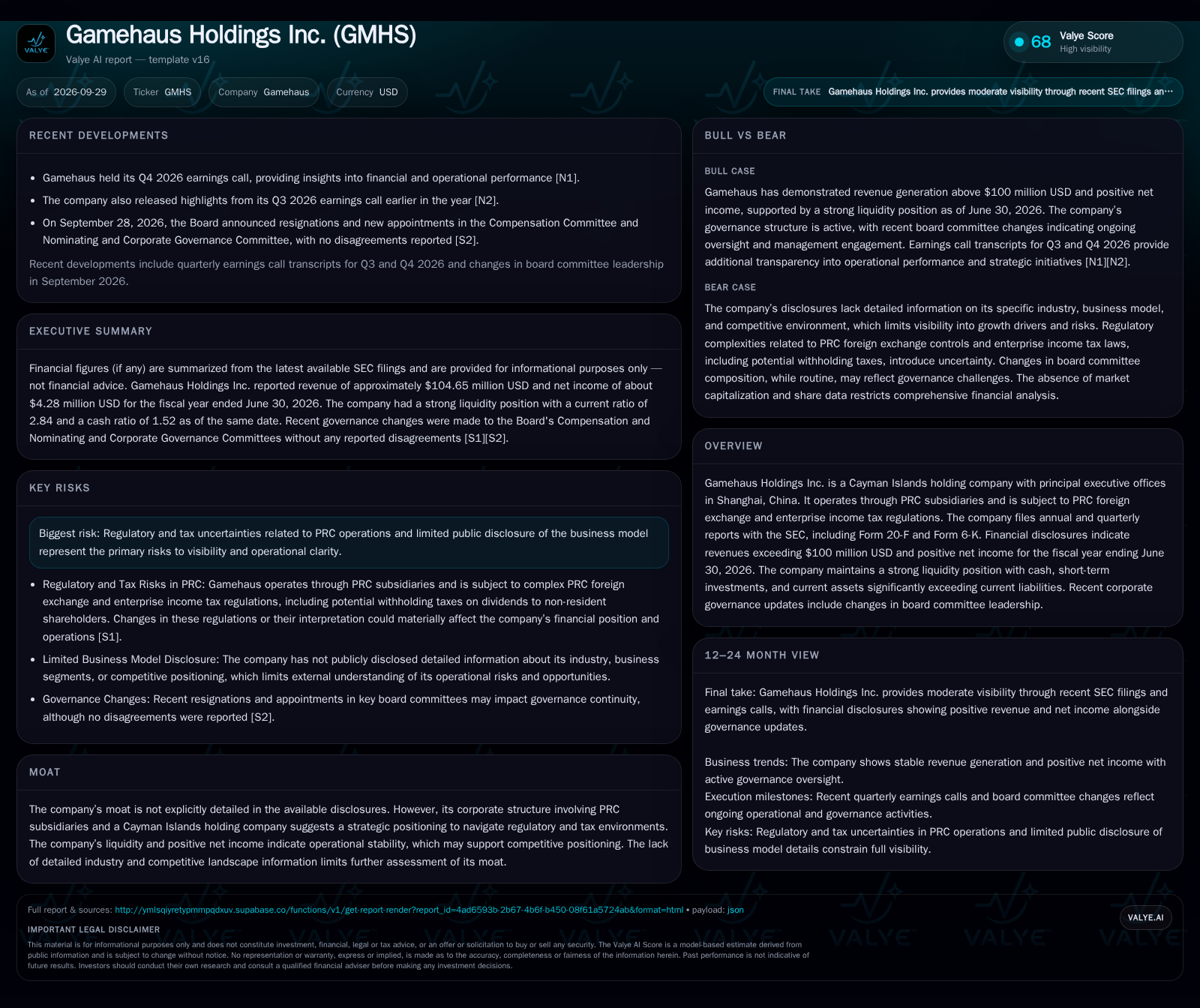
Gamehaus Holdings Inc. reported over $100 million in annual revenue with modest net income and maintains a reported liquidity position as of June 30, 2026. However, the company’s limited public disclosure on business operations and exposure to PRC regulatory and tax risks create substantial uncertainty for investors and analysts [S1] [S2].
Gamehaus Holdings Inc. stands out for its ability to generate over $100 million in annual revenues and maintain positive net income, all while operating under the complexities of a Cayman Islands holding structure with PRC subsidiaries. Despite these headline financials and active governance, the company’s lack of detailed operational disclosure and its exposure to evolving Chinese regulatory frameworks mean that visibility into its growth drivers, competitive dynamics, and risk profile remains limited. Investors and analysts must therefore focus on scenario analysis and regulatory developments to form a holistic view of Gamehaus’s prospects.
Recent Performance and Governance Developments Shape the Immediate Landscape
Gamehaus Holdings Inc. reported annual revenues of approximately $104.65 million USD and net income of $4.28 million USD for the fiscal year ended June 30, 2026, signaling operational profitability at scale [S1]. The company’s liquidity position is described by cash and equivalents of $17.57 million, short-term investments of $5.10 million, and a current ratio of 2.84 as of the same date [S1]. Notably, the company operates through PRC subsidiaries under a Cayman Islands holding structure, which exposes it to Chinese foreign exchange controls and tax laws, including potential withholding taxes on dividends paid to non-resident shareholders [S1] [S2]. Governance-wise, recent changes in board committee leadership occurred without reported disagreements, suggesting stability at the highest level [S2]. The company reported cash and liquidity metrics for the period; these figures do not by themselves establish operating runway, investment capacity, financial flexibility, or financing capacity.
Unpacking Gamehaus’s Economics: Where Profits May Originate and What Could Shift
The company’s positive net income on $104.65 million in revenue implies that its cost structure allows for at least modest profitability at current scale [S1]. However, the absence of segment, product, or service detail precludes a granular analysis of fixed versus variable costs, pricing power, or operating leverage. If Gamehaus’s revenue is driven by digital content, gaming, or platform services—a plausible scenario given its Shanghai headquarters and Cayman structure—gross margins could be relatively high and capital intensity low, supporting operating leverage as volumes rise. Conversely, if the business is asset-heavy or dependent on physical distribution, margins may be thinner and working capital needs higher.
The company’s liquidity metrics suggest it is not under immediate financial duress, but this alone does not establish the durability of its cash flows or the sufficiency of resources for growth initiatives or regulatory shocks. Exposure to PRC foreign exchange and tax regimes introduces further variability, as changes in regulations could affect both repatriation of profits and effective tax rates. The true economics of the business will hinge on how revenue is generated (transactional, recurring, or advertising-based), the scalability of its core activities, and its ability to manage regulatory compliance costs.
Competitive Context: Strategic Structure, Regulatory Navigation, and the Unknowns
Gamehaus’s Cayman Islands holding structure with PRC operating subsidiaries is a common approach for Chinese companies seeking international investment and regulatory flexibility. This architecture may offer advantages in accessing foreign capital, structuring tax efficiently, and navigating PRC restrictions on foreign ownership in sensitive sectors. However, the lack of disclosure on the company’s actual business—whether it is in gaming, e-commerce, entertainment, or another sector—prevents a direct comparison to peer groups or an assessment of market share and differentiation.
In the Chinese digital sector, competitive intensity is typically fierce, with large domestic and global players exerting pricing pressure and raising the bar for innovation. Regulatory scrutiny has also tightened in recent years, particularly for companies operating in data-sensitive or consumer-facing industries. If Gamehaus is positioned in a niche with high switching costs, strong brand loyalty, or proprietary technology, it could carve out defensible economics. Without evidence of such moats, however, the company may be vulnerable to both regulatory intervention and cutthroat competition.
Potential for Upside: Regulatory Stability and Operational Leverage Reveal New Growth
The most favorable scenario for Gamehaus would involve regulatory stability in the PRC, sustained or growing demand for its core offerings, and evidence that its business model supports operating leverage and margin expansion. If future disclosures or earnings calls reveal that the company operates in a high-growth digital segment (e.g., mobile gaming, SaaS, or digital content platforms) with scalable infrastructure and low marginal costs, revenue growth could translate into disproportionately higher profits. Confirmation would come from segment-level disclosures showing expanding gross margins, increasing ARPU (average revenue per user), or higher customer retention rates.
Further upside could be unlocked if Gamehaus successfully navigates regulatory hurdles, allowing for smoother profit repatriation and reduced tax drag. Evidence of strategic partnerships, international expansion, or new product launches would also support the bullish case. The pathway to upside relies on both external regulatory conditions and internal execution, with future filings and management commentary serving as key signals.
Sustainable Profitability Amid Disclosure Gaps: The Most Plausible Trajectory
Absent new information, the most likely scenario is that Gamehaus continues to generate modest profits and maintains a reported liquidity position buffer while operating within the current regulatory and disclosure environment. Revenue may grow in line with the broader Chinese digital economy, but the lack of transparency on its business model means that volatility in earnings or cash flows cannot be ruled out. Confirmation of this scenario would come from stable or slightly improving headline financials in future filings, continued board and management engagement, and the absence of major regulatory disruptions.
Falsification would occur if new disclosures reveal a deteriorating margin profile, significant one-off charges related to regulatory compliance, or a sudden drop in revenues—any of which would suggest that the company’s economics are more fragile than currently apparent.
How Regulatory Shocks or Business Model Weakness Could Erode Value
The primary downside risk for Gamehaus is a material adverse change in PRC regulatory or tax policy that impacts profit repatriation, imposes punitive tax rates, or restricts operating flexibility. Such developments could compress margins, introduce new compliance costs, or lead to capital controls that impede shareholder returns. If the company is operating in a sector newly targeted by regulators—such as online gaming or fintech—market access or core revenue streams could be abruptly curtailed.
Another risk is that detailed disclosures, if ever provided, reveal a high-cost or low-margin business model, weak customer retention, or heavy reliance on volatile or declining revenue sources. Evidence supporting the downside scenario would include a sharp deterioration in liquidity metrics, negative cash flow from operations, or management departures tied to strategic disagreements.
Milestones and External Triggers That Could Change the Gamehaus Thesis
Segment-level revenue and margin breakdowns, if disclosed, would clarify the true drivers of profitability and risk.
Future commentary on regulatory compliance costs or changes in PRC tax and foreign exchange policy would help assess the company’s vulnerability to external shocks.
Disclosure of customer concentration or churn rates would provide insight into business model resilience and competitive threats.
Evidence of new product launches, partnerships, or international expansion would test the scalability and growth potential of the core business.
Ongoing liquidity and cash flow trends, particularly in relation to capital expenditures or regulatory fines, would indicate potential financial flexibility.
Changes in board or executive leadership—especially if tied to strategic disagreements—could signal shifts in risk or opportunity.
Commentary or data on market share, if disclosed, would help benchmark Gamehaus against relevant peers and gauge competitive positioning.
Disclaimer: This is research-only, informational analysis and not investment advice. It may include AI-generated interpretation and general industry context. Always verify important details using primary sources.

Comments