
Bion Environmental: Technology Readiness Meets Acute Liquidity Pressure in Ammonia Recovery Ambitions
Bion Environmental Technologies has developed a commercial-ready ammonia recovery and fertilizer platform and pivoted toward bolt-on solutions for the biogas sector—yet its ability to capitalize on initial market interest is now constrained by extreme liquidity pressure, unresolved legal disputes, and dependence on near-term financing or partnerships.
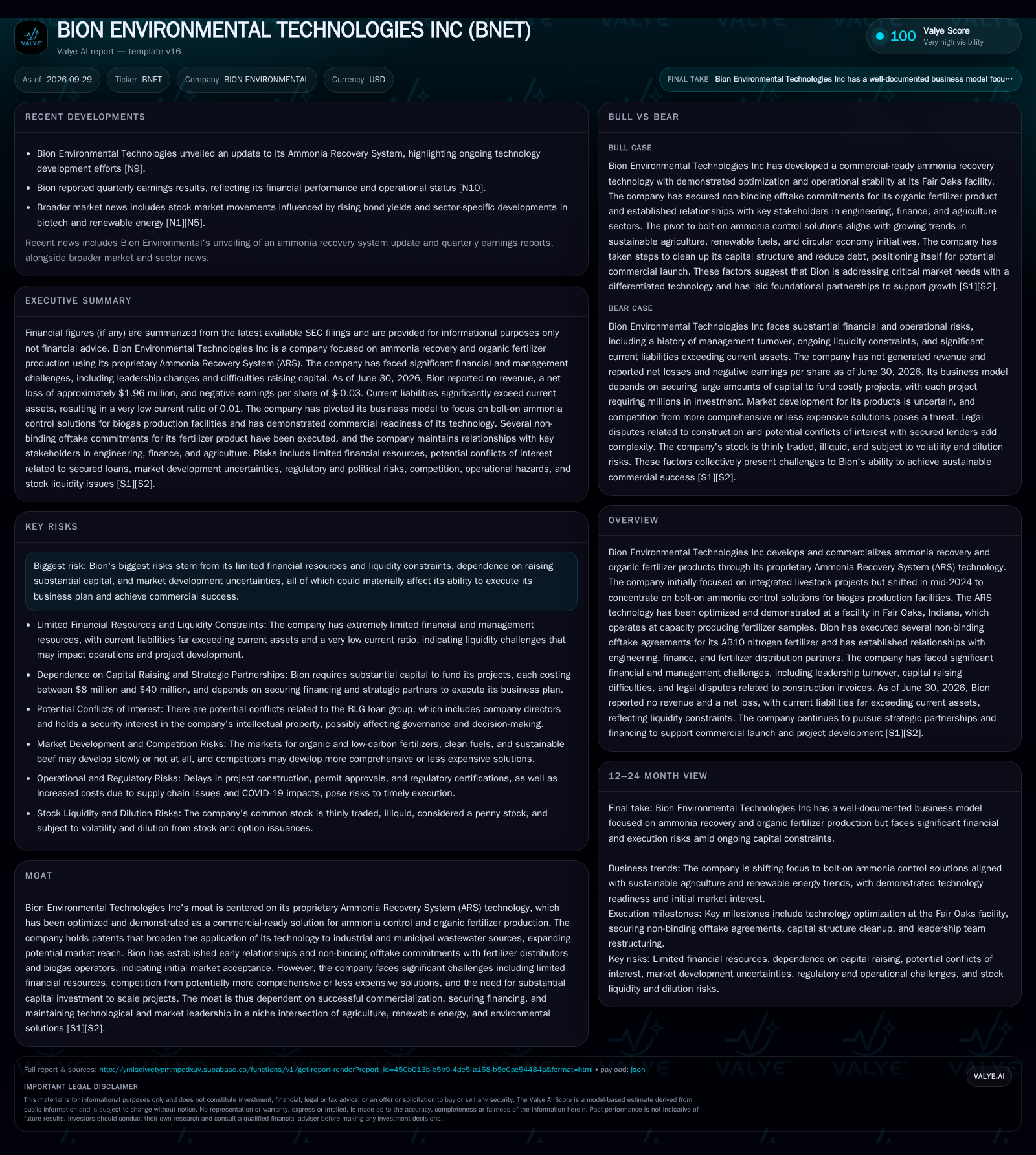
Bion Environmental Technologies has optimized and demonstrated its Ammonia Recovery System at Fair Oaks, executed non-binding offtake commitments, and shifted to bolt-on ammonia control solutions for biogas facilities. However, the company reported no revenue and a net loss of $1.96 million as of June 30, 2026, with current liabilities far exceeding assets and a current ratio of just 0.01. Its future hinges on securing strategic partnerships or financing to move beyond mission-critical operations and realize the potential of its patented technology in a capital-intensive, competitive market [S1] [S2].
Bion Environmental Technologies stands at a critical juncture: its proprietary Ammonia Recovery System is proven at demonstration scale, and the company has garnered early interest from biogas operators and fertilizer distributors. Yet, despite this technical validation and market alignment, Bion’s financial profile is severely constrained—no revenue, negative earnings, and a balance sheet with liabilities dwarfing assets. The company’s future now depends on its capacity to secure near-term funding or strategic partnerships to bridge the gap between technological promise and commercial execution.
Acute Liquidity and Market Interest Define Bion’s Present State
Bion Environmental’s situation is defined by two opposing currents: operational validation of its Ammonia Recovery System (ARS) at the Fair Oaks facility and an acute liquidity crunch. As of June 30, 2026, the company reported no revenue, a net loss of $1.96 million, and a current ratio of 0.01, with liabilities vastly exceeding assets [S1] [S2]. Despite these financial headwinds, Bion has executed several non-binding offtake commitments for its AB10 nitrogen fertilizer and has established relationships with engineering, finance, and fertilizer distribution partners [S1] [S2]. The company is maintaining only mission-critical operations and is actively seeking larger financing or strategic partnerships to enable commercial launch and project development [S1] [S2]. Legal disputes related to unpaid construction invoices at Fair Oaks and a secured promissory note with the Bion Loan Group (BLG), which holds a security interest in its intellectual property, further complicate the near-term outlook [S1] [S2].
The Economics of Ammonia Recovery: High Fixed Costs, Potentially Attractive Margins—If Scaled
Bion’s business model is predicated on the conversion of waste ammonia into high-value organic fertilizer using its proprietary ARS technology. The economics hinge on two primary levers: the ability to deploy capital-intensive systems at scale and to secure premium pricing for low-carbon fertilizer outputs. The pivot to bolt-on solutions for biogas facilities is designed to lower adoption barriers compared to large integrated livestock projects, potentially enabling a modular, repeatable deployment model. However, each project requires substantial upfront investment—estimated in the $8–40 million range—which necessitates access to external capital or well-structured partnerships.
If Bion’s technology can be embedded in existing biogas or waste facilities, it could unlock both volume (by targeting a broader installed base) and improved mix (premium fertilizer pricing linked to sustainability attributes). Operating leverage could be significant if fixed engineering, regulatory, and demonstration costs are amortized over multiple deployments. However, absent revenue and with only non-binding offtake agreements, actual unit economics, customer willingness to pay, and recurring revenue potential remain unproven. The path to profitability will likely require not only successful project execution but also validation of fertilizer pricing power and the cost of customer acquisition in a nascent market.
Patent Breadth Versus Market and Capital Barriers: The Real Moat Question
Bion’s competitive position is underpinned by its proprietary ARS technology, expanded patent coverage (including industrial and municipal wastewater), and early-stage relationships with biogas and fertilizer sector stakeholders [S1] [S2]. The company’s pivot away from large livestock projects to bolt-on ammonia control aligns with trends in sustainable agriculture and renewable energy, potentially positioning Bion as a niche technology leader at the intersection of these sectors.
However, the true defensibility of Bion’s moat is contingent on several factors. First, technology differentiation must translate into measurable cost, efficiency, or compliance advantages for customers—especially as alternative ammonia removal and fertilizer production solutions exist, some with deeper integration in the waste management or chemical sectors. Second, Bion’s acute financial constraints may limit its ability to scale, invest in ongoing R&D, or respond to competitive threats. Third, the company’s illiquid, penny-stock status and legal encumbrances could deter institutional partners or customers seeking long-term reliability. The question is whether Bion can convert its technology edge and initial market interest into a durable, revenue-generating business before competitors or substitutes erode its opportunity window.
Unlocking Value Through Strategic Partnerships and First-Mover Project Success
The favorable scenario for Bion hinges on the successful conversion of non-binding offtake commitments into binding contracts and the securing of either a major strategic partner or sufficient external financing to fund the first wave of commercial deployments. If the company can demonstrate that its ARS technology consistently delivers regulatory-compliant ammonia reductions and cost-effective fertilizer output at customer sites, it could catalyze broader adoption among biogas operators and potentially industrial or municipal wastewater facilities.
Evidence that would confirm this scenario includes: the announcement and execution of binding, revenue-generating contracts; disclosure of project-level returns or unit economics demonstrating positive margins; and the formation of a strategic partnership with a major player in the biogas, fertilizer, or ag-tech ecosystem. Further, public recognition of Bion’s ARS technology by regulatory agencies or industry consortia would validate both the solution’s efficacy and its commercial relevance. Falsification would occur if the company fails to convert non-binding agreements into real revenue, if capital remains inaccessible, or if early deployments reveal operational or regulatory shortcomings.
A Holding Pattern: Technology Validated, Commercialization Delayed by Capital Constraints
The most plausible near-term trajectory for Bion is a prolonged holding pattern: the company continues to operate its Fair Oaks demonstration facility at capacity, maintains stakeholder engagement, and pursues active fundraising or partnership discussions, but is unable to initiate full-scale commercial projects due to lack of capital. Cost-saving measures and mission-critical operations persist, with incremental progress dependent on external funding or a breakthrough in legal disputes. The company may secure additional short-term financing from related parties or existing shareholders, but this is likely to be dilutive and insufficient to materially change the growth outlook.
Confirmation would come from ongoing public disclosures of cash conservation efforts, continued demonstration activity, and repeated references to the need for external capital. Falsification would occur if the company either ceases operations due to insolvency or unexpectedly announces a major financing or partnership that enables commercial project launches.
Liquidity Exhaustion and Strategic Asset Risk in a Stalled Commercialization Effort
The adverse scenario for Bion is defined by a failure to secure the financing required to move beyond demonstration scale, leading to further cash depletion, inability to meet legal obligations, and potential loss of control over its intellectual property (IP) due to the BLG loan group’s security interest. Prolonged inability to resolve legal disputes or fund new projects could result in staff departures, loss of key relationships, and erosion of stakeholder confidence.
This scenario would be confirmed by the disclosure of additional legal actions, asset sales, IP foreclosure, or public statements regarding insolvency risk. If Bion’s technology is not commercialized under its own stewardship, there is a risk that the IP could be acquired at distressed valuations by competitors or creditors, negating any first-mover advantage and leaving shareholders with little or no value.
Milestones That Will Determine Whether Bion’s Technology Becomes a Commercial Reality
Execution of binding, revenue-generating contracts for ammonia control or fertilizer sales would be a critical validation of commercial traction.
Successful closing of a major financing round or the formation of a strategic partnership that provides sufficient capital for project deployment would materially alter the risk profile.
Disclosure of project-level economics—such as capital outlay, operating margins, and payback periods—would help test the scalability and profitability of the ARS model.
Resolution or escalation of legal disputes related to Fair Oaks construction invoices and the status of the BLG secured loan are pivotal to asset security and operational continuity.
Evidence of repeat deployments or reference customers among biogas operators would indicate network effects and market acceptance.
Regulatory recognition or third-party validation of ARS performance, especially in new verticals (e.g., municipal wastewater), would broaden addressable market and support pricing power.
If disclosed, customer retention or renewal rates for ARS-enabled projects would be an important signal of long-term value and switching costs.
Disclaimer: This is research-only, informational analysis and not investment advice. It may include AI-generated interpretation and general industry context. Always verify important details using primary sources.

Comments