
Rocky Mountains Group Ltd: Early-Stage Financial Literacy Ambitions Confront Execution and Scale Limits
Rocky Mountains Group Ltd offers one-on-one financial literacy seminars in New Zealand, positioning itself as an independent educator in a fragmented, competitive market. With minimal current revenue, a nascent team, and a significant accumulated deficit, the company’s future depends on scaling instruction, effective marketing, and differentiating its value proposition from larger financial institutions.
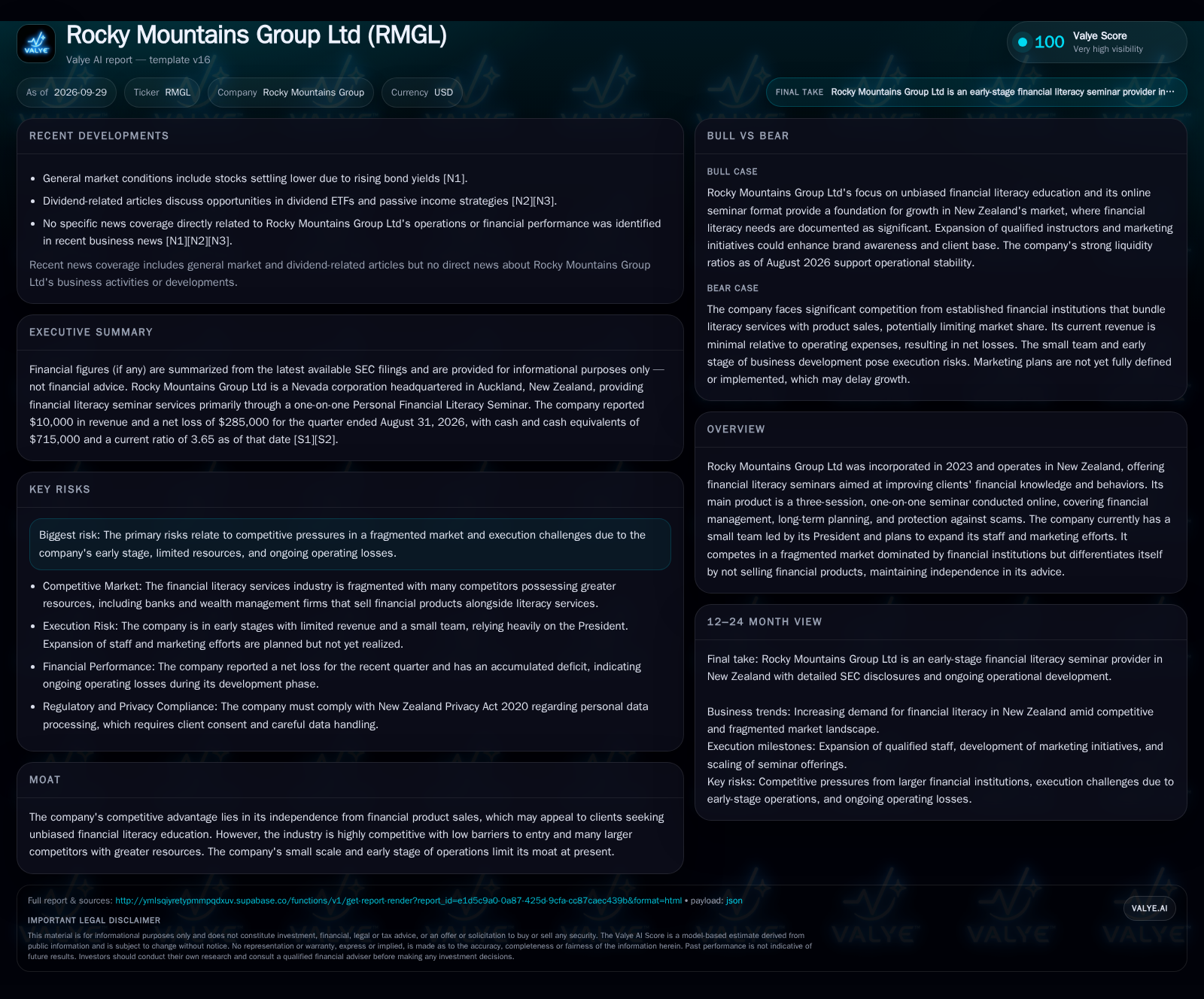
Rocky Mountains Group Ltd provides online, individualized financial literacy seminars and differentiates itself by not selling financial products. As of August 2026, the company reported $10,000 in quarterly revenue and a net loss of $285,000, with just two employees. Expansion plans hinge on hiring, marketing, and leveraging its independence in a crowded, low-barrier industry [S1] [S2].
Rocky Mountains Group Ltd is attempting to carve a niche in New Zealand’s crowded financial literacy market by offering high-touch, one-on-one online seminars that emphasize unbiased education. With only two employees and minimal revenue as of August 2026, the company faces the dual challenges of scaling its instructor base and establishing a recognizable brand amidst competition from powerful financial institutions. The next phase will test whether its independence and personalized approach can drive sustainable growth, or if execution and market realities will limit its ambitions.
Present-Day Operating Realities: Limited Revenue and Team Size Define the Starting Line
As of August 31, 2026, Rocky Mountains Group Ltd reported just $10,000 in revenue for the prior quarter, with a net loss of $285,000 and an accumulated deficit totaling $51.5 million. The company had cash and cash equivalents of $715,000, a current ratio of 3.65, and two employees—one of whom is the President, who also serves as the sole seminar instructor. The company plans to hire two additional qualified professionals by the end of 2026, but for now, operational capacity is tightly constrained [S1] [S2].
These facts underscore the company’s early-stage status and highlight the importance of rapid execution: revenue is negligible compared to operating expenses, and the company remains highly dependent on a single individual for delivery of its core service.
Unit Economics and Growth Constraints in a High-Touch, Flat-Fee Model
Rocky Mountains Group’s revenue model is straightforward: a flat $5,000 fee per individual for a three-session, one-on-one online seminar [S1]. This approach suggests attractive per-client pricing, but also imposes natural limits on scalability—each session requires significant instructor time, and the company’s ability to generate revenue is directly capped by instructor capacity.
With only the President currently delivering seminars, maximum attainable revenue is a function of how many clients can be served per week. Even with planned staff expansion, instructor hiring and training become gating factors. Fixed costs—such as salaries, marketing, and compliance—must be spread across a still-small client base, resulting in current negative operating leverage. The company’s net loss of $285,000 on $10,000 in revenue suggests high baseline costs relative to current scale [S2].
To achieve profitability, Rocky Mountains Group would need to: (a) increase the number of paying clients, (b) hire and retain additional qualified instructors, and/or (c) potentially develop group seminar or digital/self-guided offerings to improve instructor leverage and reduce marginal cost per client. The company’s current economics favor high-touch, premium positioning, but such a model is vulnerable to capacity bottlenecks and slow ramp-up, unless new instructors can be added without eroding quality or reputation.
Independence vs. Scale: Can a Pure-Play Educator Outcompete Financial Institutions?
Rocky Mountains Group differentiates itself by refusing to sell financial products, claiming independence as a competitive advantage in a market where most financial literacy providers—such as banks, wealth managers, and insurance brokers—embed education within product sales [S1]. This positioning may appeal to clients wary of conflicted advice, but raises questions about brand recognition, trust, and distribution.
The New Zealand financial literacy sector is fragmented and competitive, with established institutions leveraging broader brand awareness, bundled service offerings, and existing customer relationships. For Rocky Mountains Group, the challenge is twofold: (1) acquiring clients without the cross-selling channels enjoyed by banks and brokers, and (2) convincing prospects that its independence translates into higher-quality or more trustworthy education.
Switching frictions may be low—clients can easily seek education elsewhere, often at lower or no cost, especially from government programs or employer-sponsored initiatives. The potential for network effects or recurring revenue appears limited unless Rocky Mountains Group can develop alumni communities, ongoing support, or advanced offerings to retain clients beyond the initial seminar.
Unlocking Growth: Instructor Scale and Marketing Drive Adoption
A favorable trajectory would see Rocky Mountains Group successfully hiring and onboarding additional qualified instructors, enabling it to serve more clients while maintaining quality standards. Effective marketing—through webinars, white papers, social media, and industry partnerships—could build brand awareness and drive demand among individuals and families seeking unbiased financial literacy education.
If the company can demonstrate a steady increase in seminar bookings, rising client acquisition rates, and positive word-of-mouth referrals, it could achieve a virtuous cycle: higher revenues fund further marketing and instructor recruitment, while growing alumni base enhances reputation and trust. Over time, Rocky Mountains Group could experiment with group seminars or digital content to further scale its reach.
Evidence confirming this scenario would include: (a) sequential growth in client numbers and revenues, (b) successful hiring and retention of new instructors, (c) increasing marketing spend with measurable ROI in new client acquisition, and (d) positive client satisfaction or NPS scores, if disclosed.
Incremental Progress Amid Execution and Market Headwinds
The most plausible medium-term outcome is slow, incremental progress: the company adds a small number of instructors and clients, but revenue growth remains modest relative to fixed costs. Marketing initiatives may yield some awareness and leads, but customer acquisition costs could remain high in a market saturated with free or subsidized alternatives.
Operating losses likely persist as the company builds capacity and refines its processes. The independence pitch may win some clients but is unlikely to meaningfully disrupt incumbent providers unless Rocky Mountains Group can develop a differentiated curriculum, measurable client outcomes, or a trusted brand identity.
Confirmation would come from gradual increases in headcount, client numbers, and revenue, but continued net losses and limited evidence of step-change adoption.
Scaling Stalls: Execution Risks and Competitive Realities Constrain Growth
A negative outcome would see Rocky Mountains Group struggling to recruit and retain qualified instructors, thus failing to expand client capacity. Marketing efforts might underperform, with low conversion rates and high acquisition costs, making it difficult to reach break-even at any foreseeable scale.
Competition from established banks and wealth managers could further squeeze the company’s addressable market—especially if those providers offer free or low-cost literacy services as a loss leader. The company’s accumulated deficit and ongoing net losses could erode potential financial flexibility, forcing management to curtail growth investments, reduce headcount, or seek additional capital.
Evidence for the downside would include stagnant or declining revenue, inability to hire instructors as planned, persistent high losses, and little to no traction in marketing or client engagement metrics.
Milestones That Will Test Rocky Mountains Group’s Independent Growth Thesis
Quarterly revenue growth and number of clients served—if disclosed—will reveal whether the company is gaining market traction and scaling its core service offering.
The pace of instructor hiring and retention, relative to stated plans, will demonstrate whether the company can overcome the bottleneck of single-instructor delivery.
Marketing campaign rollouts (webinars, white papers, social media presence) and their impact on inbound leads and client conversion rates would help validate the effectiveness of planned growth initiatives.
Gross margin per client—if disclosed—would show whether the flat-fee, high-touch model is economically viable as scale increases.
Client satisfaction and referral rates (e.g., NPS or testimonial volume) would help test the value proposition and the effectiveness of the company’s independent positioning.
Operating expense trends as a percentage of revenue will indicate whether negative operating leverage is improving or worsening as the company attempts to scale.
Cash burn rate and remainingreported liquidity position, given ongoing losses, will determine the urgency of achieving scale or raising additional capital.
Evidence of repeat or follow-on business (e.g., advanced seminars, alumni engagement)—if disclosed—would shed light on the potential for higher lifetime value and reduced reliance on constant new client acquisition.
Disclaimer: This is research-only, informational analysis and not investment advice. It may include AI-generated interpretation and general industry context. Always verify important details using primary sources.

Comments