
Nymox Pharmaceutical: Clinical-Stage Ambitions Collide with Acute Liquidity Pressure and Pivotal Trial Uncertainty
The company’s prospects now hinge on trial outcomes, regulatory clarity, and its ability to secure partnerships or funding before potential financial flexibility erodes further.
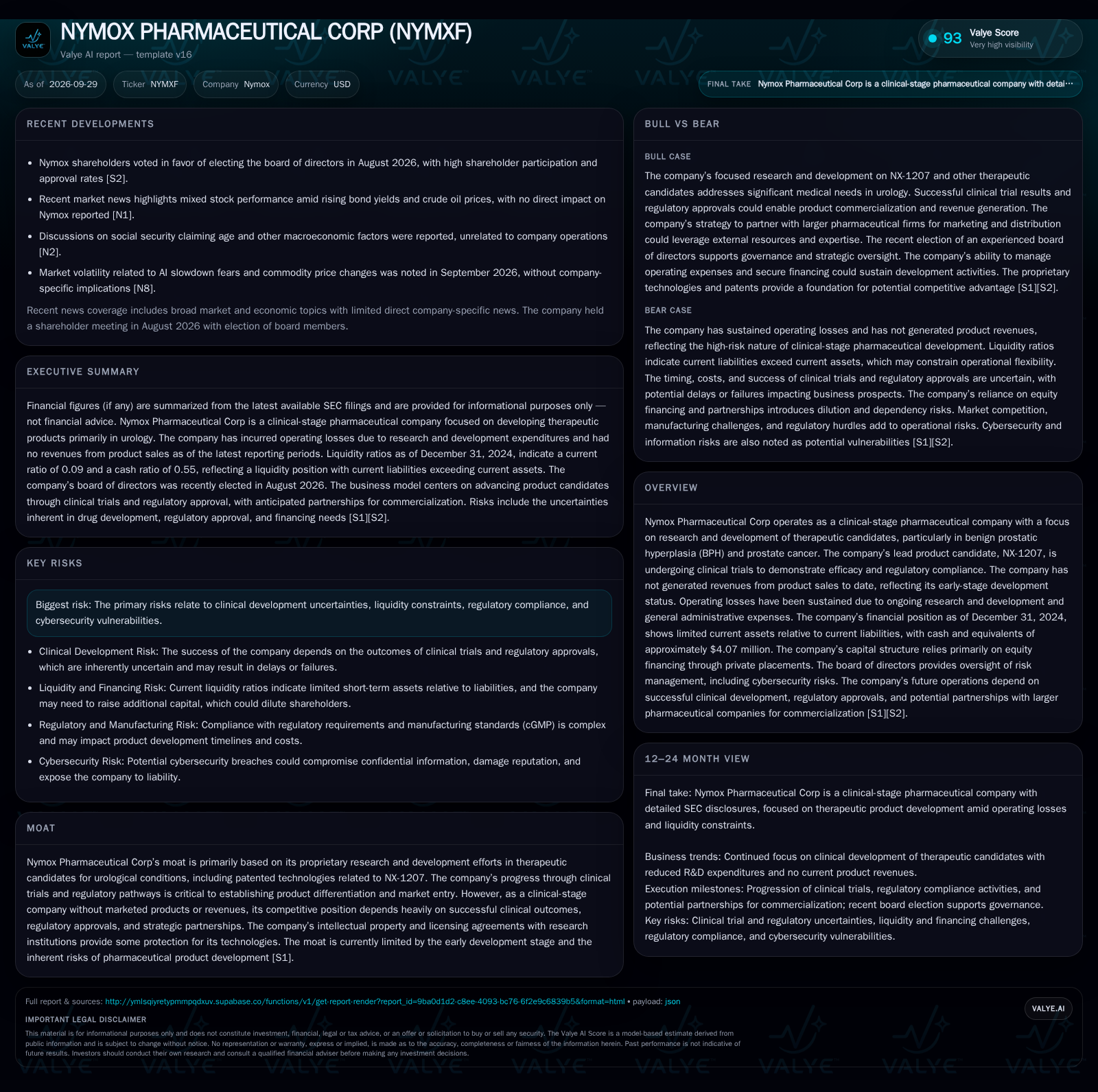
Nymox Pharmaceutical is a clinical-stage biotech focused on BPH and prostate cancer therapeutics, with no product revenues and a sharply negative current ratio as of December 2024. The company’s lead candidate, NX-1207, is in clinical trials, but ongoing operating losses and a cash position well below current liabilities put severe pressure on the timeline for regulatory progress and partnering activity. Successful trial data and partnership traction could unlock value, but dilution and execution risks are acute given the constrained balance sheet and uncertain path to commercialization. [S1] [S2]
Nymox Pharmaceutical Corp exemplifies the high-stakes gamble inherent in early-stage biotech. Despite two decades of research in urological therapeutics, the company has yet to generate any product revenue and faces mounting financial pressures, with a current ratio below 0.1 as of the last reporting period. Its future now depends on the fate of NX-1207 in clinical trials, the possibility of regulatory progress, and the urgent need for external funding or a strategic partnership. The path forward is defined by binary clinical outcomes and the company’s ability to survive the wait.
Acute Liquidity Pressure Defines Nymox’s Near-Term Outlook
Nymox Pharmaceutical’s financial snapshot as of December 2024 reveals an acute liquidity crunch: $4.07 million in cash and equivalents against $7.43 million in current liabilities, yielding a current ratio of just 0.09. The company has posted no product revenues for both 2024 and 2025, and its accumulated deficit reached $216.7 million by year-end 2025. R&D expenditures fell sharply from $3.28 million in 2024 to $1.48 million in 2025, a reduction that may be symptomatic of funding constraints or a deliberate narrowing of focus. This context signals that Nymox’s operational flexibility is severely limited and that the window for achieving pivotal milestones before further capital raising is tightening. [S1]
The company reported cash and liquidity metrics for the period; these figures do not by themselves establish operating runway, investment capacity, financial flexibility, or financing capacity. For instance, the company may be forced to prioritize short-term survival over longer-term investments in clinical development or regulatory engagement.
How Nymox’s Model Hinges on Clinical Milestones and External Funding
Nymox’s business model is classic clinical-stage biotech: investment in R&D to advance proprietary drug candidates through clinical trials, with the aim of securing regulatory approval and ultimately monetizing those assets—typically via out-licensing, partnerships, or acquisition. The company has no product revenues, so every dollar spent is funded by equity, convertible debt, or private placements. Fixed costs are dominated by R&D and general administrative expenses, while marketing spend remains nil due to the absence of commercial products. The sharp decline in R&D spending in 2025 likely reflects both cash preservation and the completion or winding down of certain trial phases.
Operating leverage is highly negative at this stage: costs are largely fixed and front-loaded, while upside is back-loaded and binary, dependent on clinical or regulatory inflection points. With a current cash position insufficient to cover short-term liabilities, Nymox’s viability depends on its ability to raise new capital before hitting a liquidity wall, or to secure a partnership that brings non-dilutive funding. Capital needs will remain elevated until a pivotal trial readout or commercial deal is achieved.
The dependency on external funding creates a structural vulnerability in Nymox’s business model, as capital markets for early-stage biotech are highly sensitive to clinical news flow and broader market sentiment. If trial outcomes are delayed or less favorable than expected, investor appetite may wane, exacerbating liquidity pressures. Conversely, positive data could improve financing terms but may also trigger increased R&D spending and operational scale-up costs, requiring careful cash flow management. The timing and structure of financing rounds, including the balance between equity dilution and convertible instruments, will be critical in preserving shareholder value while maintaining development momentum.
Proprietary Focus in Urology: Moat Potential and Competitive Exposures
Nymox’s differentiation rests on its proprietary NX-1207 candidate for BPH and prostate cancer, supported by patent filings and research collaborations. If NX-1207 demonstrates clinically meaningful efficacy and safety, it could address an unmet need in urological therapeutics—a market with established players and well-known off-patent drugs. However, as a pre-commercial entity, Nymox lacks the scale, distribution reach, and regulatory experience of larger pharmaceutical peers. The company’s moat is currently theoretical, based on intellectual property and early clinical data rather than established market share or recurring revenue.
Competition comes from both established pharma companies with approved BPH therapies and other clinical-stage biotech firms pursuing alternative mechanisms or delivery methods. Switching costs for prescribers and patients are typically low unless a new therapy offers clear efficacy or tolerability advantages. The question is whether NX-1207’s clinical profile can justify premium pricing or rapid adoption if approved. Until then, Nymox’s competitive position is fragile and contingent on successful trial outcomes.
Breakout Value If NX-1207 Delivers Positive Data and Partnership Traction
The bull case for Nymox hinges on a successful clinical readout for NX-1207, demonstrating statistically significant improvements in BPH or prostate cancer outcomes with an acceptable safety profile. Such data could catalyze regulatory filings and increase the attractiveness of the asset to large pharmaceutical partners. In this scenario, Nymox could secure a licensing agreement or co-development partnership, providing upfront cash, milestone payments, and the resources to commercialize the product globally.
Confirmation of this scenario would come from: (1) positive, peer-reviewed clinical trial results; (2) announcements of partnership or licensing deals with established pharma companies; (3) successful regulatory submissions or Fast Track designations. A rapid improvement in the company’s cash position from non-dilutive sources would also signal a transition from survival mode to value realization.
Survival Mode: Delayed Progress and Ongoing Dilution
The most plausible near-term outcome is continued slow advancement of clinical programs amid ongoing capital constraints. If clinical data for NX-1207 is promising but not transformative, Nymox may face a protracted period of additional trials or regulatory back-and-forth, necessitating further equity raises and shareholder dilution. The company’s ability to attract meaningful partnership interest may be limited until later-stage or confirmatory data is available.
Evidence for this scenario would include: (1) further reductions in R&D spending or delays to clinical timelines; (2) ongoing reliance on small private placements or convertible debt; (3) a lack of partnership announcements or regulatory progress. Shareholder dilution and operating losses would likely continue, with the company treading water until a definitive inflection point is reached.
Liquidity Exhaustion Before Clinical Validation
The adverse scenario is that Nymox’s cash position deteriorates before it can deliver pivotal clinical or regulatory milestones, forcing the company into distressed financing or even insolvency. In this case, NX-1207 may fail in trials or produce ambiguous results, making partnership or additional financing difficult. The company could be forced to halt development, sell assets at distressed valuations, or enter bankruptcy proceedings.
This outcome would be confirmed by (1) a rapid depletion of cash without corresponding trial progress; (2) inability to raise capital on reasonable terms; (3) public disclosure of going concern warnings or default on obligations. The risk of value destruction is high in this scenario, especially given the company’s acute current ratio and lack of revenue.
Milestones That Will Determine Whether Nymox Can Survive and Deliver Value
Updates on clinical trial progress and, if disclosed, any interim or final efficacy/safety data for NX-1207.
Announcements of new equity raises, private placements, or other financing events; the size, terms, and dilution impact would help test the company’s ability to sustain operations.
Any public disclosure of partnership, licensing, or co-development agreements with larger pharmaceutical companies.
Regulatory submissions, feedback, or Fast Track/Breakthrough Therapy designations related to NX-1207.
Changes in R&D spending levels, which could indicate either progress or further cash constraints.
Board or management changes beyond the August 2026 election, particularly if linked to strategic shifts.
Going concern disclosures, auditor warnings, or changes in the company’s ability to meet immediate obligations.
If disclosed, backlog of clinical trial sites, patient enrollment rates, or other operational execution metrics.
Disclaimer: This is research-only, informational analysis and not investment advice. It may include AI-generated interpretation and general industry context. Always verify important details using primary sources.

Comments