
Gulf Resources: Bromine Expansion, Regulatory Headwinds, and the Economics of Chemical Scale
Despite a sharp rebound in sales and recent asset expansion, Gulf Resources continues to grapple with operational losses, regulatory risks in China, and episodic production disruptions. The company’s ability to translate scale investments into sustainable profitability—and to navigate the country’s evolving compliance landscape—remains the core question for investors.
Gulf Resources, a major Chinese bromine producer, saw sales jump 250% as of August 2025 and acquired additional salt fields to expand its resource base. However, operational losses deepened through Q1 2026, and government-mandated plant closures in late 2023 highlighted persistent regulatory and environmental risks. Key variables include bromine segment economics, production continuity, and the ability to leverage new assets into margin improvement.
Gulf Resources, Inc. occupies a prominent, if precarious, position in China’s specialty chemical landscape, operating as one of the country’s largest bromine producers. Recent headline growth—a 250% sales surge as of August 2025 and the acquisition of new salt fields—contrasts sharply with deepening operational losses and recurring regulatory friction. The company’s near-term fate hinges on its ability to convert expanded capacity and resource access into sustainable profits, all while navigating a tightening regulatory environment and episodic production interruptions. For investors, the core tension is whether scale and asset control can ultimately overcome structural margin and compliance pressures.
Recent Growth, Regulatory Disruptions, and Persistent Losses Define the Current Landscape
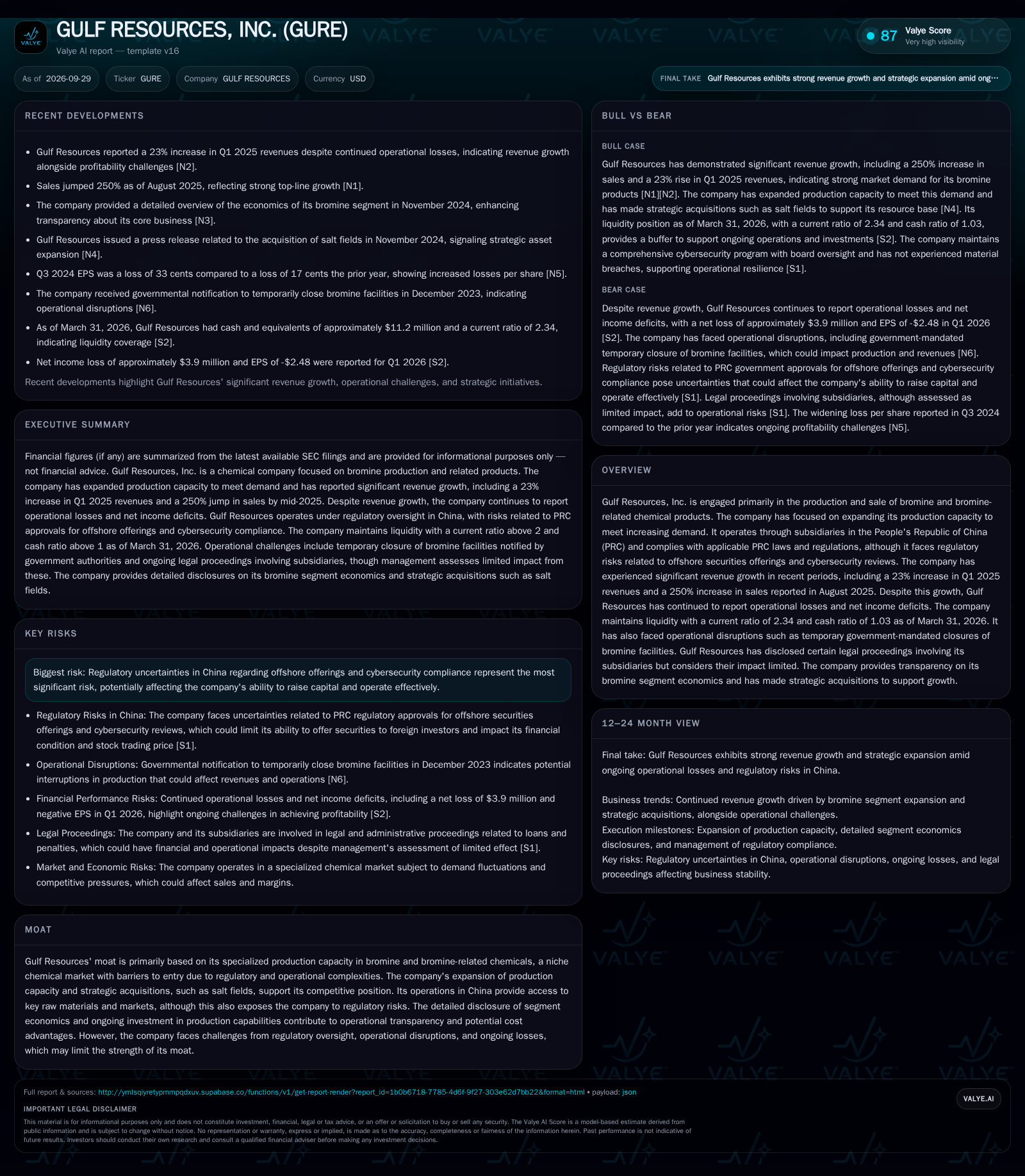
Gulf Resources reported a dramatic 250% jump in sales as of August 2025, suggesting either a rebound in demand or the effect of increased production capacity coming online [N1]. This headline growth, however, has not translated into profitability: the company posted a net loss of approximately $3.9 million and basic and diluted EPS of -$2.48 for Q1 2026 [S2]. Operational continuity remains challenged, as evidenced by a government-mandated temporary closure of bromine facilities in December 2023, highlighting ongoing regulatory and environmental risks [N6]. On the asset side, the acquisition of salt fields in late 2024 points to a strategy of securing raw materials and expanding vertical integration [N4]. Liquidity coverage appears adequate, with $11.2 million in cash and a current ratio of 2.34 at March 2026, but persistent losses raise questions about long-term sustainability [S2].
Economics of Bromine Production: Scale, Margins, and Cost Pressures
Bromine production is highly capital-intensive, requiring significant upfront investment in extraction and processing infrastructure. Gulf Resources’ recent expansion and salt field acquisition suggest a push for greater scale and resource control, which in theory should drive down per-unit costs if capacity utilization remains high. The company’s November 2024 disclosure of detailed bromine segment economics signals management’s attention to transparency and cost structure [N3]. However, the sector is exposed to volatile input costs, energy price swings, and environmental compliance expenses—which can erode margins, particularly during periods of regulatory intervention or forced facility closures.
In the absence of disclosed unit margins or contract structures, it is plausible that Gulf Resources sells both commodity bromine and value-added derivatives, with pricing power varying by end market. Fixed costs dominate, so incremental volume growth should improve gross margins if market prices remain stable. Yet, the persistent net losses indicate either insufficient pricing leverage, underutilized capacity, or structurally high compliance and operating costs. The acquisition of additional salt fields could reduce raw material costs over time, but integration and ramp-up risks remain.
Navigating a Concentrated Market with High Barriers and Intense Regulatory Scrutiny
Gulf Resources operates in a niche segment of the chemical industry, where barriers to entry are substantial due to the need for specialized extraction rights, environmental permits, and technical expertise. As one of China’s largest bromine producers by output, the company benefits from scale and established customer relationships. However, competition comes not only from domestic producers but also from global chemical majors and potential substitutes such as synthetic or alternative flame retardants.
The company’s vertical integration strategy—evidenced by the salt field acquisition—could help secure feedstock and insulate margins against input price volatility. However, regulatory risk is a persistent counterforce; government directives can abruptly halt production, as seen in December 2023 [N6]. Environmental compliance is a moving target, with stricter standards likely to favor larger, well-capitalized incumbents but also increasing cost and operational complexity. The company’s detailed segment disclosures suggest a willingness to differentiate on transparency, but it lacks the diversified product base and global reach of larger peers.
Capacity Expansion and Asset Integration Drive Margin Recovery and Profitability
The most favorable scenario for Gulf Resources is one in which increased production capacity and the newly acquired salt fields enable higher utilization rates, improved vertical integration, and lower per-unit costs. If market demand for bromine and related chemicals remains robust, the company could leverage fixed-cost absorption to drive margin expansion and move toward profitability. Demonstrated improvement in gross margins, sustained positive operating cash flow, and narrowing or reversing net losses would be key confirming signals.
Evidence that would strengthen this scenario includes: sequential improvement in operating margins, successful integration of the salt field assets with measurable cost savings, and absence of further major regulatory shutdowns. Rapid recovery from any operational disruptions and increased disclosure around customer retention or pricing power would also support the upside case.
Operational Volatility and Margin Pressure Persist Despite Asset Growth
The most plausible path is one where Gulf Resources continues to post periodic sales gains and asset expansions but remains constrained by regulatory volatility, episodic production interruptions, and ongoing margin pressure. The company may see improved resource security and some cost benefits from its salt field acquisition, but these could be offset by rising compliance costs and unpredictable facility availability.
This scenario would be confirmed by continued net losses, modest improvements in gross margin (if disclosed), and a pattern of regulatory or environmental disruptions that prevent full capacity utilization. If the company is able to maintain liquidity through asset sales, working capital management, or modest external financing, it could avoid acute financial distress but remain structurally unprofitable.
Regulatory Shocks and Operational Setbacks Undermine Financial Stability
In a negative scenario, Gulf Resources faces further regulatory clampdowns—such as extended plant closures or new environmental mandates—that significantly curtail production and revenue. Rising compliance costs, legal proceedings with greater-than-anticipated impact, or failure to integrate new assets could exacerbate losses and erode liquidity. If bromine market prices soften or demand falters, the company’s high fixed cost base could rapidly amplify losses.
Confirmation of this scenario would come from additional government notifications requiring shutdowns, disclosure of larger-than-expected legal or regulatory penalties, a marked decline in cash balance, or evidence of distressed asset sales. Deterioration in current or quick ratios, or the need for emergency capital raises, would also signal heightened financial vulnerability.
Milestones and Metrics That Will Define Whether Scale Can Overcome Structural Headwinds
Quarterly gross margin trends (if disclosed), to assess whether scale and vertical integration are improving profitability.
Utilization rates at bromine and salt field facilities, which would show whether the company is overcoming regulatory and operational disruptions.
Disclosure of average realized bromine prices and cost per ton (if available), to track pricing power and input cost control.
Frequency and severity of regulatory interventions, such as further mandated shutdowns or new compliance requirements.
Cash burn rate and changes in cash and equivalents each quarter, as persistent operating losses could erode the liquidity buffer.
Evidence of successful integration and production ramp-up at acquired salt field assets, such as increased internal raw material sourcing.
Updates on legal proceedings and any material penalties, as these could impact financial stability or operational continuity.
Progress in diversifying the customer base or product mix, which could reduce reliance on commodity bromine and improve margins.
Disclaimer: This is research-only, informational analysis and not investment advice. It may include AI-generated interpretation and general industry context. Always verify important details using primary sources.

Comments