
IDT CORP: AI-Driven Retail and Fintech Platform Expansion Tests the Durability of Recurring Revenue and Competitive Reach
With a major footprint in independent retail POS, cross-border fintech, and AI-augmented communications, IDT’s strategy blends recurring revenue with reinvestment from legacy businesses. The challenge: sustaining network effects and margin expansion as digital and regulatory complexity rises.
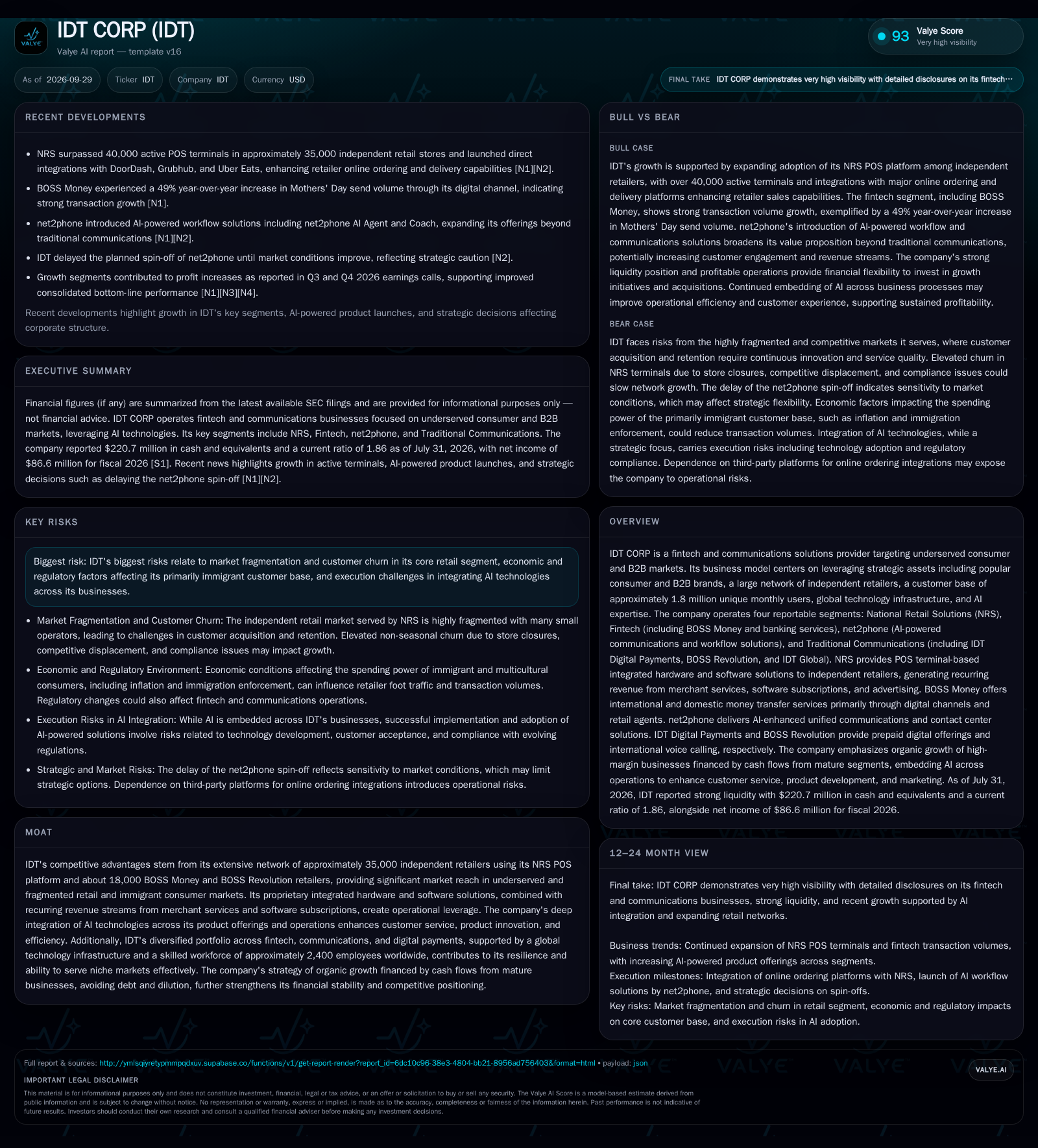
IDT CORP’s growth hinges on scaling its NRS POS platform, expanding digital fintech services for immigrant communities, and embedding AI in communications and workflow solutions. Recent developments—like NRS surpassing 40,000 terminals and new online ordering integrations—underscore both opportunity and operational complexity as IDT advances its multi-segment, AI-powered model. [S1] [N1] [N2]
IDT CORP’s evolution from a traditional communications provider into a diversified fintech and AI-driven platform operator has reached a pivotal moment. With its NRS POS network breaking past 40,000 active terminals and digital money transfer growth outpacing legacy channels, IDT is leveraging recurring, high-margin revenues to fund further expansion—while embedding AI across its portfolio to sharpen its competitive edge. Yet, the company’s reliance on fragmented retail and immigrant customer bases, combined with execution and regulatory risks in AI and fintech, means the path to sustained margin and network growth is far from assured. The next phase will test whether IDT’s combination of scale, technology, and capital discipline can deliver durable outperformance in increasingly complex markets.
Recent Milestones Redefine Scale and Strategic Focus
IDT’s NRS segment surpassed 40,000 active POS terminals in approximately 35,000 independent retail locations, with integrations to major delivery platforms (DoorDash, Grubhub, Uber Eats) rolling out in 2026. This expansion cements NRS as a leading POS provider for small-format retailers, reinforcing its $159.4 million revenue base—of which roughly 95% is recurring. [S1] [N1] [N2]
BOSS Money’s digital channel achieved a 49% year-over-year jump in Mothers' Day send volume, underscoring the growing importance of digital remittances among IDT’s core immigrant clientele. [N1]
net2phone launched new AI-powered workflow solutions (including agentic AI for communications and contact centers) but delayed its anticipated spin-off, citing unfavorable market conditions. This signals both product innovation and a pragmatic approach to capital markets timing. [N2]
How Recurring Revenue Models and Platform Leverage Shape IDT’s Profit Engine
IDT’s core business model is defined by recurring revenue streams anchored in network effects and software integration. NRS generates the majority of its $159.4 million in annual revenue from merchant services, software subscriptions, and advertising fees tied to its installed base of active POS terminals. The recurring component—approximately 95%—creates revenue predictability and supports operating leverage as fixed costs are spread over a growing terminal network. [S1]
BOSS Money’s economics hinge on transaction volume, average revenue per transfer, and digital channel mix. As digital adoption rises, incremental margins may improve, given lower physical agent costs and higher self-service utilization, but the company must balance promotion costs and compliance expenditures to sustain growth.
net2phone’s unified communications and contact center solutions—now enhanced by AI—are provisioned as SaaS subscriptions, with revenue scaling by seat count and workflow integration. This model offers high gross margins and positive operating leverage, but is exposed to churn and pricing pressure in a competitive market.
IDT’s legacy communications businesses (including BOSS Revolution and IDT Global) generate sizeable cash flows that are reinvested in higher-growth segments. [S1] [N2]
Network Scale, Niche Focus, and AI Integration Define the Competitive Chessboard
IDT’s competitive edge in POS and fintech is rooted in its penetration of fragmented, underserved markets—namely independent retailers and immigrant consumers. The NRS platform’s 40,000+ terminal footprint and integrations with leading delivery apps could increase switching friction for retailers, especially those seeking unified POS, payments, and online ordering.
The fintech segment, led by BOSS Money, leverages a multi-channel approach—digital and agent-based—to serve first- and second-generation immigrants, a demographic often overlooked by larger banks and fintechs. This niche focus provides some insulation from direct competition with pure-play neobanks or global remittance giants, but also exposes IDT to macro and regulatory shocks affecting its user base.
net2phone faces a crowded landscape of UCaaS and CCaaS providers, where differentiation increasingly depends on the depth of AI-powered features, workflow integration, and vertical customization. Its agentic AI initiatives may confer a temporary advantage, but sustaining this edge will require continual innovation and successful customer adoption.
Across segments, IDT’s ability to embed AI deeply into its offerings—improving customer experience, automating workflows, and mitigating risk—could be a source of durable advantage. However, the risk of rapid technology diffusion and regulatory scrutiny remains high, and the company must continually prove its value proposition to both customers and channel partners.
Sustained Platform Expansion and AI Monetization Drive Margin and Market Share Gains
In the most favorable scenario, NRS continues to expand its terminal network at or above its recent pace, benefiting from increased adoption of online ordering integrations. This drives higher average recurring revenue per terminal as retailers leverage more services, while platform scale attracts additional advertising and fintech partners.
BOSS Money capitalizes on demographic trends and digital channel migration, achieving further transaction growth and improved unit economics as digital volumes outpace legacy agent-based transfers. Regulatory hurdles are managed effectively, and compliance costs remain contained.
net2phone’s AI-powered workflow solutions gain traction in both North and South American markets, allowing IDT to capture share from less agile incumbents. AI integration delivers measurable improvements in customer retention and ARPU, while the eventual spin-off—timed for market recovery—unlocks shareholder value.
Evidence supporting this scenario would include accelerating POS terminal and digital transaction growth, rising per-terminal and per-user revenue metrics, robust adoption rates for new AI features, and margin expansion in quarterly disclosures.
Incremental Growth Balances Platform Expansion with Execution and Market Friction
A more probable scenario sees NRS’s terminal base and recurring revenue growing at a moderate pace, punctuated by periods of elevated churn due to retailer closures or competitive displacement. Online ordering integrations provide incremental lift but are offset by the operational complexity and margin-sharing with third-party platforms.
BOSS Money sustains healthy, if decelerating, growth in digital remittance volumes, while agent-based channels remain resilient but face cost and compliance pressures. Customer acquisition costs remain manageable, but promotional intensity rises as competition heats up.
net2phone’s AI solutions drive modest ARPU uplift and retention improvements, but broader market adoption is gradual, with the spin-off contingent on improved market conditions and capital market receptivity.
Confirmation of the base case would involve steady, single-digit growth in core KPIs, stable gross margins, and management commentary emphasizing balanced investment and risk management. Evidence of rising compliance and technology costs, or periodic setbacks in customer retention, would also be consistent with this scenario.
Network Churn, Regulatory Headwinds, and AI Execution Risks Erode Momentum
In a negative scenario, elevated churn among NRS retailers—due to economic stress, compliance failures, or competitive offerings—results in a shrinking active terminal base and lower recurring revenue. Integration issues or unfavorable terms with delivery platforms could further compress margins or limit retailer adoption.
BOSS Money faces transaction volume declines as macroeconomic or policy shocks reduce remittance flows, particularly if inflation, immigration enforcement, or regulatory changes disproportionately impact its core customer base. Increased compliance costs or adverse regulatory findings could further erode profitability.
net2phone’s AI initiatives falter due to poor customer uptake, technology missteps, or regulatory pushback, leading to increased churn and stagnant revenues. The delayed spin-off becomes indefinite, tying up capital and management attention.
Downside evidence would include sequential declines in active POS terminals or transaction volume, rising operating expenses relative to revenue, regulatory disclosures around compliance failures, and management commentary signaling retrenchment or cost-cutting.
Thesis-Testing Metrics for IDT’s Platform Growth and Resilience
Quarterly change in active NRS POS terminals—net additions or losses provide the clearest signal of network health and competitive traction.
Monthly average recurring revenue per terminal for NRS—if disclosed, to gauge the effectiveness of cross-sell and value-added service adoption.
Digital transaction volume and average revenue per transaction in BOSS Money—key for assessing the pace and profitability of fintech migration.
Churn rates for both NRS and net2phone—if available, to monitor retention risk and competitive displacement.
Adoption and usage metrics for new AI-powered features, especially within net2phone and BOSS Money—would help determine the ROI on technology investment.
Gross margin trends by segment—especially for NRS and BOSS Money, to track the impact of platform integrations and compliance costs.
Regulatory disclosures or commentary on compliance costs, data privacy, and AI governance—material for understanding risk exposure and potential shocks.
Timing and structure of any resumed net2phone spin-off or other capital market actions—as a signal of management’s confidence and the external environment.
Disclaimer: This is research-only, informational analysis and not investment advice. It may include AI-generated interpretation and general industry context. Always verify important details using primary sources.

Comments