
Carnival Corporation: Profit Recovery, Liquidity Constraints, and the Next Phase of Cruise Industry Competition
Sustainable differentiation and capital discipline will shape Carnival’s ability to convert today’s rebound into durable value.
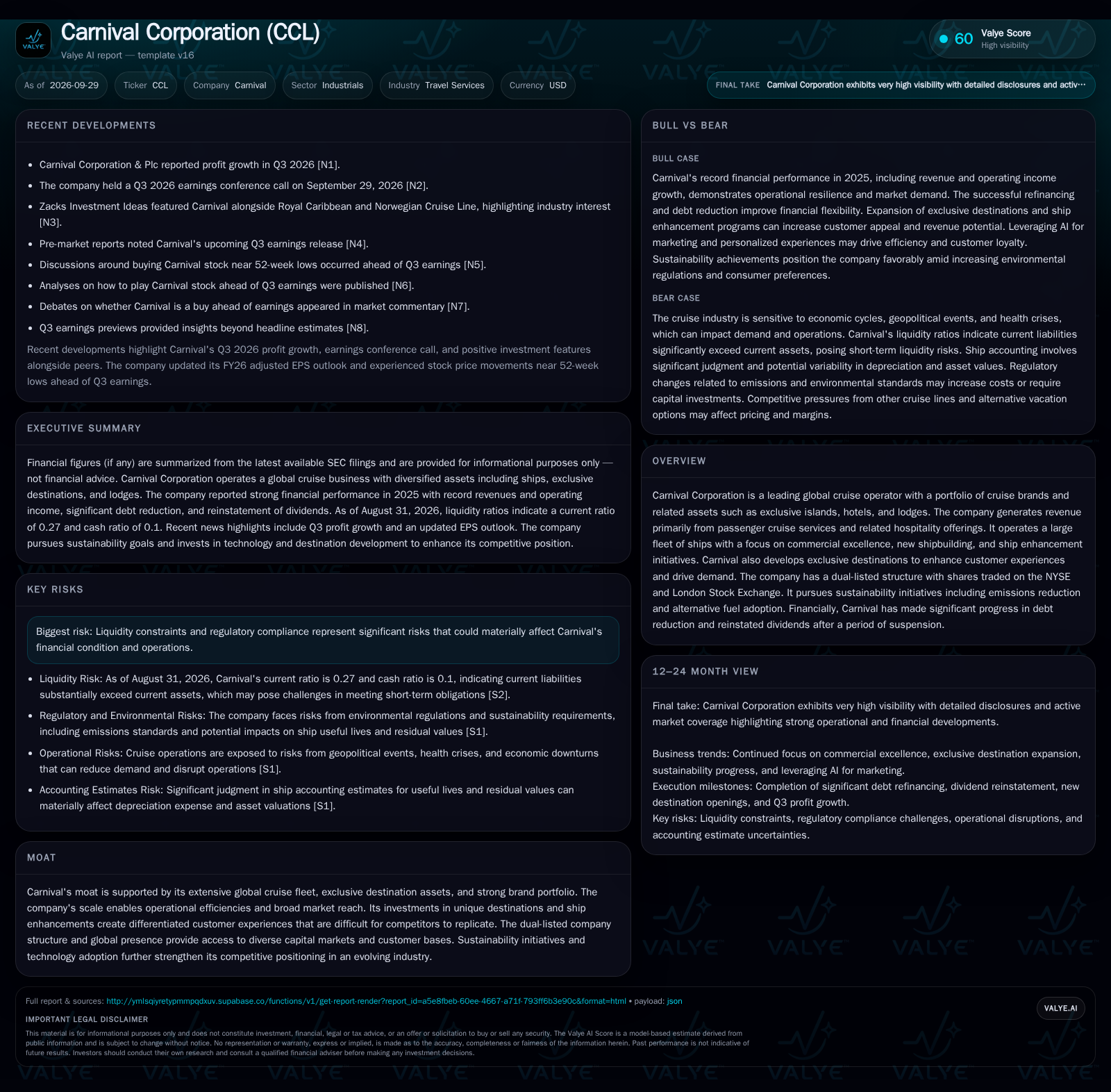
Carnival reported profit growth in Q3 2026 and reinstated its dividend after record 2025 results, yet its latest current and cash ratios reveal significant short-term liquidity pressure. The company’s expansion of exclusive destinations and ship enhancements aims to boost customer appeal and pricing, but faces regulatory, competitive, and macroeconomic uncertainties. The ability to manage capital needs and differentiate through assets and technology will determine whether Carnival’s post-pandemic recovery can translate into long-term resilience and margin improvement. [S2] [N1]
Carnival Corporation stands at a crossroads as it emerges from a volatile period with signs of financial recovery and renewed investor attention. Against a backdrop of intensifying competition, new regulatory demands, and evolving customer expectations, Carnival’s strategic emphasis on exclusive destinations, ship upgrades, and sustainability will be rigorously tested. The next phase will hinge on Carnival’s ability to convert cyclical momentum into durable, capital-efficient growth.
Profit Growth and Liquidity Constraints Define the 2026 Snapshot
Carnival Corporation reported profit growth in Q3 2026, alongside an updated EPS outlook and renewed market interest as the company’s stock traded near 52-week lows ahead of earnings. The cited source reports dividend-related activity; that disclosure alone does not establish dividend-policy continuity, management confidence, or a material constraint on capital flexibility. This juxtaposition of operational recovery and acute liquidity pressure is the defining feature of Carnival’s present financial situation. [S2] [N1]
How Carnival’s Revenue Model and Capital Structure Shape Its Economic Leverage
Carnival’s core revenue engine is built on passenger cruise services, augmented by hospitality offerings such as exclusive islands, hotels, and lodges. The company’s diversified brand portfolio allows it to target a range of demographics and price points, while exclusive destinations and on-board amenities drive incremental spend and can support premium pricing. Variable costs are high due to fuel, crew, and provisioning, but fixed-cost leverage is substantial—meaning high occupancy and pricing yield material improvements in operating margin.
However, the capital intensity of the cruise business is extreme: ships require billions in upfront investment, ongoing enhancement, and regulatory compliance. Depreciation is a significant non-cash expense, and ship accounting relies on management estimates for useful lives and residual values, introducing some variability into reported earnings. Carnival’s recent debt reduction improved its interest expense profile, but the company remains highly levered and must carefully balance reinvestment in fleet upgrades and destinations with the need to service debt and address liquidity constraints. [S2]
The interplay between Carnival's revenue generation and capital structure also influences its risk profile and investment appeal. High fixed costs and capital intensity mean that the company must maintain strong demand and pricing to cover substantial depreciation and interest expenses. In periods of demand softness, operating leverage can amplify losses, while in growth phases, it can magnify profits. The balance sheet's leverage level constrains flexibility, especially in volatile macroeconomic environments where access to capital markets may tighten. Therefore, the effectiveness of capital allocation decisions—including timing of fleet renewal, destination investments, and debt management—directly impacts Carnival’s ability to sustain earnings growth and navigate cyclical downturns.
Exclusive Destinations, Scale, and Brand Breadth: Carnival’s Defense Against Intensifying Competition
Carnival’s competitive advantage rests on the sheer scale of its fleet, its global reach, and a portfolio of well-known cruise brands. Exclusive islands and proprietary destinations are a key differentiator, offering unique experiences that are difficult for rivals to quickly replicate and allowing for higher onboard and destination-based spend. Investments in AI-driven marketing and personalization could enhance customer acquisition efficiency and retention if executed effectively.
Yet, Carnival operates in a fiercely competitive market alongside other global cruise lines and faces substitution risk from land-based vacations, all-inclusive resorts, and emerging travel trends. Rivals can also invest in new ships, premium experiences, and technology. Regulatory pressures—especially around emissions, sustainability, and health protocols—raise costs for the whole industry, but larger operators like Carnival may be better positioned to absorb these burdens due to scale. Still, with competitors also expanding and innovating, Carnival’s ability to continually refresh its offering and maintain a price/experience advantage is not assured.
Carnival’s scale advantage also enables operational efficiencies in procurement, fuel contracts, and crew management, which can partially offset rising input costs. However, scale alone does not guarantee sustained competitive advantage if innovation and customer experience do not keep pace. The rise of digital platforms and data analytics in travel marketing means that Carnival must continuously invest in technology to personalize offers and optimize pricing dynamically. Failure to do so could erode market share to more agile competitors or disruptors offering niche or highly customized experiences. Additionally, environmental regulations may increasingly favor operators who can deploy newer, more efficient vessels, potentially reshaping competitive dynamics over the medium term.
Unlocking Durable Growth Through Asset Differentiation and Margin Expansion
In a favorable scenario, Carnival leverages its exclusive destinations and ongoing ship enhancements to drive higher occupancy, premium pricing, and increased onboard spend. Effective use of AI for marketing and personalization could reduce customer acquisition costs and boost loyalty, while sustainability initiatives may attract environmentally conscious travelers and preempt regulatory penalties. If demand remains robust and macroeconomic conditions hold steady, Carnival could see operating leverage drive further margin expansion.
This scenario would be confirmed by sustained growth in net yields (revenue per passenger), occupancy rates, and onboard revenue per guest, alongside evidence of improved cash flows and further debt reduction. Announcements of additional exclusive destination openings, new ship launches with differentiated offerings, or successful refinancing would further support this thesis.
Balancing Operational Recovery with Capital Discipline in a Mixed Demand Environment
The most plausible outcome is that Carnival sustains moderate revenue and earnings growth as cruising demand stabilizes above pre-pandemic levels but faces periodic volatility from economic and geopolitical shocks. Pricing remains competitive, with occasional discounting required to maintain occupancy. Regulatory and sustainability costs rise, but are partially offset by operational efficiencies and technology adoption.
Evidence for this scenario would include stable or slightly improving current and cash ratios, continued but slower debt reduction, and modest growth in occupancy and net yields. Delays or scaling back of certain capex projects, announcements of cost containment initiatives, or incremental regulatory compliance investments would also be consistent with a disciplined, cautious approach.
Liquidity Stress and External Shocks Threaten Momentum
In an adverse scenario, Carnival’s liquidity crunch intensifies due to weaker-than-expected demand, an economic downturn, or a major operational disruption (such as a health or geopolitical crisis). The company could be forced to raise capital on unfavorable terms, sell core assets, or suspend dividends to address immediate cash needs. Rising regulatory costs (e.g., for emissions compliance) or unexpected maintenance issues could further pressure margins and erode investor confidence.
Signs confirming this scenario would include a further deterioration in the current ratio, negative operating cash flow, emergency financings, asset sales at distressed prices, or a renewed dividend suspension. Material declines in occupancy, pricing, or booking trends, or regulatory penalties, would also indicate that Carnival’s recovery is at risk.
Operational, Financial, and Strategic Milestones That Will Define Carnival’s Next Chapter
Quarterly trends in occupancy rates and net yields (revenue per passenger day) will indicate the effectiveness of commercial and pricing strategies.
Updates on exclusive destination openings, enhancements, or new ship deliveries would signal Carnival’s progress in differentiating its product portfolio.
Progress on debt reduction, refinancing, or any asset sales—especially if used to bolster liquidity—should be closely tracked.
Evidence of cost containment or operational efficiency gains, including fuel efficiency and sustainability initiatives, will affect both margins and regulatory positioning.
Announcements of regulatory changes or compliance costs in emissions, safety, or health protocols could materially impact capital needs.
If disclosed, customer acquisition costs and retention rates—particularly as Carnival invests in AI-driven marketing—would help assess ROI on technology initiatives.
Disclaimer: This is research-only, informational analysis and not investment advice. It may include AI-generated interpretation and general industry context. Always verify important details using primary sources.

Comments