
Luvu Brands: Retail Expansion, Margin Discipline, and the Next Phase of Branded Consumer Growth
Luvu Brands has delivered revenue growth and margin improvement through disciplined cost management and an expanded retail presence for its Jaxx brand. While operational execution is improving, the company remains exposed to intense e-commerce competition, supply chain risks, and the challenge of converting top-line gains into sustainable profitability.
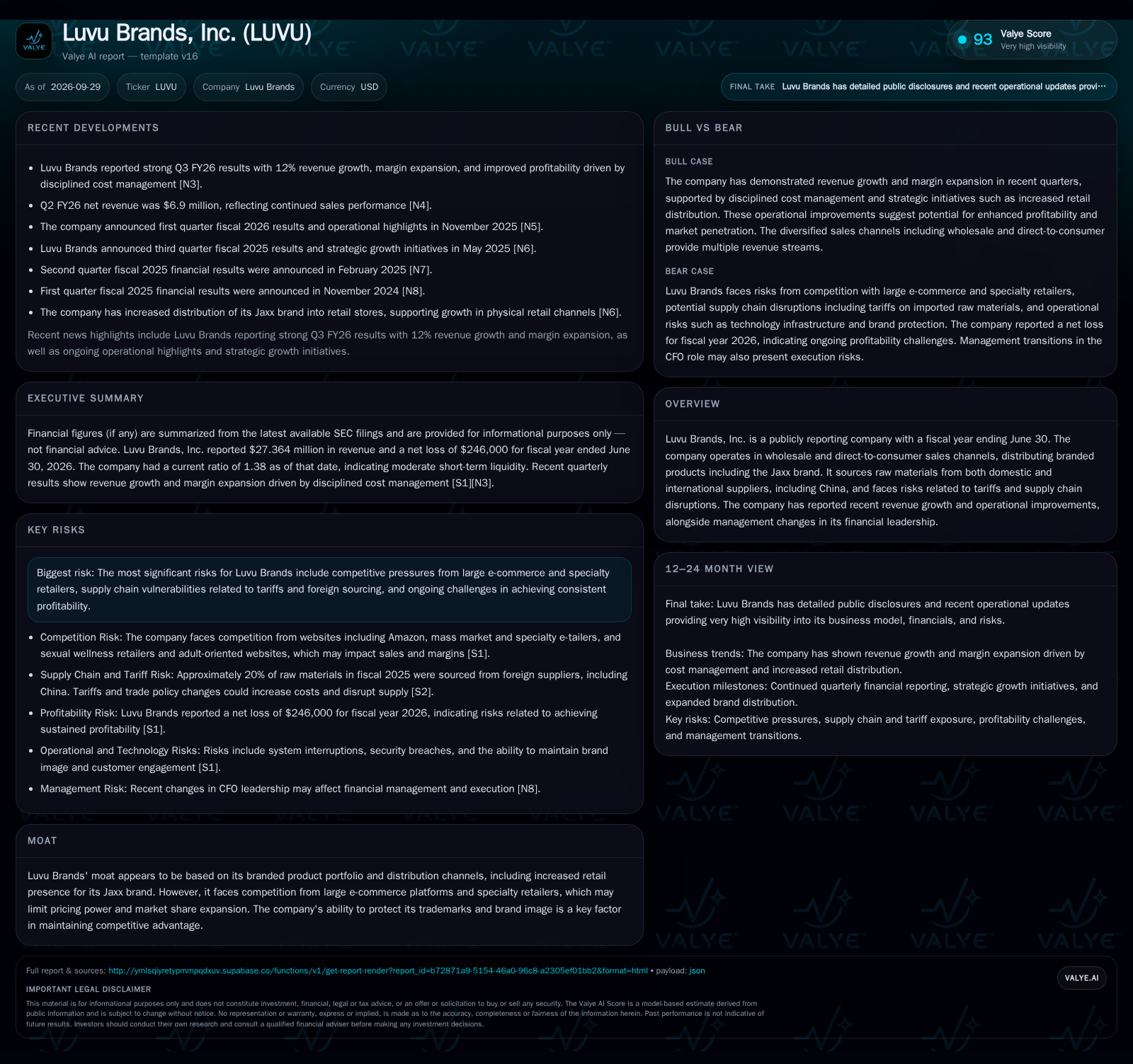
Luvu Brands reported $27.364 million in revenue and a net loss of $246,000 for FY26, with recent quarters showing double-digit revenue growth and margin expansion. The company is pushing its Jaxx brand into more retail stores and maintaining a current ratio of 1.38, but continues to face competition from both e-commerce giants and specialty retailers, as well as exposure to tariffs and supply chain disruptions. Sustained profitability remains elusive despite these operational improvements. [S1] [N3] [N6]
Luvu Brands, Inc. is navigating a crucial phase: recent operational improvements have driven revenue growth and margin gains, primarily through cost discipline and an expanded retail footprint for its Jaxx brand. Yet, the company’s net loss for FY26 underscores the difficulty of translating operational progress into lasting profitability. As Luvu Brands balances wholesale and direct-to-consumer sales against the backdrop of e-commerce competition and supply chain risk, the question becomes whether these recent gains can be sustained and amplified—or whether structural challenges will ultimately limit upside.
Recent Financial Results Signal Operational Progress but Persistent Losses
For the fiscal year ended June 30, 2026, Luvu Brands reported total revenue of $27.364 million alongside a net loss of $246,000, with basic and diluted EPS at $0. The company reported cash and liquidity metrics for the period; these figures do not by themselves establish operating runway, investment capacity, financial flexibility, or financing capacity. Notably, Q3 FY26 results showed 12% revenue growth and margin expansion, attributed to disciplined cost management. Additionally, Luvu Brands has expanded distribution of its Jaxx brand into retail stores, aiming to drive further top-line growth. However, despite these operational improvements, the company has not yet achieved sustained profitability, highlighting the ongoing tension between growth ambitions and margin pressures in a highly competitive sector. [S1] [N3] [N6]
Beyond headline revenue and net loss figures, a deeper analysis of working capital dynamics and cash flow generation would clarify the sustainability of Luvu Brands’ operational improvements. Furthermore, the timing and magnitude of capital expenditures related to retail expansion or technology investments will directly impact near-term profitability and cash runway, underscoring the importance of balancing growth initiatives with financial prudence.
Revenue Streams, Margin Structure, and the Challenge of Scaling Profitably
Luvu Brands’ business model blends wholesale and direct-to-consumer (DTC) channels, each with distinct economic profiles. Wholesale typically offers higher volume but lower gross margins, while DTC channels—especially e-commerce—can deliver richer margins but require significant investment in digital infrastructure, marketing, and customer support. The recent focus on expanding retail distribution for the Jaxx brand suggests an effort to capture higher-volume sales through established retail partners, potentially at the expense of some margin. Margin expansion in recent quarters points to effective cost controls, but the company’s net loss for the year highlights that either gross margins remain thin or fixed costs are still high relative to scale.
Supply chain complexity and tariff exposure further complicate the economic picture. With approximately 20% of raw materials sourced from foreign suppliers, including China, volatility in input costs and potential trade disruptions could erode margins or force price increases that dampen demand. [S1] [S2]
The interplay between channel mix and margin structure is critical to understanding Luvu Brands’ path to profitability. Wholesale channels, while generating volume, often require trade promotions and discounting that compress gross margins. In contrast, direct-to-consumer sales can command premium pricing but demand sustained marketing spend and customer acquisition costs. If the company can improve customer lifetime value through loyalty programs or repeat purchase rates in its DTC channel, it may justify upfront marketing investments by lowering overall customer acquisition cost over time. Additionally, supply chain strategies such as nearshoring or diversifying suppliers could mitigate tariff risks and input cost volatility, but might entail higher fixed costs or capital outlays that affect margin scalability.
Brand Portfolio and Retail Push Face E-Commerce and Specialty Retail Giants
Luvu Brands competes in a landscape dominated by large e-commerce players (such as Amazon) and specialized retailers, both online and brick-and-mortar. The company’s brand-driven approach, anchored by the Jaxx line, offers some differentiation, but these advantages are constrained by the scale and marketing power of larger competitors. While increasing retail presence can drive incremental sales and visibility, it also exposes Luvu Brands to the margin pressures and promotional intensity common in physical retail.
The dual-channel strategy (wholesale and DTC) provides some resilience against shifts in consumer behavior or retail partnerships, but also fragments focus and may dilute pricing power. Without clear evidence of proprietary technology, unique distribution advantages, or insurmountable brand loyalty, Luvu Brands’ moat appears modest and vulnerable to both price-based competition and imitation. Success will likely hinge on the company’s ability to build distinctive brand equity, defend against commoditization, and maintain favorable retail relationships.
Luvu Brands’ competitive positioning hinges not only on brand differentiation but also on its ability to navigate the evolving retail landscape. The shift toward omnichannel retailing requires seamless integration between online and offline customer experiences, inventory management, and fulfillment capabilities. Without proprietary technology or unique customer data analytics, Luvu Brands may struggle to optimize this integration, limiting its ability to compete effectively against larger players with advanced digital ecosystems. Moreover, the company’s reliance on retail partners introduces vulnerability to channel conflict and margin dilution through promotional demands. Strategic partnerships that align incentives and co-invest in marketing could strengthen these relationships, but require careful negotiation and ongoing collaboration.
Disciplined Execution and Retail Expansion Drive Sustainable Profitability
A favorable scenario for Luvu Brands would see the company leveraging its recent operational discipline and expanded retail distribution to achieve sustained revenue growth and positive net income. If margin expansion continues—possibly through further cost optimization, improved sourcing terms, or higher-margin DTC sales—the business could cross the threshold into consistent profitability. Retail partnerships for the Jaxx brand may unlock new customer segments and increase average order volumes, while DTC initiatives could support better data-driven marketing and customer retention.
Evidence supporting this scenario would include consecutive quarters of both top-line and bottom-line growth, upward-trending gross and operating margins, and clear indications that retail and online channels are growing without cannibalizing each other. Additional signals could be successful brand launches, increased retail footprint, or supply chain improvements that reduce input volatility.
Incremental Gains Amid Competitive and Operational Headwinds
The most plausible path is one of incremental progress: Luvu Brands grows revenue moderately through its blended channel approach and ongoing retail expansion, but faces persistent pressure on margins from competition, supply chain costs, and the need to invest in marketing and technology. Occasional quarterly profitability may be offset by periods of higher input costs or promotional spending.
This scenario would be confirmed by continued, but not accelerating, revenue growth; stable or slowly improving margins; and a pattern of small profits or losses quarter to quarter. Management stability and measured expansion of retail partnerships would support this outcome, while ongoing supply chain or competitive pressures could limit upside.
Competitive Pressures and Supply Chain Shocks Undermine Profitability
In a more adverse scenario, Luvu Brands faces intensified competition from e-commerce platforms and specialty retailers, leading to margin compression, customer attrition, or the need for deep promotional discounts. Simultaneously, supply chain disruptions—such as new tariffs or input shortages—could drive up costs, squeeze margins, and force the company to either absorb losses or pass costs onto price-sensitive consumers.
Management turnover, particularly in financial leadership, could further undermine execution and market confidence.
Milestones and Metrics That Will Define Luvu Brands’ Next Chapter
Quarterly trends in revenue growth and gross/operating margin expansion, especially in relation to retail expansion and cost management initiatives.
Net income trajectory and consistency—whether the company can deliver positive net income for multiple consecutive quarters.
The pace and impact of Jaxx brand retail distribution—number of new retail doors, velocity per door, and any evidence of brand-driven pricing power if disclosed.
The split of revenue and margin contribution between wholesale and direct-to-consumer channels, if disclosed, to assess the sustainability of margin improvements.
Updates on supply chain stability, sourcing diversification, and sensitivity to tariffs or input cost changes.
Stability and continuity in financial leadership, particularly in the CFO role, to support execution and long-term planning.
Disclaimer: This is research-only, informational analysis and not investment advice. It may include AI-generated interpretation and general industry context. Always verify important details using primary sources.

Comments