
Flag Ship Acquisition Corp: SPAC Viability Tested by Liquidity Strain and Regulatory Deadlines
Its ability to deliver shareholder value now hinges on executing a timely merger and preserving trust account integrity.
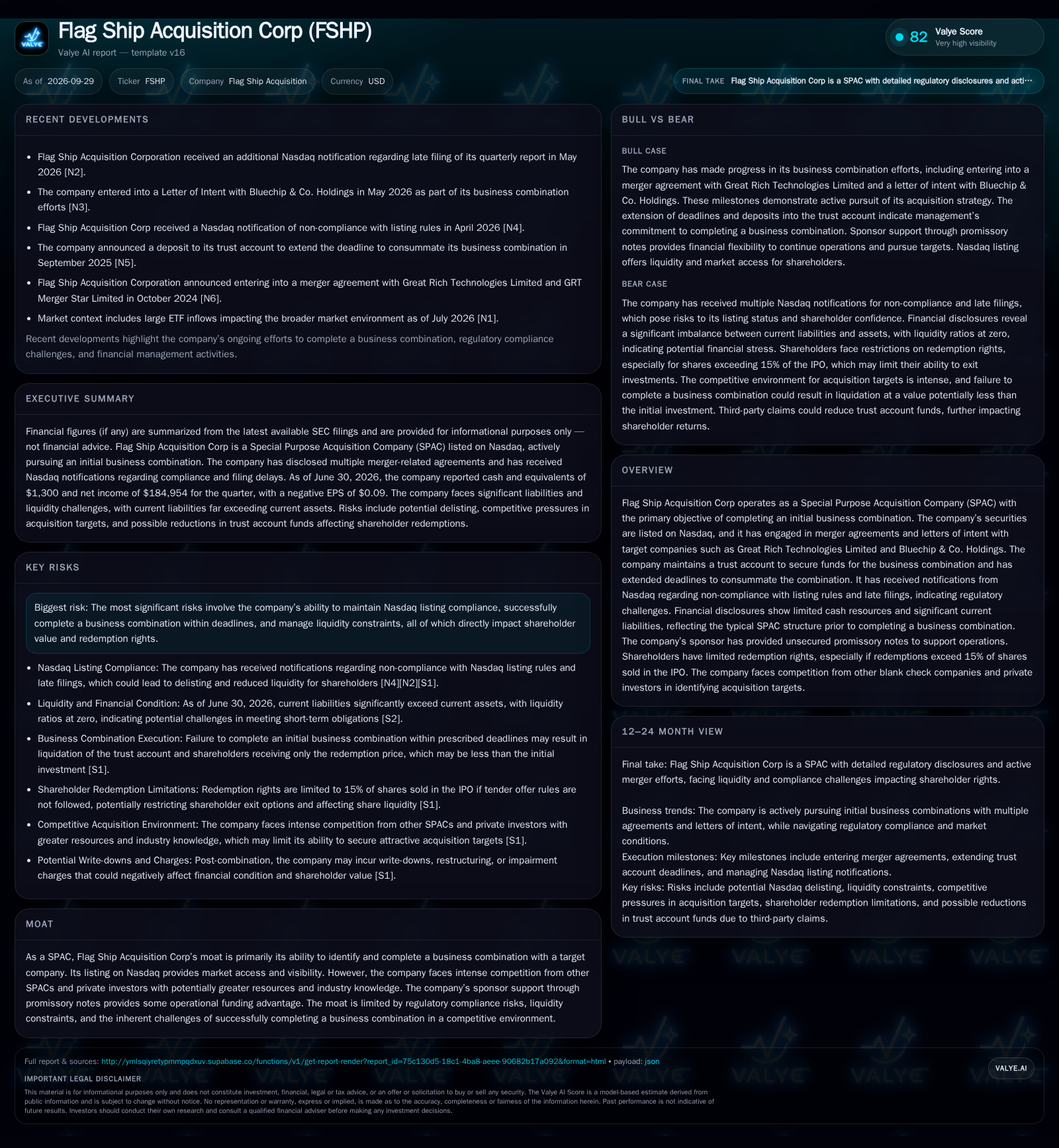
Flag Ship Acquisition Corp is a Nasdaq-listed SPAC under acute financial and regulatory pressure, with trust account extensions, merger negotiations, and sponsor funding efforts all in play. The company’s ability to avoid delisting and maximize shareholder redemptions is now tightly linked to closing a business combination before deadlines and managing third-party claims on trust assets. Execution risk is exacerbated by a highly competitive SPAC environment and structural redemption limitations for public shareholders. [S1] [S2] [N2] [N3] [N4] [N5] [N6]
Flag Ship Acquisition Corp, a blank-check company listed on Nasdaq, is racing against the clock and its balance sheet to secure a business combination that would deliver value to shareholders. With acute liquidity pressures—current liabilities vastly outstripping assets—and repeated regulatory warnings, the company’s survival as a listed SPAC now depends on timely execution of announced merger plans and careful management of trust account funds. The challenge is compounded by sector-wide competition for targets, structural redemption limitations, and the looming risk of Nasdaq delisting.
Acute Liquidity Pressure and Regulatory Deadlines Define the Current Moment
Flag Ship Acquisition Corp’s present situation is shaped by several high-stakes developments. First, the company’s balance sheet as of June 30, 2026, shows cash and equivalents of just $1,300 and current assets of $57,828, dwarfed by current liabilities of $18.8 million, resulting in a zero current and cash ratio—an acute liquidity crunch that is unsustainable without a transformative event. [S2] Second, the company has received multiple Nasdaq notifications for non-compliance with listing rules and late filings in 2026, escalating the risk of delisting, which would threaten shareholder liquidity and undermine the SPAC’s ability to close a business combination. [N2] [N4] Third, the company has signed a merger agreement with Great Rich Technologies Limited and a letter of intent with Bluechip & Co. Holdings, indicating active pursuit of a transaction before the extended deadline. [N3] [N6] Finally, the sponsor’s provision of unsecured promissory notes has kept operations afloat, but the fundamental imbalance between obligations and liquid assets leaves little margin for error. [S1]
SPAC Economics: Trust Account Mechanics and the Race Against Redemption
Flag Ship Acquisition Corp’s business model is typical of SPACs: it holds IPO proceeds in a trust account, which are only released upon completion of a qualifying business combination. Until then, the company generates negligible operating revenue—only interest or dividends from trust investments—while incurring costs to identify and negotiate with targets. [S1] [S2] The economics pivot on two levers: (1) the ability to secure a value-accretive merger before trust funds are eroded by redemptions, claims, or expenses, and (2) the preservation of listing status on Nasdaq, which is necessary both for the transaction and for shareholder liquidity.
Operating leverage is minimal pre-merger, as the company has few fixed assets or employees, but financial leverage is high due to sponsor loans and deferred underwriting costs. The trust account is both an asset and a constraint: it is shielded for public shareholders, but subject to third-party claims and potential reduction from restructuring or litigation. The company’s reported net income for the quarter is not operationally meaningful, as it is driven by financial accounting rather than core business activity. [S2] Capital needs are typically modest for ongoing SPAC operations, but become acute if a deal is not completed and trust funds are depleted by claims or extensions.
Competing for Targets in a Crowded SPAC Landscape
Flag Ship Acquisition Corp faces intense competition from other SPACs and private equity investors in identifying and securing attractive acquisition targets. [S1] In recent years, the proliferation of SPACs has saturated the market, driving up valuations for potential targets and compressing the window to strike deals before trust expiration. Larger or more specialized SPACs may offer superior industry expertise, sponsor support, or post-merger capital, making them more attractive to target companies.
The company’s Nasdaq listing theoretically provides credibility and liquidity, but repeated non-compliance notifications undermine this advantage. Sponsor support via unsecured promissory notes offers some operational continuity, but does not differentiate FSHP meaningfully in a market where sponsor backstops, PIPEs, and reputation are increasingly important. The risk: if FSHP cannot demonstrate certainty of close or superior value to targets, it will be outcompeted by better-capitalized or more agile acquirers.
Value Creation If a Merger Closes Before Deadline and Trust Integrity Is Preserved
The most constructive scenario for Flag Ship Acquisition Corp is a timely completion of a business combination with either Great Rich Technologies Limited or Bluechip & Co. Holdings, before further erosion of trust assets or a Nasdaq delisting event. If the merger closes and public shareholders retain access to the trust account at or near the $10.00 per share level, value could be realized through: (1) minimal dilution from redemptions, (2) a compelling target with growth prospects, and (3) the maintenance of listing status, supporting post-merger trading liquidity.
Evidence that would confirm this scenario includes a definitive merger agreement with detailed terms, a successful shareholder vote or tender offer with limited redemptions, and SEC/Nasdaq clearance for continued listing. Further, target company fundamentals that justify the implied valuation and a clear post-merger capital plan would be necessary to sustain value. A low level of third-party claims on trust assets and minimal restructuring charges would also support the upside case.
Execution Pressures Yield a Highly Dilutive or Marginal Outcome for Shareholders
The most plausible outcome, given current facts, is that Flag Ship Acquisition Corp faces continued execution pressure, and if a business combination is completed, it is likely to be under less-than-ideal terms. High redemption rates—driven by shareholder anxiety over liquidity and delisting risk—could leave the post-merger company with limited cash and a volatile trading debut. Listing compliance may be restored temporarily if a deal closes, but ongoing reporting and governance challenges could persist.
Confirmation of this scenario would be a merger announcement with a high percentage of public shares redeemed, material reductions in trust account value from claims or expenses, and a post-combination company with limited capital for growth. Falsification would require evidence of robust shareholder participation, low redemptions, and a well-capitalized, credible target company with clear growth prospects.
Failure to Close a Deal Triggers Liquidation and Potential Trust Shortfall
If Flag Ship Acquisition Corp fails to complete a business combination within the prescribed deadlines, it will be forced to liquidate, returning only the remaining trust account funds to public shareholders. This downside is amplified by the risk that third-party claims, restructuring charges, or regulatory penalties further reduce the redemption amount below the nominal $10.00 per share. [S1]
Supporting evidence for this scenario would include continued Nasdaq non-compliance, missed SEC filing deadlines, an absence of definitive merger agreements, and escalating legal or vendor claims on trust assets. A notice of delisting or a formal liquidation announcement would confirm the downside pathway.
Milestones That Will Determine Shareholder Outcomes for Flag Ship Acquisition
Shareholder approval or completion of a definitive merger agreement, including disclosure of transaction terms and anticipated post-merger capital structure.
Nasdaq compliance updates—specifically, whether the company regains and maintains listing status through timely filings and governance improvements.
Level of public shareholder redemptions in connection with any approved business combination (if disclosed), as high redemptions will impact post-merger capitalization and trading liquidity.
Trust account balance and any material deductions due to claims, restructuring charges, or regulatory actions, as these directly affect redemption value.
Details on sponsor or third-party funding arrangements, including additional backstops, PIPE commitments, or new promissory notes (if disclosed).
Progress updates on regulatory clearance for the proposed merger, including SEC and Nasdaq feedback or approval.
Material litigation or third-party claims that could impair the trust account or delay transaction timelines.
Disclosure of any amendments to shareholder redemption limitations or changes to trust account protection mechanisms.
Disclaimer: This is research-only, informational analysis and not investment advice. It may include AI-generated interpretation and general industry context. Always verify important details using primary sources.

Comments