
Cal-Maine Foods: Price Fluctuations, Disease Impact, and Growth Prospects in Specialty Eggs and Prepared Foods
After a sharp decline in conventional egg prices and a substantial operating loss, Cal-Maine Foods faces a pivotal period of integration and repositioning.
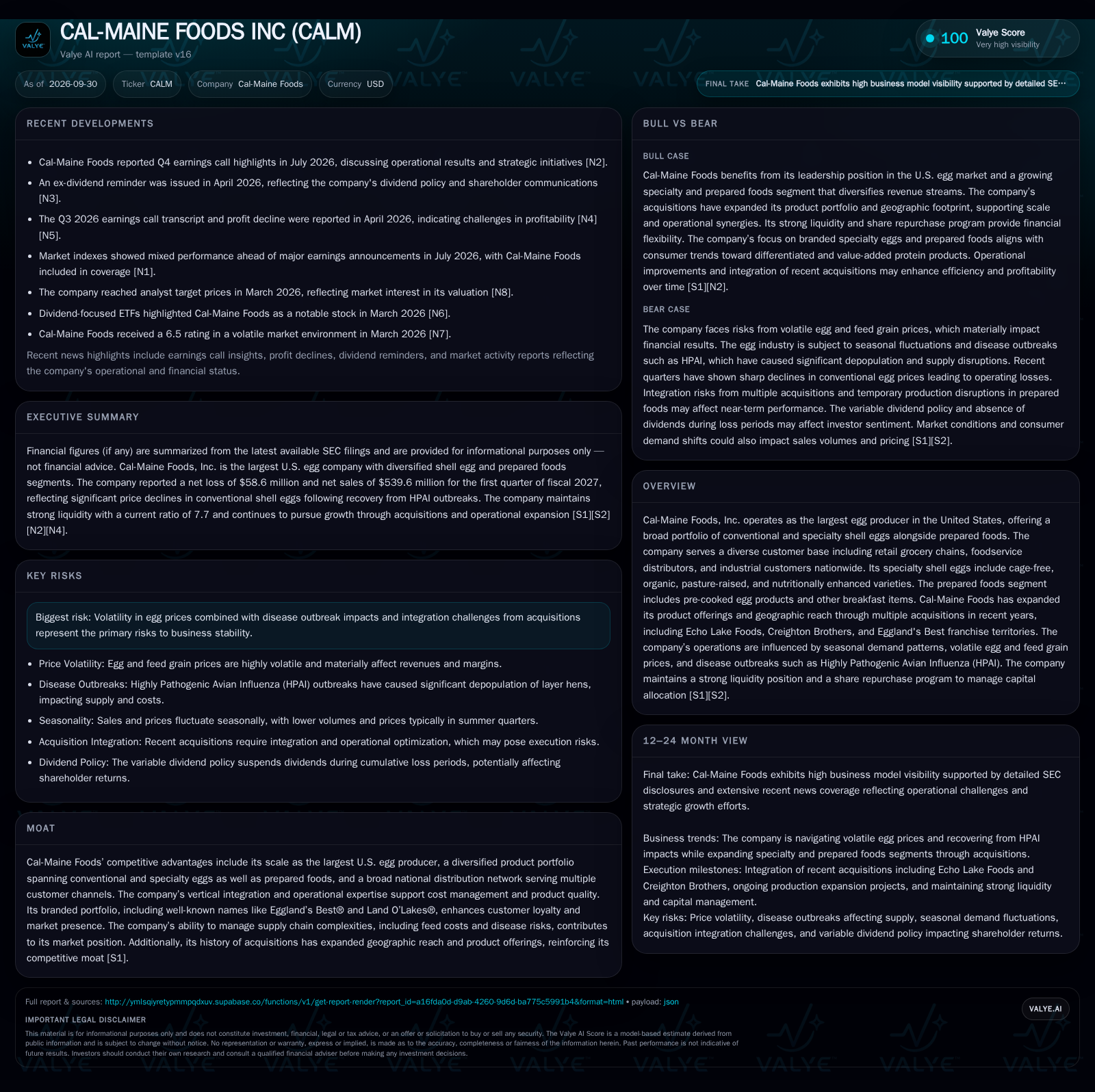
Cal-Maine Foods, the largest U.S. egg producer, saw Q1 FY27 net sales drop 41.5% year over year as the egg market corrected from HPAI-driven shortages, resulting in a $58.6 million net loss. The company’s diversified portfolio and recent acquisitions offer potential for margin recovery, but execution and market volatility remain central risks. Reported liquidity position, with $113.5 million in cash and a current ratio of 7.7 as of August 2026. Integration of new businesses and the ramp-up of prepared foods will be key factors in the coming quarters. [S1] [S2]
Cal-Maine Foods, the nation’s largest egg producer, is at a crossroads after a dramatic swing in egg market conditions. The rapid recovery in layer hen populations following avian flu outbreaks led to a 59% plunge in conventional shell egg prices and a consequential $58.6 million net loss in the first quarter of fiscal 2027. With a sizable cash reserve and a diversified product and brand portfolio, Cal-Maine is banking on specialty eggs and prepared foods—bolstered by recent acquisitions—to stabilize earnings and reduce exposure to commodity cycles. The question is whether the company’s scale, integration discipline, and brand strength can offset the structural volatility inherent to its core markets. [S2]
Operating Losses and Market Adjustments Define the 2026-2027 Landscape
Cal-Maine Foods reported net sales of $539.6 million and a net loss of $58.6 million in the first quarter of fiscal 2027, marking a 41.5% year-over-year sales decline. This reversal was driven primarily by a 59.3% drop in conventional shell egg prices as the U.S. layer hen population rebounded from prior HPAI outbreaks. The company shifted from a $249.2 million operating profit in the prior-year quarter to an $82.2 million operating loss. In parallel, prepared foods—now 11.7% of sales—faced temporary production dips amid expansion projects. The company reported cash and liquidity metrics for the period; these figures do not by themselves establish operating runway, investment capacity, financial flexibility, or financing capacity. The company also has $320.7 million remaining in its share repurchase authorization, providing some capital allocation flexibility. [S2]
Volatility in Egg Prices and Inputs Challenges Diversification Economics
Cal-Maine’s core economics are defined by exposure to highly variable wholesale egg prices and feed grain costs, both of which can swing rapidly with supply shocks and commodity cycles. Roughly half of conventional shell egg sales are indexed to spot market prices, leaving the company acutely sensitive to both surges and collapses in egg pricing. The remainder, along with most specialty egg sales, are under hybrid or cost-plus arrangements, providing some earnings stability but still subject to broader market trends.
Specialty eggs—such as cage-free, organic, and pasture-raised—tend to command higher and more stable margins, especially when priced on a cost-plus basis. Expansion into prepared foods (e.g., pre-cooked eggs, breakfast items) introduces a more value-added, less commodity-driven revenue stream, but also requires upfront capital and integration spend. In the near term, operating leverage cuts both ways: sharp price declines can rapidly turn fixed costs into losses, while successful ramp-up of specialty and prepared foods could restore margin resilience. The company's liquidity position helps buffer near-term volatility, but sustained profitability will depend on the speed and effectiveness of portfolio diversification and cost management.
Fragmented Market Dynamics: Scale, Brand Range, and Vertical Integration
Cal-Maine’s scale as the largest U.S. egg producer offers benefits in procurement, distribution, and supply chain management. Its broad product and brand portfolio (including Eggland’s Best®, Land O’Lakes®, and Van’s®) provides access to both mass-market and premium consumer segments. Vertical integration supports cost control and quality assurance but also means the company bears the brunt of fixed costs during downturns.
Competition remains intense among national and regional egg producers, especially as consumer preferences shift toward specialty and value-added products. Retailers and foodservice buyers exert significant bargaining power, often favoring the lowest-cost, most reliable suppliers. Substitution risk from other protein sources or plant-based alternatives is modest but growing, especially in the premium segment. The key competitive lever is the ability to maintain supply reliability, product innovation, and brand loyalty while absorbing input cost shocks and integrating acquired operations.
Specialty and Prepared Foods Drive Potential Margin Improvement
A favorable outcome for Cal-Maine would see the successful integration of recent acquisitions—such as Echo Lake Foods and Eggland’s Best® franchise territories—driving scale advantages and product mix improvements. If the company can grow its specialty egg and prepared foods segments to a larger share of total sales, and these segments deliver more stable and attractive margins, operating results could recover even amid continued volatility in conventional egg prices.
Confirmation of this scenario would include: sustained growth in specialty and prepared foods revenue, improving segment margins, evidence that recent acquisitions are delivering cost or revenue synergies, and a return to positive net income. A decline in the proportion of total sales tied to spot egg prices, and improved operating leverage as fixed costs are spread over a broader, higher-value product base, would further support the bull thesis.
Cyclical Volatility and Integration Execution Shape Core Performance
The most plausible trajectory is that Cal-Maine continues to experience significant quarter-to-quarter volatility driven by egg and feed prices, but gradually benefits from a more diversified revenue base as specialty and prepared foods expand.
Evidence supporting this scenario would include stabilization of conventional egg prices, moderate but steady growth in specialty and prepared foods, and incremental improvements in operating margin. Conversely, if integration drags on or cost overruns persist, margin recovery could be delayed. The base case does not assume a rapid return to previous profit highs, but rather a slow normalization as recent investments begin to pay off.
Extended Price Downturns and Integration Challenges Threaten Profitability
A more adverse scenario would involve continued weakness in conventional egg prices, possibly exacerbated by overproduction or muted demand. If integration of acquired businesses proves more costly or disruptive than anticipated—leading to sustained production inefficiencies or customer attrition—the company could experience prolonged operating losses.
This scenario would be confirmed by ongoing negative net income, persistent declines in gross margin, and evidence of integration setbacks (such as missed synergy targets or recurring production delays). Additional outbreaks of avian influenza or renewed input cost spikes could further pressure results, while any erosion of liquidity or reductions in the share repurchase authorization would indicate increased financial strain.
Assessing Cal-Maine’s Progress on Diversification and Margin Enhancement
Quarterly revenue and margin growth in specialty shell eggs and prepared foods, especially as a percentage of total sales, would help validate the diversification thesis.
Operating margin trends, including gross margin recovery or further compression, will indicate the effectiveness of cost management and integration.
Updates on the pace, cost, and operational impact of integrating Echo Lake Foods, Van’s Foods, and other recent acquisitions would clarify execution risk.
If disclosed, customer retention rates and new account wins in both retail and foodservice channels would signal market acceptance of the expanded portfolio.
The proportion of sales under market-based versus cost-plus or hybrid pricing structures would reveal exposure to future commodity swings.
Incidence and business impact of any further Highly Pathogenic Avian Influenza (HPAI) outbreaks will remain a critical external variable.
Liquidity movements—such as significant changes in cash balance, current ratio, or share repurchase activity—would signal evolving capital allocation priorities.
Production uptime and efficiency metrics in the prepared foods segment, if disclosed, would test the success of expansion and integration efforts.
Disclaimer: This is research-only, informational analysis and not investment advice. It may include AI-generated interpretation and general industry context. Always verify important details using primary sources.

Comments