
Laredo Oil’s Enhanced Recovery Ambitions Collide with Persistent Financial and Operational Hurdles
Laredo Oil, Inc.
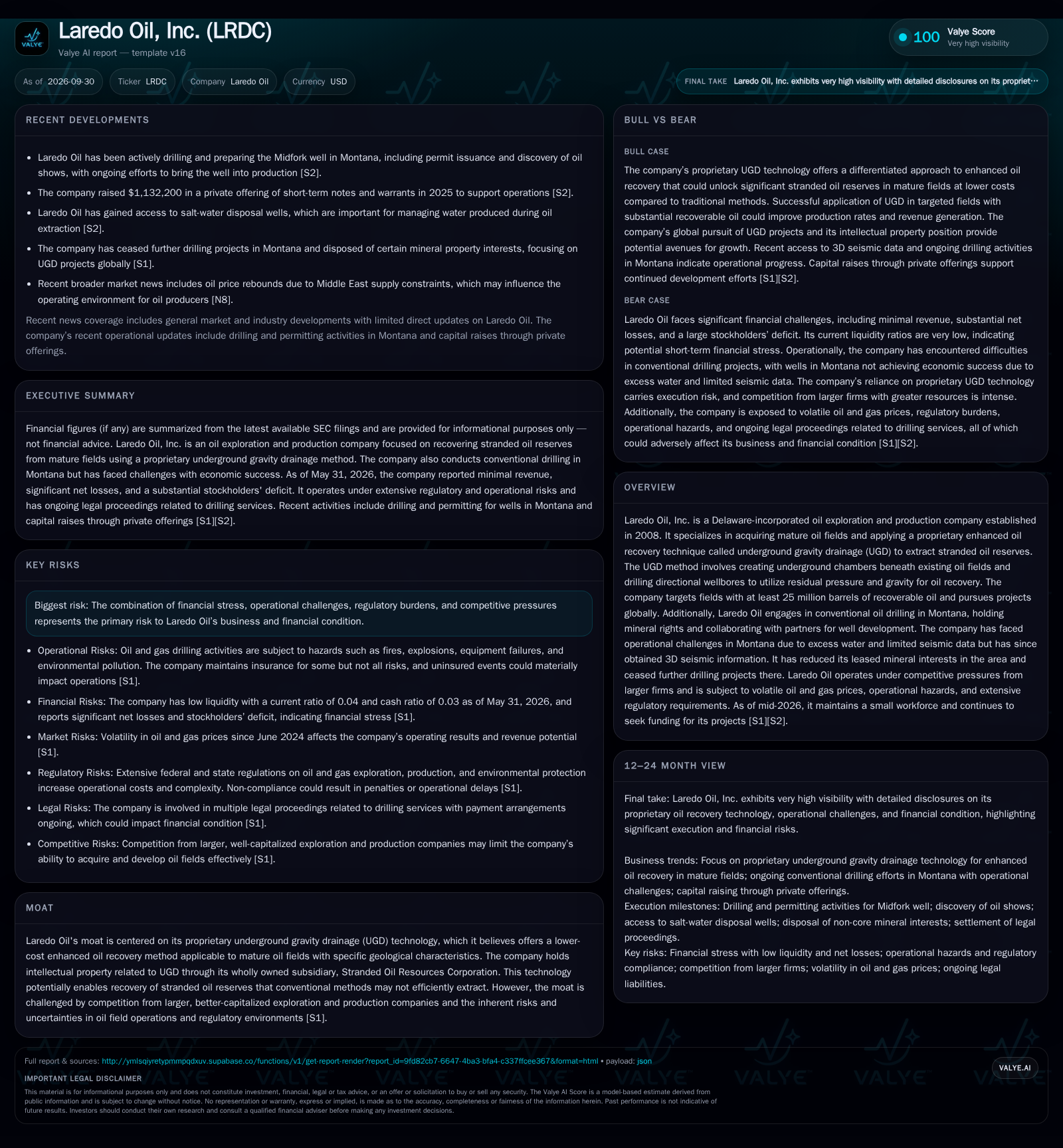
Laredo Oil, Inc. targets stranded reserves in mature oil fields using its proprietary underground gravity drainage (UGD) technology, aiming to recover oil at lower costs than conventional enhanced oil recovery methods. Despite recent drilling activity in Montana and capital raised through private offerings, the company’s financial condition is precarious, with minimal revenue, large net losses, and a severe current ratio shortfall. Competitive, regulatory, and operational hazards persist, and near-term viability depends on both successful demonstration of UGD and urgent financial stabilization. [S1] [S2]
Laredo Oil, Inc. is attempting to carve out a niche in the crowded oil exploration sector by leveraging proprietary underground gravity drainage (UGD) technology to recover oil left behind in mature fields. While the promise of extracting stranded reserves at a lower cost positions Laredo as a potential technology disrupter, its financials tell a story of acute stress: minimal revenue, deep losses, and a balance sheet under significant strain. Recent operational setbacks in Montana and the abandonment of non-core assets underscore the execution risk, while ongoing capital needs and legal entanglements heighten the pressure. [S1] [S2]
Latest Financial and Operational Updates Reshape Laredo Oil’s Immediate Outlook
As of May 31, 2026, Laredo Oil reported cash and cash equivalents of $420,676, current assets of $492,039, and current liabilities of $13,221,198—resulting in a current ratio of 0.04 and a cash ratio of 0.03. The company posted only $3,141 in revenue for the fiscal year and a net loss of $7,971,671, with a stockholders’ deficit of $14,235,368 as of February 2026. [S1] [S2]
Operationally, Laredo drilled five wells in Montana with Texakoma, but none were economically productive due to excess water and lack of 3D seismic data (recently acquired). Most leased mineral property interests have been abandoned, and the company exited its Hell Creek Crude LLC stake in late 2025. [S1]
Recent activity includes drilling and permitting for the Midfork well in Montana, with oil shows discovered and production preparation underway. The company also gained access to salt-water disposal wells, critical for managing water during extraction. [S2]
To support operations, Laredo raised $1,132,200 in a 2025 private offering of short-term notes and warrants. Legal proceedings related to drilling services in Montana remain ongoing, with payment arrangements in place. [S2]
Economic Model: Enhanced Recovery Potential Versus Capital and Cost Pressures
Laredo Oil’s core economics center on its proprietary underground gravity drainage (UGD) technology, which aims to recover stranded oil from mature fields by leveraging gravity and residual reservoir pressure. Theoretically, UGD could unlock reserves at a lower cost per barrel than conventional enhanced oil recovery (EOR) methods, potentially extending the life and profitability of fields that larger players might overlook. If successful, this would create a margin advantage by reducing variable extraction costs and extending asset utility.
However, the capital outlay required for UGD implementation is substantial, involving underground chamber construction and directional drilling—both capital-intensive and operationally complex, especially for a company with reported liquidity position. Laredo’s current financial position constrains its ability to scale UGD projects or absorb lengthy development timelines, making it highly sensitive to execution delays or cost overruns.
Conventional drilling in Montana, while less capital-intensive, has so far failed to generate positive returns, highlighting the risk of sunk costs and low probability of near-term cash flow from this segment. With minimal revenue and persistent net losses, the company’s business model is fundamentally unproven at commercial scale, and continued dependence on external financing is likely unless a UGD project demonstrates sustained, profitable production.
Differentiation and Disadvantages in a Crowded Energy Sector
Laredo’s moat is rooted in its UGD intellectual property, which, if validated, could give it a proprietary edge in extracting oil from mature fields that conventional EOR methods leave behind. This technology focus targets a niche often neglected by larger firms, who may prioritize new field development or large-scale tertiary recovery.
Nonetheless, Laredo faces formidable competition from major exploration and production companies with greater capital, technical resources, and established operating footprints. These incumbents can more easily absorb regulatory costs, weather commodity price swings, and outcompete on acquisition of promising acreage.
There is also the risk of technology substitution: should alternative EOR innovations or digital reservoir management tools gain traction, Laredo’s UGD may lose its relative advantage. Moreover, the company’s small workforce and limited operational track record restrict its capacity to execute multiple projects simultaneously, making it vulnerable to being outpaced or outbid in competitive asset markets.
Breakthrough Validation: What Would It Take for UGD to Transform Laredo’s Fortunes?
The most optimistic scenario envisions Laredo Oil successfully deploying UGD technology in a mature field with at least 25 million barrels of recoverable oil, demonstrably lowering extraction costs and achieving sustained commercial-scale production. Such a breakthrough would likely unlock new revenue streams, improve margins, and attract strategic partners or acquirers interested in scaling the technology globally.
Key confirming evidence would include: (a) documented production rates and recovery factors from a UGD-equipped field that exceed conventional EOR benchmarks; (b) new field development or licensing agreements with larger industry players; (c) a step-change in quarterly revenue and operating cash flow directly attributable to UGD operations; and (d) successful, non-dilutive capital raises or strategic investments predicated on operational results.
Falsification would occur if UGD pilot projects fail to deliver commercial production, if cost overruns erode the promised margin advantage, or if there is no traction with industry partners or customers after technical demonstration.
Incremental Progress Amid Persistent Liquidity and Execution Strains
The most plausible path for Laredo Oil over the next 12–24 months involves incremental advances rather than a rapid turnaround. The company may continue limited drilling and production efforts in Montana, leveraging new 3D seismic data to reduce dry hole risk, while simultaneously seeking to pilot UGD in a promising field—if sufficient funding can be secured.
Progress would likely be uneven: sporadic operational milestones (such as first oil from Midfork) could generate modest revenue, but are unlikely to offset ongoing cash burn or the need for further capital raises. Regulatory compliance costs, legal settlements, and commodity price volatility will continue to weigh on results.
Downside evidence would include continued revenue stagnation, inability to fund UGD pilots, or further asset disposals out of necessity rather than strategic focus.
Failure to Demonstrate Commercial Viability Triggers Asset Liquidation or Restructuring
In the adverse scenario, Laredo is unable to demonstrate commercial-scale UGD success or generate meaningful revenue from Montana conventional wells.
Confirming signals would include: (a) announcements of further asset abandonments or sales at distressed valuations; (b) the inability to raise new funding despite repeated attempts; (c) escalation of legal or regulatory liabilities; and (d) public disclosure of going concern uncertainties or bankruptcy proceedings.
Falsification would require clear evidence of new funding sufficient to support operations through at least one full development cycle, or a sudden, material improvement in field productivity that drives sustainable operating cash flow.
Milestones That Will Determine If Laredo Oil’s UGD Bet Can Deliver
Quarterly production rates and realized pricing from any field where UGD is deployed—if disclosed—would directly test the technology’s commercial viability.
Updates on the Midfork well in Montana, including production start, initial flow rates, and water cut, will illuminate whether recent drilling can reverse the trend of uneconomic outcomes.
Evidence of new licensing or joint development agreements for UGD technology with larger industry players would indicate external validation and scale-up potential.
Disclosure of additional capital raises, especially non-dilutive or strategic investments, will be critical for near-term solvency and the ability to fund UGD pilots.
Settlements or material developments in ongoing legal proceedings related to drilling services could affect both cash flow and operational focus.
Regulatory filings or management commentary regarding going concern risks, restructuring, or asset impairments will serve as early warnings for financial distress.
Disclaimer: This is research-only, informational analysis and not investment advice. It may include AI-generated interpretation and general industry context. Always verify important details using primary sources.

Comments