
CarMax at a Crossroads: Navigating Used Vehicle Volatility, Scale Advantages,
CarMax’s latest quarter demonstrates robust revenue and positive net income, yet the company’s reported cash balance highlight the need for disciplined operational execution amid macroeconomic uncertainty. As competitive pressures mount and consumer dynamics shift, CarMax’s ability to leverage its scale, brand, and service diversification could determine whether it sustains its leadership in the evolving used-vehicle market.
The company’s scale, brand recognition, and integrated offerings remain core advantages, but exposure to swings in used vehicle demand and pricing, as well as the need for precise inventory and cost management, pose meaningful risks to future performance. How well CarMax adapts its operations and capital structure to these dynamics will shape its trajectory over the next several quarters. [S2]
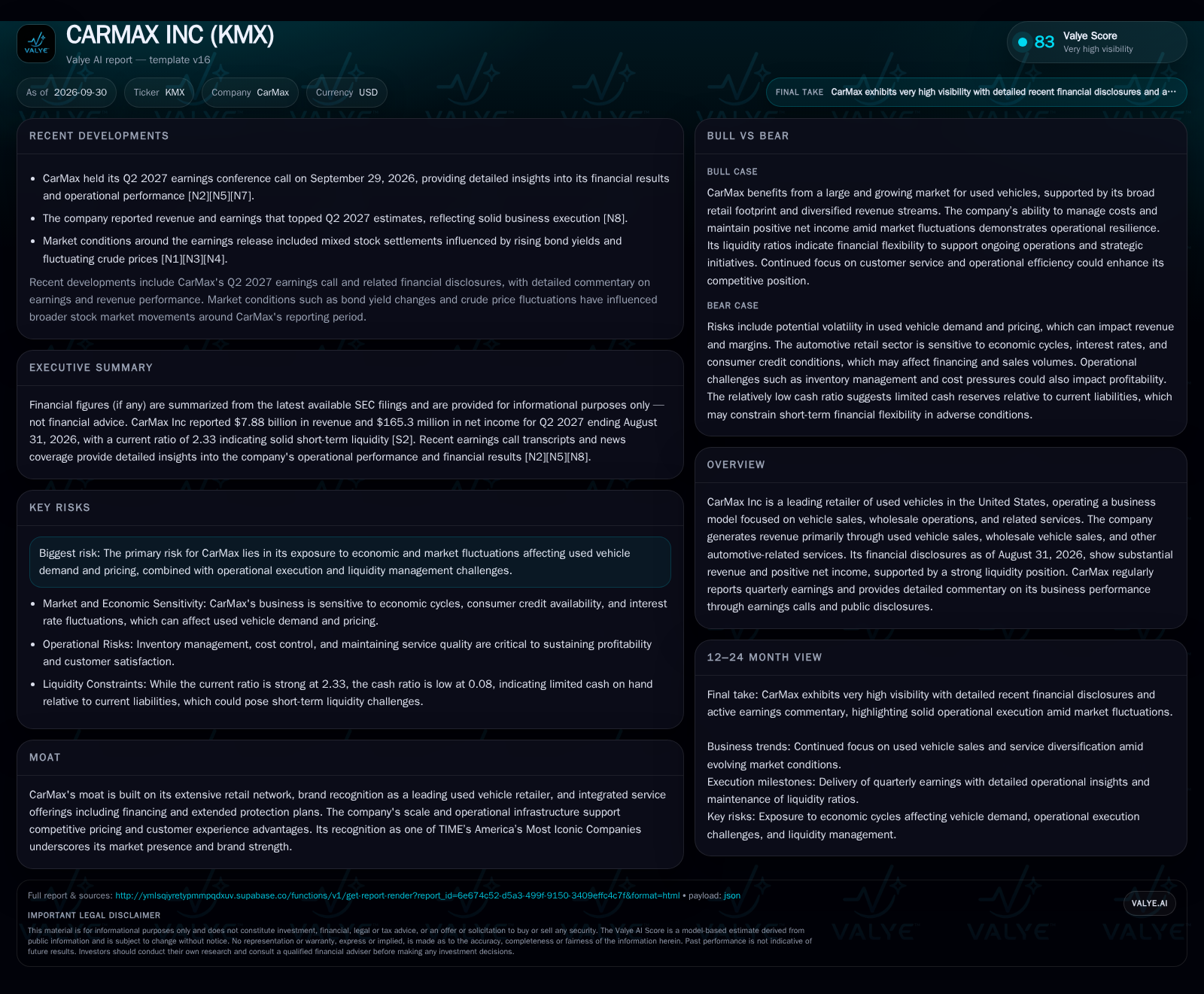
CarMax’s recent financials underline both the durability and the complexity of its operating model. With $7.88 billion in revenue and $165.3 million in net income for the quarter ended August 31, 2026, the company remains a heavyweight in the used vehicle retail market. As digital and traditional competitors vie for share in a shifting automotive landscape, CarMax’s next moves will be critical in determining whether its scale and brand can translate into sustained advantage.
Latest Quarter Underscores Profitability and Liquidity Tension
CarMax reported $7.88 billion in revenue and $165.3 million in net income for the quarter ended August 31, 2026, with basic and diluted EPS of $1.16. These figures highlight the company’s ability to generate substantial sales and maintain profitability in the face of ongoing macroeconomic uncertainty. However, the cash ratio is 0.08, reflecting that just a small fraction of those assets is held in cash or cash equivalents. This combination signals that while CarMax is not immediately at risk of a liquidity crunch, it remains operationally dependent on inventory turnover and receivables collection to meet near-term obligations. The company’s recognition as one of TIME’s America’s Most Iconic Companies in early 2026 further strengthens its brand profile, but does not directly mitigate financial or operational risks. [S2]
How Scale Drives Cash Flow—and Where Leverage Cuts Both Ways
CarMax’s business model is anchored in high-volume, low-margin used vehicle retailing, supplemented by wholesale vehicle sales and ancillary services such as financing, extended warranties, and repairs. The company’s gross profit per unit is sensitive to shifts in used car pricing, which can be volatile due to supply-demand mismatches, macroeconomic shocks, and changing consumer preferences. At scale, CarMax benefits from procurement efficiencies, distribution network leverage, and more favorable terms with lenders and service partners.
Operating leverage is significant: fixed costs tied to retail locations, logistics, and technology infrastructure mean that incremental volume can drive disproportionately higher profitability when demand is strong. Conversely, if volumes soften or pricing deteriorates, margin compression can be swift. Capital requirements are substantial, as inventory acquisition, reconditioning, and floorplan financing all demand significant ongoing investment. If credit tightens or used vehicle values fall, CarMax could face a working capital squeeze.
The interplay between scale and leverage also influences CarMax's strategic flexibility. While scale enables negotiation power with suppliers and lenders, it can simultaneously constrain rapid shifts in operational focus due to the inertia of a large, established infrastructure. For instance, adjusting inventory levels or reallocating capital toward digital initiatives may require overcoming legacy processes and fixed cost commitments. Moreover, the capital-intensive nature of the business means that any misjudgment in demand forecasting can lead to excess inventory, which not only ties up cash but also risks accelerated depreciation and markdowns. Therefore, CarMax’s management must balance the benefits of scale economies with the agility needed to respond to market fluctuations efficiently.
Scale, Brand, and Service Breadth as Differentiators—But Digital Threats Loom
CarMax’s moat is rooted in its nationwide retail footprint, brand recognition, and vertically integrated service offerings—including in-house financing and extended protection plans. These advantages allow CarMax to offer a streamlined, ‘one-stop’ used car buying experience, which historically has supported customer trust and repeat business. Its operational infrastructure and purchasing power can translate into competitive pricing and inventory breadth unavailable to smaller rivals.
However, the competitive landscape is evolving. Pure-play digital used car retailers, traditional franchise dealers, local independents, and emerging online marketplaces all compete for share. Digital-first competitors can offer lower overhead, more dynamic pricing, and frictionless online experiences. If convenience, price transparency, and digital integration become decisive for consumers, CarMax’s physical footprint could become a relative disadvantage unless it rapidly evolves its omnichannel capabilities. The company’s recognized brand may help defend share, but is not immune to disruption from more agile or innovative entrants.
In addition to competitive pressures from digital entrants, CarMax faces evolving consumer expectations around transparency and convenience that challenge traditional retail models. The company's integrated service offerings provide a competitive moat, yet these services must continuously innovate to match or exceed the seamless experiences offered by digital-native competitors. For example, the ability to provide real-time inventory visibility, instant financing approvals, and contactless transactions could become baseline customer expectations. Failure to integrate these capabilities effectively risks eroding customer loyalty and market share, particularly among younger, digitally savvy buyers. Conversely, leveraging proprietary data from its large customer base could enable CarMax to personalize offerings and optimize pricing dynamically, reinforcing its competitive position if executed well.
Volume Recovery and Digital Integration Could Unlock Margin Expansion
A favorable scenario sees macroeconomic stabilization, easing interest rates, and improved consumer sentiment driving a rebound in used vehicle demand. If CarMax leverages its scale to secure inventory at attractive prices, optimizes reconditioning costs, and further digitizes its sales and service channels, it could boost both volumes and per-unit profitability. Enhanced digital integration—such as seamless online purchasing, remote appraisals, and streamlined financing—would appeal to changing consumer expectations and potentially expand the company’s addressable market.
Evidence that would confirm this scenario includes sustained growth in unit sales, improvements in gross profit per vehicle, and expansion of digital transaction share. Faster inventory turnover, higher finance penetration rates, and stable-to-expanding margins would also support the upside thesis. Conversely, if unit economics stagnate or digital adoption lags, the scenario would be called into question.
Managing Through Cyclicality: Stable Volumes, Tight Margins, Incremental Digital Gains
The most plausible near-term outcome is one of cautious operational discipline amid continued economic and industry volatility. Used vehicle demand may remain choppy, with CarMax maintaining volumes through aggressive pricing, targeted marketing, and incremental digital enhancements. Margins could stay compressed as inventory acquisition costs remain stubbornly high and consumer affordability is pressured by still-elevated interest rates.
In this scenario, CarMax’s scale and brand recognition help preserve market share, but operating leverage works both ways—profitability remains positive but below historical peaks. Digital initiatives show gradual customer uptake, but do not fundamentally transform the cost structure or sales mix. Evidence supporting this view would include steady unit sales, relatively flat gross margin per vehicle, and modest growth in digital-enabled transactions. Deterioration in inventory days or spikes in discounting would challenge the base case.
Liquidity Stress and Demand Shock: Where the Model Gets Exposed
Slower inventory turnover would tie up capital, potentially forcing markdowns and eroding margins. If credit markets seize, both customer financing and CarMax’s own floorplan borrowing could become more expensive or less available, compounding liquidity pressure.
Signs of this scenario playing out would include a spike in inventory days outstanding, negative cash flow from operations, increased reliance on short-term borrowing, or downward revisions to earnings guidance. Any evidence of distress financing, covenant breaches, or asset sales to raise cash would further confirm the downside.
Testing the CarMax Thesis: Concrete Evidence to Track in the Coming Quarters
Quarterly unit sales growth and gross profit per vehicle, if disclosed, as signals of demand strength and pricing power.
Trends in inventory days outstanding and turnover velocity, which would highlight the company’s ability to manage working capital and avoid markdowns.
Digital transaction share and online customer engagement metrics, as indicators of progress in omnichannel transformation.
Finance penetration rates and credit approval trends, given the importance of consumer lending to overall sales volume.
Operating cash flow and changes in net working capital, to assess liquidity health beyond static balance-sheet metrics.
Any new or expanded credit facilities, refinancing activity, or changes in borrowing costs, which would signal evolving liquidity risk.
Management commentary on macroeconomic outlook, inventory strategy, and digital initiatives from future earnings calls.
Disclaimer: This is research-only, informational analysis and not investment advice. It may include AI-generated interpretation and general industry context. Always verify important details using primary sources.

Comments