
Haoxi Health Technology: Marketing Innovation in Medical Aesthetics Faces Profitability and Competitive Pressures
Haoxi Health Technology Ltd has carved out a niche in the medical aesthetics sector with customized livestreaming marketing solutions, but ongoing net losses and limited transparency about its commercial mechanics raise questions about the durability of its business model as competition intensifies.
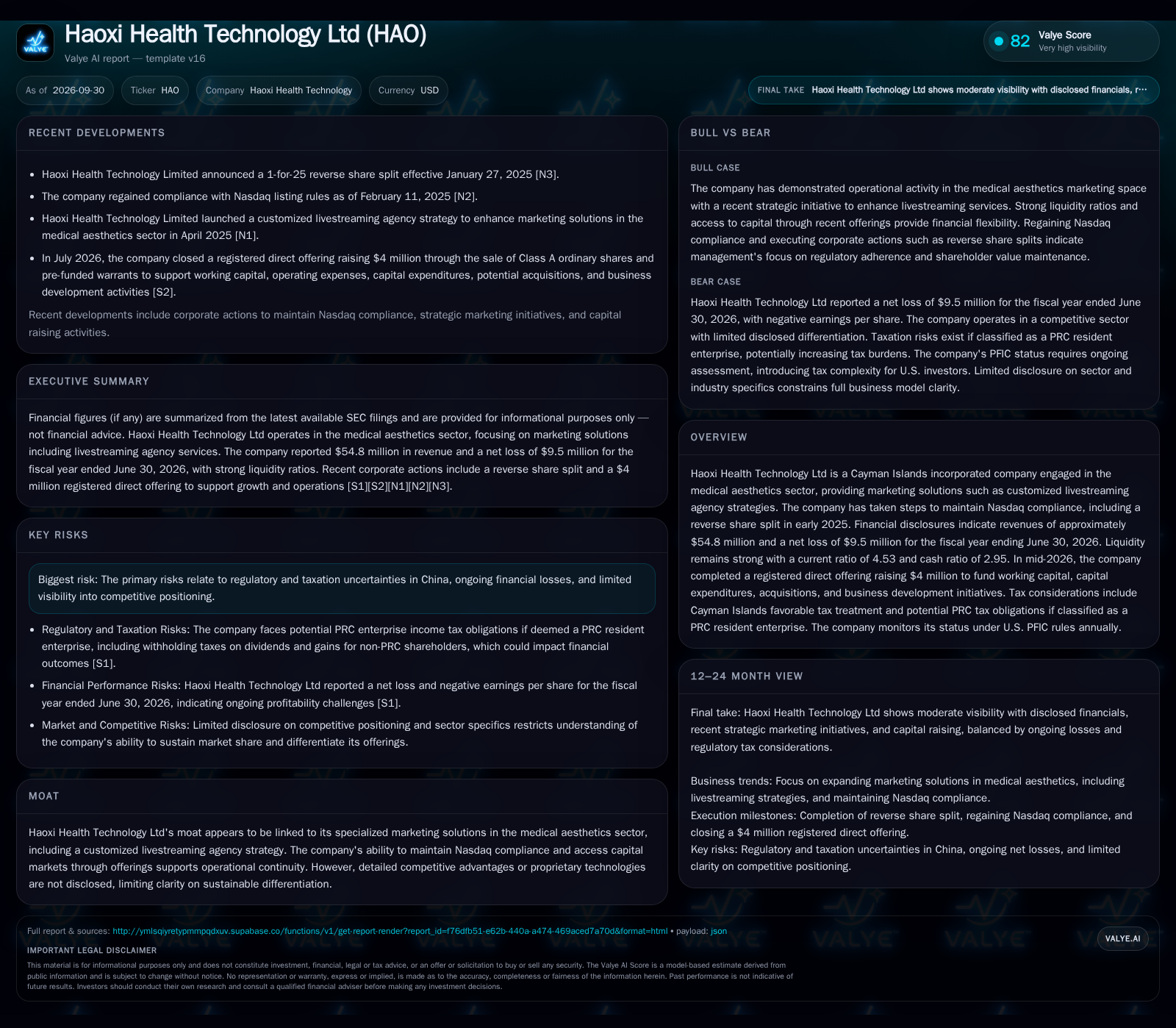
Haoxi Health Technology Ltd reported $54.8 million in revenue but a $9.5 million net loss for FY2026, highlighting both operational scale and profitability challenges. The company recently raised $4 million to fund expansion and remains Nasdaq-compliant after a reverse split. Its focus on livestreaming marketing in medical aesthetics could offer differentiation, but competitive advantages and sustainable economics are not yet established. Regulatory and tax risks in China, along with ongoing losses, remain central watchpoints. [S1] [S2] [N1] [N2] [N3]
Haoxi Health Technology Ltd operates in the fast-evolving medical aesthetics sector, offering marketing solutions with a focus on livestreaming agency strategies. While the company’s $54.8 million in fiscal 2026 revenue demonstrates meaningful activity, a $9.5 million net loss signals that profitability remains elusive. Recent efforts—including a $4 million capital raise and initiatives to maintain Nasdaq compliance—suggest management is intent on pursuing growth and operational stability. However, questions linger about the firm’s ability to establish a defensible commercial model, especially given scant disclosure on competitive positioning and the tax complexities of cross-border operations.
Recent Financials and Strategic Actions Define Haoxi’s Operating Landscape
Haoxi Health Technology Ltd reported $54.8 million in revenue and a net loss of $9.5 million for the fiscal year ended June 30, 2026, revealing significant scale but ongoing operational losses. [S1] The company reported approximately $10.9 million in cash and a current ratio of 4.53 as of June 2026. [S1] In July 2026, Haoxi completed a $4 million registered direct offering, earmarking proceeds for working capital, capital expenditures, potential acquisitions, and business development. [S2] These developments highlight a company in transition—balancing expansion and innovation with the imperative to address persistent losses and regulatory obligations.
How Haoxi’s Revenue Model Relies on Marketing Innovation and Scalability
Haoxi Health Technology’s core activity lies in delivering marketing solutions to the medical aesthetics sector, including a notable push into customized livestreaming agency strategies. [N1] While this model may allow the company to tap into growing demand for digital marketing among clinics and practitioners, the economics depend on the structure of its client contracts, pricing power, and the scalability of its services. If Haoxi operates on a project or retainer basis, unit economics could vary widely by client mix, campaign complexity, and the digital platforms leveraged. The company’s revenue growth suggests some traction, but the $9.5 million net loss in FY2026 implies that either gross margins are thin, operating expenses are high, or both—potentially due to elevated customer acquisition costs, technology investment, or sales and support infrastructure. [S1]
Capital needs are likely to remain significant if Haoxi continues to invest in technology, talent, and business development. [S2] Operating leverage could materialize if revenue growth outpaces fixed cost expansion, but current losses suggest Haoxi is not yet at scale or that cost discipline remains an issue.
The scalability of Haoxi’s marketing services hinges critically on the balance between standardized campaign frameworks and customized client solutions. If the company can modularize its livestreaming offerings to reduce per-client customization costs, it may enhance gross margins by leveraging repeatable processes and technology platforms. Conversely, excessive reliance on bespoke campaigns could constrain scalability and inflate operating expenses. Moreover, the pricing power Haoxi can command is likely contingent on demonstrable marketing outcomes and the ability to integrate data-driven insights that optimize campaign performance. Without clear metrics linking marketing spend to patient acquisition or revenue uplift for clinics, negotiating higher fees or longer-term contracts could remain challenging.
Medical Aesthetics Marketing: Competitive Pressures and Differentiation Hurdles
Haoxi’s focus on livestreaming agency strategies in medical aesthetics suggests an attempt to differentiate in a crowded sector where traditional digital marketing agencies, platform-native influencers, and in-house clinic marketers all compete for share. The company’s ability to sustain an edge may depend on proprietary campaign tools, data analytics, or exclusive partnerships with platforms or clinics. However, the available evidence does not establish the existence of defensible technology, exclusive client arrangements, or sticky recurring contracts.
Barriers to entry in digital marketing are generally low, and switching costs for clients may be limited unless Haoxi’s solutions demonstrably drive superior patient acquisition or retention outcomes. Substitution risk is real, as clinics can shift marketing spend between agencies, platforms, or self-serve solutions. The question is whether Haoxi can build enough brand equity, sector expertise, or technical integration to command premium pricing or foster loyalty.
In addition to client retention and pricing, Haoxi’s competitive position may also depend on its agility in adapting to evolving digital marketing trends and platform algorithms. The medical aesthetics sector is subject to rapid shifts in consumer behavior and regulatory scrutiny around advertising claims, which require marketing agencies to be both innovative and compliant. Haoxi’s ability to invest in proprietary analytics or AI-driven targeting tools could create a differentiated value proposition, but only if such investments translate into measurable client benefits. Furthermore, strategic alliances with platform providers or exclusive content creators could raise switching costs and create a more defensible market niche. However, the relatively low barriers to entry mean that sustaining differentiation will require continuous innovation and operational excellence.
What Could Drive a Step-Change in Profitability and Market Share?
A plausible upside scenario is one where Haoxi’s livestreaming agency model becomes the standard for medical aesthetics marketing, leading to rapid client adoption and recurring, high-margin revenue streams. If the company can demonstrate that its customized livestreaming campaigns consistently deliver better ROI for clinics than alternative marketing approaches, it could justify premium pricing and expand its client base.
Evidence that would confirm this scenario includes growing gross margins, a shift to recurring revenue contracts, and customer retention rates rising (if disclosed). Strategic partnerships with leading medical aesthetics brands or digital platforms would further validate the company’s positioning. Accelerating revenue growth alongside operating leverage—where expenses grow more slowly than sales—would be a key proof point.
Incremental Growth Amid Intense Competition and Cost Pressure
The most plausible near-term scenario is that Haoxi achieves steady but modest revenue growth as it continues to refine its marketing solutions and expand its client roster in the medical aesthetics sector. However, ongoing losses are likely to persist unless the company either raises prices, lowers customer acquisition costs, or finds efficiencies in service delivery.
Confirmation of this scenario would be visible in continued revenue expansion with flat or only slightly improving net losses, periodic capital raises to fund operations, and limited disclosure of major customer wins or proprietary technology. If Haoxi can at least stabilize losses while growing top-line, it may buy time to achieve scale. Falsification would occur if losses widen or if revenue stagnates despite ongoing investment.
Under steady growth conditions, Haoxi’s path to profitability would likely depend on incremental improvements in customer acquisition efficiency and operational cost management. For example, optimizing the sales funnel to reduce lead conversion times or leveraging automation in campaign management could lower variable costs. Additionally, diversifying the client base to include larger clinics or chains with more predictable marketing budgets might increase contract size and reduce revenue volatility. However, such gains may be offset if competitive pressures force pricing concessions or if regulatory changes increase compliance costs. Thus, even with revenue growth, the company must carefully manage expense growth and capital allocation to avoid exacerbating losses.
Profitability Eludes Haoxi as Tax and Regulatory Risks Materialize
In a downside scenario, Haoxi fails to stem operational losses, possibly due to intensifying competition, client churn, or ineffective differentiation. If gross margins remain compressed and customer acquisition costs rise, the company may burn through its cash reserves and require further dilutive capital raises.
Additional risk factors include the potential for adverse tax treatment if Haoxi is deemed a PRC resident enterprise, which could increase effective tax rates and reduce net income available to shareholders. [S1] Evidence for this scenario would include mounting net losses, shrinking cash balances, more frequent or distressed capital raises, and negative developments around regulatory or tax status.
If Haoxi’s competitive differentiation fails to materialize, the company may face accelerating client churn and downward pressure on pricing, which would compress gross margins further. In such a scenario, the fixed costs associated with technology development and talent retention could become increasingly burdensome, eroding operating leverage. Regulatory risks, including potential changes in advertising rules for medical aesthetics or data privacy requirements, could also impose unforeseen compliance costs or limit marketing tactics. Moreover, adverse tax rulings could materially reduce net income, thereby constraining reinvestment capacity and heightening the risk of dilutive capital raises. These dynamics could culminate in a negative feedback loop, undermining investor confidence and strategic flexibility.
Concrete Benchmarks to Test the Durability of Haoxi’s Business Model
Gross margin trends—if disclosed—would reveal whether the shift to livestreaming agency services is improving the company’s unit economics.
Customer retention rates and the share of recurring versus project-based revenue would help assess whether Haoxi’s offerings are sticky or commoditized.
Any disclosure of major client wins, exclusive partnerships, or new platform integrations would serve as proof points for competitive differentiation.
Updates on PRC tax residency status and PFIC assessments are critical for evaluating the company’s net income potential and investor tax risk.
The pace and nature of technology investment (e.g., proprietary campaign management tools) would clarify whether Haoxi is building defensible IP.
Management commentary or filings on customer acquisition cost and average contract size—if disclosed—would help test the scalability thesis.
Evidence of operating leverage, such as expenses growing slower than revenue, would support the case for eventual profitability.
Disclaimer: This is research-only, informational analysis and not investment advice. It may include AI-generated interpretation and general industry context. Always verify important details using primary sources.

Comments