
Bassett Furniture: Margin Expansion and Retail Strategy Tested Amid Demand Uncertainty
Bassett Furniture’s modest sales uptick and notable margin improvements reflect operational discipline and selective retail expansion, but the company’s exposure to cyclical demand, execution risks in omnichannel retailing, and evolving consumer preferences present persistent strategic questions.
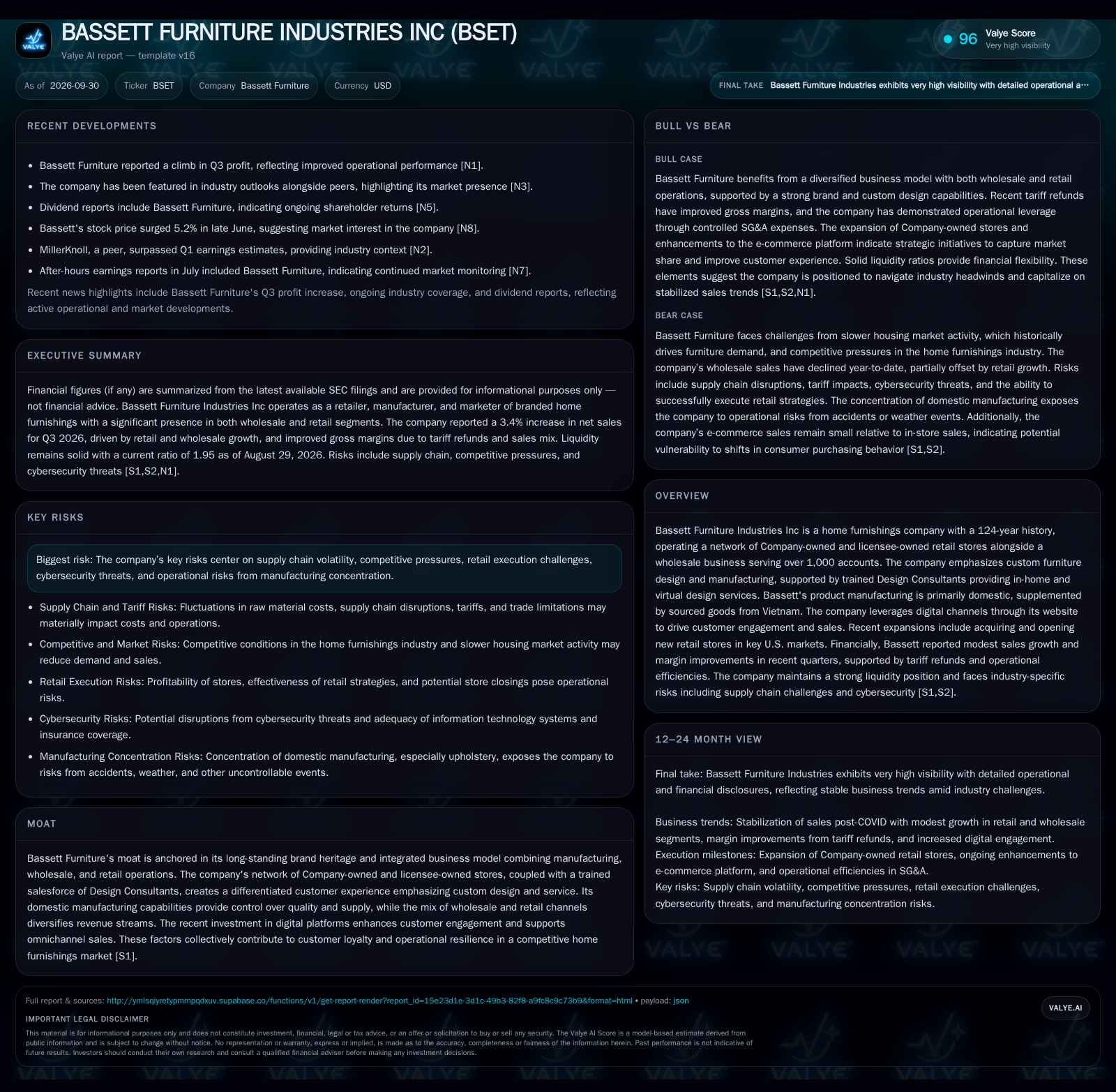
Bassett Furniture posted a 3.4% year-over-year sales increase in Q3 2026, with gross margin up 130 basis points to 57.5%—driven by tariff refunds and a higher mix of retail sales. The company opened and acquired new stores in key markets, while leveraging a refreshed web platform to boost digital engagement and e-commerce. Despite these positives, nine-month sales remained flat, and wholesale revenue declined, highlighting ongoing demand and channel-mix challenges.
Bassett Furniture’s recent performance reveals a company threading the needle between cost discipline and selective growth in a mature, competitive market. Margin expansion in Q3 2026—driven by tariff refunds and an improved sales mix—offset tepid top-line performance, while store expansion and digital investments signal a bid to capture incremental share in a challenging demand environment. Yet, with wholesale sales under pressure and the broader home furnishings sector sensitive to housing and consumer cycles, the durability of these gains remains an open question. The company’s ability to balance omnichannel execution, supply chain resilience, and evolving consumer expectations will likely determine whether these operational wins translate into sustained value creation [S1] [S2].
Recent Margin Gains and Retail Initiatives Shape Near-Term Trajectory
Bassett Furniture reported a 3.4% year-over-year increase in net sales for Q3 2026, reaching $82.8 million, with retail sales up 4.5% and wholesale sales up 1.4% [S2]. Gross margin improved by 130 basis points to 57.5%, primarily due to tariff refunds and a higher mix of retail sales, which carry structurally higher margins than wholesale channels [S2]. SG&A leverage contributed to a 150-basis-point reduction in expenses as a percentage of sales for the quarter, reflecting disciplined cost control [S2]. Despite these positives, nine-month sales were flat, with wholesale down 3.0% year-over-year, highlighting continued demand and channel-mix headwinds [S2]. Bassett expanded its Company-owned retail network in 2026, acquiring a New Jersey store and opening a new location in Cincinnati, with an Orlando store planned [S1]. As of August 29, 2026, the company held $35.4 million in cash and reported liquidity-ratio trends of 1.95 [S2].
How Bassett Makes Money: Channel Mix, Customization, and Cost Structure Dynamics
Bassett’s revenue model combines Company-owned and licensee-owned retail stores, a large network of wholesale accounts, and a growing digital channel. Retail sales are supported by a consultative, design-led approach and the availability of custom furniture, which the company positions as a differentiator. While retail sales tend to carry higher gross margins compared to wholesale, the specific average transaction values or per-visit economics are not disclosed in the report and should be considered as general industry tendencies rather than Bassett-specific facts. The company’s margin structure benefits from a higher proportion of retail sales, as demonstrated by recent results. Variable costs are significant in manufacturing and logistics, but fixed SG&A leverage improves as sales volumes rise, especially in Company-owned stores. Tariff refunds provided a one-time margin boost in Q3 2026, but underlying profitability is heavily dependent on sourcing costs, supply chain efficiency, and the balance between imported and domestically manufactured goods. Digital investments, such as the late-2023 website relaunch, are intended to increase customer engagement and e-commerce order flow, which could incrementally enhance operating leverage if digital penetration rises. Capital requirements for retail expansion are ongoing, with each new store representing a multi-year payback profile that is sensitive to local demand and execution. However, the specific payback period or return on investment for new stores is not disclosed and remains a conditional consideration.
Differentiation in a Crowded Home Furnishings Landscape
Bassett operates in a fragmented home furnishings market, competing with national chains, regional independents, direct-to-consumer upstarts, and big-box retailers. Its core differentiator is the emphasis on custom design services and the ability to deliver personalized in-home or virtual consultations through trained Design Consultants. The Company-owned and licensee-owned store network supports brand consistency and service, while domestic manufacturing enables faster lead times and quality control—though the reliance on imported components and products from Vietnam introduces exposure to global supply shocks. Digital engagement is a strategic focus, but e-commerce sales remain a minority of total revenue, and the pace of consumer migration to online furniture buying is uncertain. Scale competitors may pressure margins through pricing and promotional activity, while emerging DTC brands compete on convenience and design innovation. Bassett’s moat is thus rooted in service differentiation and operational execution rather than scale or cost leadership.
Margin Resilience and Omnichannel Growth Drive Outperformance
A favorable outcome for Bassett would see continued expansion of higher-margin retail sales, driven by the successful ramp-up of new Company-owned stores and further gains in e-commerce conversion. If the company leverages its design consultant model and digital platform to capture incremental share from both traditional and online competitors, it could sustain gross margins above recent levels, especially if supply chain costs remain stable. Additional tariff refunds or sourcing efficiencies could provide further upside. Confirmation would come from sequential increases in retail same-store sales, a rising proportion of e-commerce revenue, and sustained SG&A leverage. A visible inflection in wholesale sales—potentially through new account wins or expanded Bassett Custom Studios—would further support a bullish case.
Stable Sales with Incremental Margin Improvement, Amid Channel and Demand Headwinds
The most plausible trajectory is one of modest retail-driven growth offsetting softness in wholesale, with gross margins remaining elevated versus historical averages due to a favorable sales mix and ongoing cost discipline. Digital and omnichannel initiatives contribute to gradual gains in customer engagement but do not radically shift channel economics in the near term. The company continues selective retail expansion, but each new store’s ramp is slow and subject to local demand volatility. Supply chain costs stabilize but do not significantly improve, and the overall home furnishings market grows in line with housing and macroeconomic trends. Evidence supporting this scenario would include flat-to-low-single-digit annual sales growth, stable gross margins, and consistent SG&A as a percentage of sales. Falsification would occur if wholesale declines accelerate or if new store openings fail to generate expected returns.
Demand Shocks and Execution Missteps Pressure Margins and Cash Flow
A negative scenario would unfold if housing market weakness or shifts in consumer spending sharply curtail demand for big-ticket home furnishings, leading to a pronounced drop in both retail and wholesale sales. If e-commerce fails to gain traction and new store investments underperform, fixed cost deleverage could erode profits, especially if promotional activity intensifies among competitors. Supply chain disruptions or cost inflation—without offsetting tariff relief—would further compress margins. Signs of this scenario would include consecutive quarters of declining sales, contraction in gross margin, rising inventory or working capital needs, and negative operating cash flow. Asset impairments from underperforming stores or warehouse consolidation would further signal stress.
Milestones That Will Define Bassett’s Strategic and Financial Outcomes
Trends in retail same-store sales growth, as a proxy for the effectiveness of new store openings and the design consultant model.
The proportion of total sales generated through e-commerce and digital channels—if disclosed—indicating progress on omnichannel strategy.
Sequential changes in wholesale sales, particularly the pace of decline or stabilization, to assess channel health.
Gross margin trajectory, especially the sustainability of gains post-tariff refunds and shifts in sales mix.
SG&A as a percentage of sales, to monitor ongoing cost discipline and operating leverage.
Inventory turns and working capital metrics, which would signal supply chain management and demand forecasting effectiveness.
Store-level profitability for new and existing Company-owned locations, if disclosed, to evaluate capital allocation outcomes.
Frequency and impact of any asset impairments or charges related to warehouse consolidation or store closures.
Disclaimer: This is research-only, informational analysis and not investment advice. It may include AI-generated interpretation and general industry context. Always verify important details using primary sources.

Comments