
BestGofer Inc.: Pre-Operational Delivery Ambitions Meet Regional Service Reality and Funding Constraints
With a pre-launch delivery app and all current revenue stemming from a localized home inspection subsidiary, BestGofer faces a pivotal test of execution, scalability, and financial runway as it attempts to enter the crowded gig-economy delivery space.
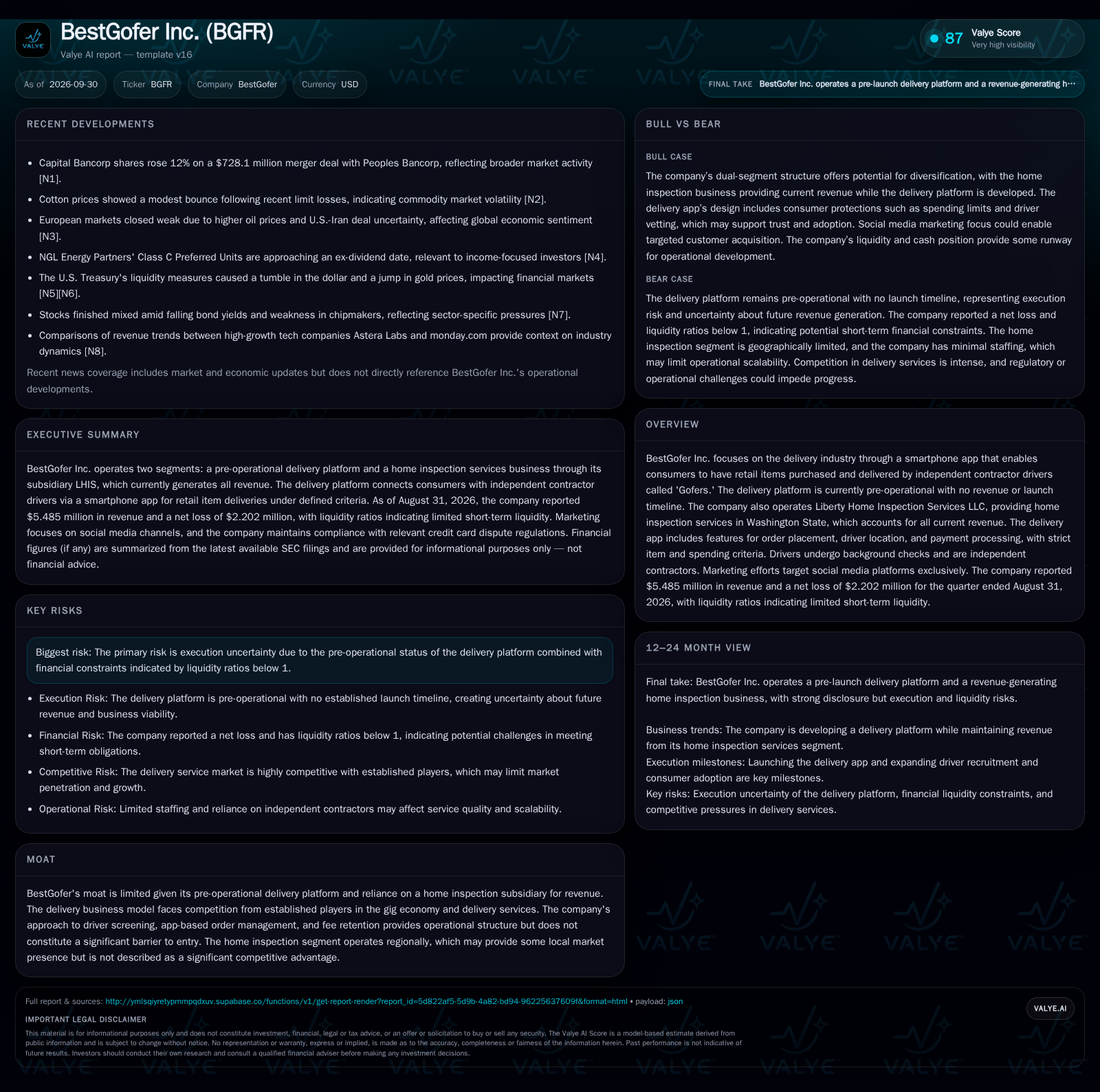
BestGofer Inc. remains a single-segment operator in practice, with its home inspection business in Washington State generating all revenue and its flagship delivery platform still pre-operational. The company's success hinges on launching and scaling its delivery app, navigating competition, and resolving operational and financial bottlenecks. Near-term milestones are critical for validating the business model and ensuring survival beyond its current regional niche. [S2]
BestGofer Inc. is at an inflection point, straddling the reality of a small, regionally confined home inspection business and the ambition of a yet-to-launch on-demand delivery platform. The next few quarters will be a critical test of execution, capital allocation, and the ability to build trust and adoption in a fiercely competitive gig-economy market.
A Dual-Segment Structure With Only One Revenue-Generating Engine
As of August 31, 2026, BestGofer Inc. reported $5.485 million in revenue and a net loss of $2.202 million for the quarter, with all revenue coming from Liberty Home Inspection Services LLC (LHIS), its wholly owned subsidiary operating in Washington State. The company’s much-touted delivery platform remains pre-operational, having not generated any revenue nor set a public launch timeline. The company reported cash and liquidity metrics for the period; these figures do not by themselves establish operating runway, investment capacity, financial flexibility, or financing capacity. Staffing is extremely lean, with only one employee handling core functions, and hiring is contingent on future revenue growth. [S2]
The lean staffing model, while cost-efficient in the short term, introduces significant operational risks. With a single employee responsible for both strategic direction and day-to-day operations, the company faces potential bottlenecks in decision-making, execution speed, and responsiveness to market dynamics. This structure may impede the ability to rapidly iterate on the delivery platform, address technical issues, or scale customer support, all of which are critical in highly competitive gig-economy environments. Furthermore, reliance on limited human resources could exacerbate vulnerabilities to unforeseen disruptions or employee turnover, potentially derailing progress during pivotal launch phases.
Revenue Model Tension: Home Inspection Stability vs. Delivery Platform Uncertainty
BestGofer’s current economics are anchored in the home inspection services business—a locally focused, high-touch operation with inherently limited scalability due to geographic and personnel constraints. Home inspection is typically a low fixed-cost, variable-revenue business, but its market ceiling is capped by local real estate activity and the company’s minimal staffing. Margins in this sector are generally modest, leaving little room for error or significant reinvestment.
The delivery platform, if launched, would introduce a fundamentally different, high-variability business model. The company plans to retain 30% of each delivery fee, with the remainder going to independent contractors ('Gofers'). This mirrors the gig economy model seen in larger delivery platforms, where scale is crucial for both customer density and route optimization. However, such platforms typically have low gross margins after accounting for customer acquisition costs, marketing, insurance, and technology development. Without critical mass, the per-transaction economics may be unfavorable, and the need to subsidize early deliveries or offer sign-up incentives could amplify cash burn.
The delivery platform’s unit economics will be highly sensitive to customer acquisition cost (CAC) dynamics and contractor utilization rates. Given the competitive landscape, BestGofer may need to invest heavily in marketing and incentives to attract both consumers and Gofers initially. If CAC remains elevated without commensurate transaction volume growth, the platform could experience prolonged negative margins. Additionally, contractor utilization rates—how frequently Gofers complete deliveries—will directly impact revenue stability and predictability. Low utilization could inflate per-transaction costs and reduce profitability, while high turnover among contractors might increase recruitment and training expenses, further pressuring margins.
Facing Entrenched Rivals in Both Local and National Markets
BestGofer’s delivery platform, if launched, would enter a market dominated by established gig-economy and delivery giants with deep pockets, brand recognition, and robust operational infrastructure. These incumbents benefit from network effects, high app engagement, and aggressive pricing or promotional strategies that can suppress new entrants. The company’s approach—emphasizing driver vetting, spending limits, and consumer protections—may marginally differentiate the offering, but these features are easily replicable and do not constitute a durable moat.
In the home inspection segment, LHIS operates in a fragmented, regionally competitive market where reputation, local agent relationships, and service quality drive business. As a single-state operator with limited staff, LHIS lacks the scale or brand presence to fend off local competitors or expand meaningfully without significant investment. Across both segments, BestGofer’s competitive position is tenuous and unproven, particularly given its limited resources and lack of unique technology or network-based defensibility.
What Could Unlock Growth: Seamless Launch and Localized Adoption
A favorable outcome hinges on the successful launch of the delivery platform, coupled with rapid traction in select local markets where competition is less intense or underserved. If BestGofer can efficiently recruit and retain a base of qualified Gofers—and match them with enough consumer demand—its 30% fee retention could yield attractive unit economics, especially in markets where larger platforms are less active.
Early evidence supporting this scenario would include: a timely and smooth app launch; initial transaction volumes that demonstrate latent demand; positive consumer and driver reviews; and the ability to maintain low customer acquisition costs through focused social media marketing. If LHIS can sustain or grow its revenue base, it could provide a modest cash flow buffer during the delivery platform’s ramp-up phase. Confirmation would come from disclosed growth in active users, repeat transaction rates, and improving gross margin as scale is achieved.
Most Likely Trajectory: Slow Platform Rollout and Regional Steadiness
The probable outcome is a gradual, resource-constrained delivery platform rollout, with LHIS continuing to provide a baseline of regional home inspection revenue. The company may face delays in platform development, limited initial adoption due to weak brand recognition and thin marketing spend, and operational hiccups as it scales from a single-employee core. Revenue growth would likely be modest and lumpy, with the delivery segment contributing only marginally in the first few quarters post-launch—if at all.
This scenario would be confirmed by slow but steady increases in disclosed delivery transactions, incremental hiring, and continued reliance on home inspection services for the bulk of revenue. Evidence against this path would include rapid cash depletion, inability to launch the delivery app, or significant customer churn in either segment.
Where It Could Unravel: Execution Delays, Cash Drain, and Competitive Squeeze
The adverse scenario is one where the delivery platform launch is repeatedly delayed or fails to gain traction, while LHIS revenue stagnates or declines. With liquidity ratios already below 1, any further erosion of cash or inability to generate incremental revenue could force the company into cost-cutting, asset sales, or a search for dilutive external capital. Competitive pressure from larger, better-capitalized delivery platforms could suppress pricing or crowd out Gofer recruitment, making even niche market penetration difficult.
Confirmation would come from further net losses, shrinking cash balances, rising current liabilities, and lack of disclosed progress on hiring or delivery app metrics. Inability to diversify revenue beyond Washington State or to attract meaningful delivery volume would signal a heightened risk of insolvency or strategic retrenchment.
Milestones That Will Determine If BestGofer Can Transition Beyond a Regional Niche
Disclosed launch date and initial performance metrics for the delivery platform app—such as number of completed transactions, active users, and early customer/Gofer retention rates.
Growth—or contraction—in home inspection revenue, which serves as the company’s current cash flow anchor.
Evidence of successful Gofer recruitment and onboarding, particularly in non-saturated or underserved local markets (if disclosed).
Incremental hiring or expansion of full-time staff to support operational scaling, product development, and customer service.
Any disclosure of external financing, strategic partnerships, or asset sales to bolster liquidity and fund growth.
Consumer and contractor satisfaction metrics, including app ratings, complaint rates, and dispute resolution outcomes (if disclosed).
Disclaimer: This is research-only, informational analysis and not investment advice. It may include AI-generated interpretation and general industry context. Always verify important details using primary sources.

Comments