
American Vanguard: Persistent Profitability Pressure and Board Reshuffling Highlight Strategic Crossroads
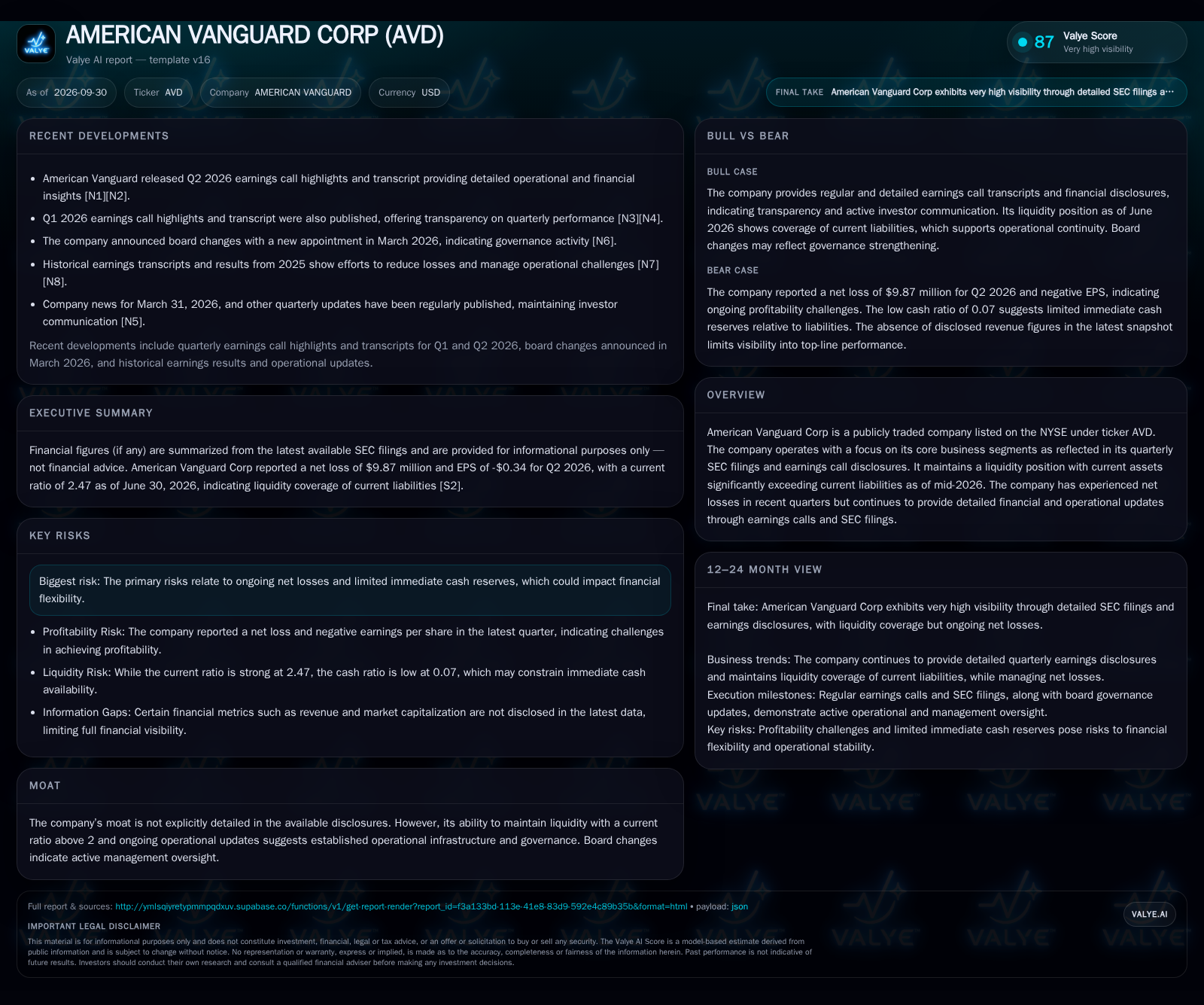
American Vanguard’s mid-2026 results reveal ongoing net losses and a reported cash balance despite a reported current ratio, raising questions about operational sustainability, capital allocation, and the impact of recent board changes as the company navigates a challenging agricultural and chemical sector landscape.
Recent board changes in March 2026 may signal a shift in governance or strategic direction. The company’s ability to improve margins or secure additional funding will be critical as it addresses persistent profitability challenges and a competitive, capital-intensive industry environment. [S2] [N6]
The March 2026 board appointment adds a layer of intrigue about possible strategic pivots or governance reforms. As American Vanguard operates in a capital-intensive, cyclical sector, its next moves—whether operational improvements, capital raises, or structural changes—could decide whether it stabilizes or faces deeper headwinds.
Losses Mount as Liquidity Tightens and Governance Shifts
American Vanguard reported a net loss of $9.87 million for the quarter ending June 30, 2026, with basic and diluted EPS of -$0.34, continuing a pattern of unprofitable operations [S2]. This loss, in the absence of disclosed revenue figures, leaves open questions about the underlying margin structure and cost discipline. [S2] A new board appointment in March 2026 signals attention to governance, possibly reflecting a response to operational or strategic challenges [N6]. These facts collectively underscore a business at risk of liquidity stress if losses persist or external shocks emerge.
Cost Structure and Capital Needs in a Margin-Pressured Sector
American Vanguard operates in the agricultural chemicals sector, which is characterized by significant fixed costs (manufacturing plants, regulatory compliance, R&D) and variable costs tied to commodity inputs and distribution. Profitability for such companies typically hinges on effective capacity utilization, pricing power against generic competitors, and the ability to maintain or grow volumes even in cyclical downturns.
The company’s current net loss suggests that either gross margins are under pressure (due to input cost inflation, pricing competition, or mix shifts) or SG&A and overhead are not scaling down with revenues.
If American Vanguard cannot restore profitability or generate sufficient operating cash flow, it may need to access external capital—via debt, equity, or asset sales—to fund operations or strategic initiatives. In a sector where regulatory hurdles and product development cycles are long, sustained losses can quickly erode potential financial flexibility.
Given the capital-intensive nature of the agricultural chemicals industry, American Vanguard’s fixed cost base creates a high operating leverage environment. This means that small fluctuations in sales volume or input costs can disproportionately impact profitability. In periods of revenue decline or margin compression, the inability to flex fixed costs downward quickly can exacerbate losses. Moreover, regulatory compliance costs and ongoing R&D investments introduce a baseline expense that must be sustained to remain competitive, limiting short-term cost-cutting options. Consequently, the company’s capacity to optimize production efficiency and prioritize high-return projects becomes critical to preserving financial health.
Navigating Commodity Pressures and Industry Consolidation
American Vanguard competes against both larger diversified agrochemical conglomerates and nimble regional players. The industry is increasingly shaped by consolidation, regulatory scrutiny, and the emergence of bio-based or digital agriculture solutions. Large competitors often benefit from scale economies in procurement, distribution, and regulatory affairs, making it difficult for smaller firms to compete on price or absorb shocks.
The company’s apparent lack of pricing power—implied by persistent losses—could reflect a commoditized product mix or an inability to differentiate through proprietary formulations or customer service. Without clear evidence of recurring revenue, high switching costs, or unique technology, American Vanguard’s position may be vulnerable to both input cost volatility and aggressive discounting by larger peers.
If the company can leverage niche markets, specialty products, or targeted distribution relationships, it could partially offset these disadvantages. However, the absence of disclosed revenue or margin details in recent filings leaves the durability of such advantages in question.
The competitive landscape’s increasing consolidation tends to favor larger players with scale advantages in procurement, production, and distribution logistics. For American Vanguard, competing effectively may require leveraging niche expertise or specialized formulations that command premium pricing and create higher switching costs for customers. However, such differentiation demands sustained investment in R&D and marketing, which may be challenging amid ongoing losses. The company’s ability to identify and exploit underserved market segments or innovate in product delivery mechanisms could partially insulate it from commoditization pressures. Without such differentiation, the risk of margin erosion due to aggressive pricing by larger competitors remains high.
Margin Recovery and Strategic Renewal Could Reverse Fortunes
A plausible path to recovery would see American Vanguard stabilize or grow revenues through a successful product launch, improved pricing discipline, or penetration into higher-margin specialty segments.
The recent board appointment could also presage a shift in strategy, such as portfolio rationalization, cost-cutting, or new partnerships. Confirmation of this scenario would come from improved quarterly operating margins, higher operating cash flow, a reported liquidity-ratio trends, or new commercial wins disclosed in future filings or earnings calls.
Evidence that would falsify this scenario would be continued net losses of similar or greater magnitude, further erosion of cash reserves, or the absence of new product or market initiatives despite governance changes.
Operational Adjustments Buy Time, But Profitability Remains Elusive
Absent a dramatic shift, American Vanguard may continue to operate with modest improvements in working capital management, tactical cost reductions, and incremental product or market adjustments.
The most likely outcome is a gradual narrowing of losses as management responds to board pressure and sector realities, but with little room for error if sector conditions deteriorate or a major customer is lost. Confirmation would be quarterly reports showing reduced losses, stable or improving current and cash ratios, but no meaningful return to profitability or cash generation.
Sustained Losses and Liquidity Strain Force Tough Choices
In this scenario, the company could be forced to seek emergency financing, accept unfavorable terms, or curtail operations to preserve cash.
A continued pattern of net losses, declining cash balances, or deteriorating relationships with creditors and suppliers would confirm this negative spiral. This could also trigger board or management turnover beyond the recent appointment, signaling a crisis response rather than strategic renewal.
The scenario would be falsified if the company demonstrates a material improvement in cash generation, secures non-dilutive external funding, or achieves an inflection in operating margins that stabilizes the business.
Testing American Vanguard’s Resilience: What Could Shift the Trajectory
Quarterly net income and operating margin trends—clear improvement would support a turnaround thesis, while persistent or worsening losses would heighten risk.
Working capital composition—details on inventory and receivables turnover (if disclosed) would clarify how quickly assets can be converted to cash.
Revenue growth and product mix—disclosure of top-line trends or specialty product contributions would help assess pricing power and margin potential.
Board and management commentary in future earnings calls—any articulation of new strategy, cost initiatives, or capital allocation priorities would provide insight into the impact of recent governance changes.
Capital-raising activity or external financing events—evidence of new debt, equity, or asset sales would reveal the company’s access to external funding and terms.
Customer concentration and contract duration—if disclosed, this would indicate revenue stability and risk of sudden demand shocks.
Industry or regulatory developments—such as changes in agricultural policy, input costs, or competitive launches, which could alter sector dynamics and affect American Vanguard’s positioning.
Disclaimer: This is research-only, informational analysis and not investment advice. It may include AI-generated interpretation and general industry context. Always verify important details using primary sources.

Comments