
Radiopharm Theranostics: Clinical Momentum, Commercial Pathways, and the Realities of Scaling Radiopharmaceutical Innovation
Radiopharm Theranostics advances a multi-candidate radiopharmaceutical pipeline with positive late-stage data and early commercial infrastructure, but faces the classic biotech challenge of translating clinical and regulatory progress into sustainable economics and market adoption.
Radiopharm Theranostics has reported strong clinical progress across its radiopharmaceutical pipeline, highlighted by RAD101’s Phase 2b success and a supply agreement with Siemens Healthineers. The key test ahead is whether its technology and partnerships can overcome the capital intensity and adoption hurdles that define radiopharmaceutical biotech.
Radiopharm Theranostics is emerging as a notable player in the radiopharmaceutical space, progressing a diverse oncology pipeline toward late-stage clinical inflection points. Recent positive data—particularly for RAD101 in brain metastases—combined with a strategic supply partnership, signal readiness for potential commercial transition. Yet, like most clinical-stage biotechs, Radiopharm faces a steep challenge: maintaining innovation momentum and financial runway long enough to achieve regulatory approval and physician adoption, all while operating with high cash burn and uncertain future reimbursement landscapes.
Recent Clinical and Commercial Milestones Set the Stage for Next-Phase Execution
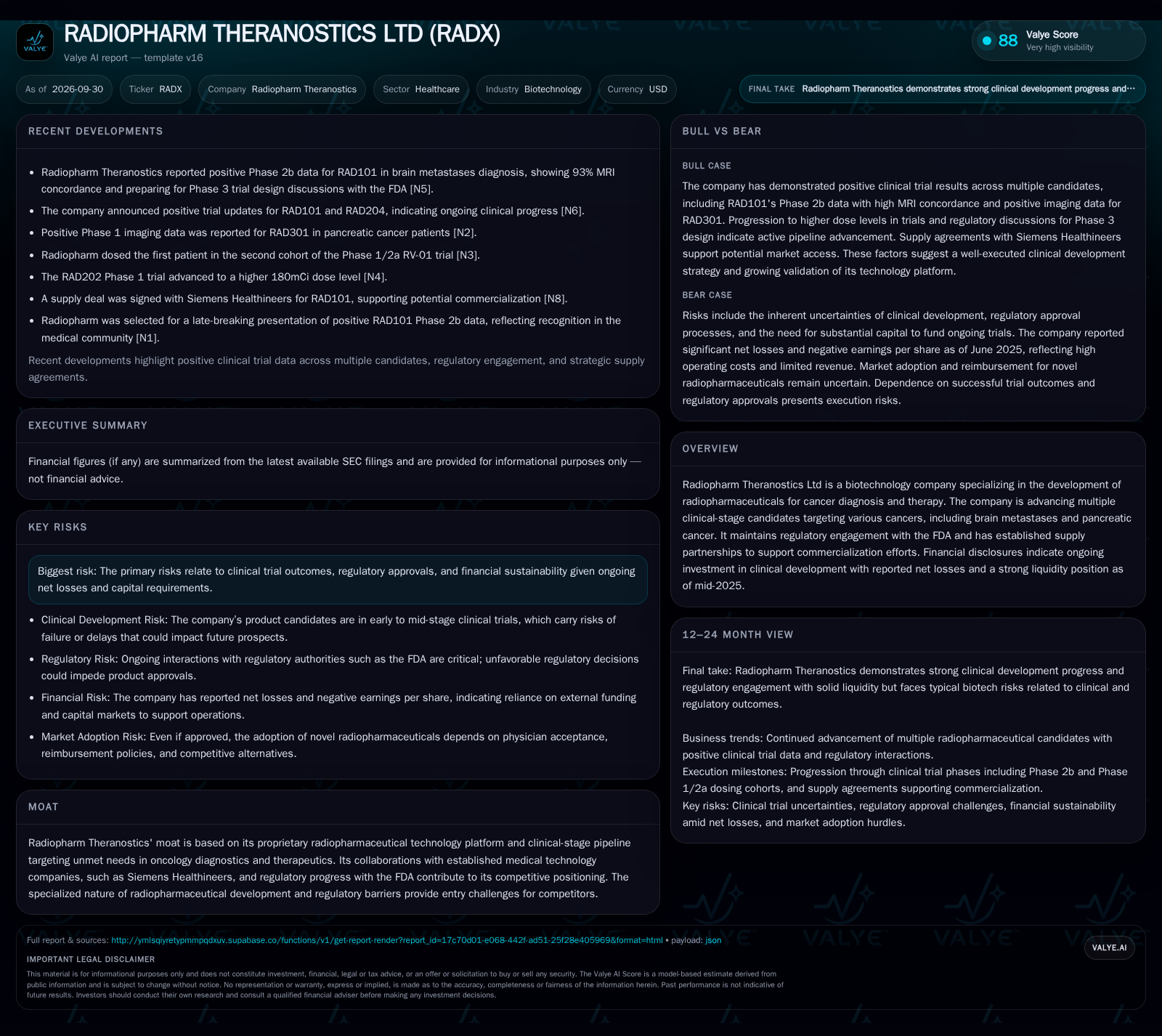
Radiopharm Theranostics has reported positive Phase 2b data for its lead diagnostic candidate, RAD101, showing 93% concordance with MRI in brain metastases—an encouraging signal for both clinical utility and regulatory advancement. The company is now in discussions with the FDA regarding Phase 3 trial design, marking a key transition from proof-of-concept to pivotal development [N5]. Beyond RAD101, the pipeline has advanced with positive trial updates for RAD204 and RAD301, as well as dose escalation milestones for RV-01 and RAD202 [N2] [N3] [N4] [N6]. A supply agreement with Siemens Healthineers for RAD101 demonstrates early commercial groundwork, aligning the company with a major medtech distributor should regulatory approvals follow [N8]. Financially, as of June 2025, Radiopharm’s revenue is still nascent at $3.63 million, with a net loss of $38.3 million and negative EPS of -1.76, reflecting the high R&D spend typical of this stage [S1]. The company reported a current ratio of 2.67 for the period. [S1]
Radiopharmaceutical Commercialization: Capital Intensity, Revenue Timing, and Margin Structure
Radiopharm’s business model is rooted in the development and eventual commercialization of radiopharmaceuticals for both diagnostic and therapeutic oncology applications. Revenue generation for such companies is typically binary and back-weighted—minimal until regulatory approval, then potentially substantial if adoption is achieved. The economics are complicated by high fixed costs (clinical trials, regulatory, manufacturing scale-up, compliance) and variable costs tied to radioactive isotope sourcing, distribution, and specialized handling.
Gross margins, once commercialized, can be attractive for proprietary agents—especially if clinical data could support premium pricing or reimbursement. However, radiopharmaceuticals often face volume constraints due to manufacturing complexity and narrow initial market indications. The Siemens Healthineers supply deal, if it matures into a commercial distribution relationship, could help Radiopharm achieve scale efficiencies and reduce go-to-market friction. R&D and SG&A will likely remain elevated through late-stage development, delaying operating leverage. The company’s current net losses and high burn rate are typical for the sector, but will intensify the pressure to secure non-dilutive capital or partnership funding as pivotal trials commence.
Pipeline Breadth and Partnerships: Sources of Advantage Amid Specialized Competitive Dynamics
Radiopharm’s competitive positioning is anchored by its multi-asset pipeline targeting several high-need oncology indications, with a focus on both diagnostics (e.g., RAD101) and therapeutics (e.g., RV-01, RAD204). The company’s ability to demonstrate positive clinical data across multiple programs increases its optionality and reduces single-asset dependency—a key advantage in a sector where attrition is high.
The Siemens Healthineers agreement provides early validation and potential channel leverage, but Radiopharm will face entrenched competition from larger radiopharma incumbents, as well as emerging molecular imaging and theranostic platforms. Key barriers to entry for new competitors include the complexity of radiopharmaceutical chemistry, regulatory hurdles, and the need for distribution infrastructure that can handle radioactive compounds. However, switching costs for oncologists and hospitals may be moderate, as adoption will turn on demonstrated clinical benefit, reimbursement, and workflow integration. Radiopharm’s moat is thus partially technological, partially executional, and partially relational—dependent on both proprietary science and strategic partnerships.
If Clinical and Regulatory Success Translate: Pathways to Rapid Uptake and Margin Expansion
The most favorable scenario for Radiopharm would see RAD101 and at least one therapeutic candidate achieve pivotal trial success, leading to FDA approval and rapid uptake in their target indications. The existing Siemens Healthineers partnership could then accelerate commercial launch, leveraging established distribution networks and sales channels. If clinical benefit is clear and reimbursement is secured at favorable rates, Radiopharm could see strong initial adoption in specialized oncology centers, driving early revenue inflection and operating leverage.
Evidence that would confirm this scenario includes: positive Phase 3 trial outcomes, FDA acceptance of regulatory submissions, announced reimbursement agreements or CMS coding decisions, and early sales traction post-approval. A rapid ramp in revenue, improved gross margin, and expansion of the Siemens partnership (or new distribution agreements) would further validate the upside.
Most Likely Trajectory: Clinical Progress with Staggered Approvals and Ongoing Capital Needs
The most plausible path for Radiopharm involves continued clinical progress across its pipeline, but with staggered timelines to approval and commercial launch. It is likely that not all candidates will succeed, and regulatory review may introduce delays or require additional studies. Revenue will remain modest until at least one product is approved and launched, while operating losses persist due to high fixed R&D and commercialization costs.
Confirmation of this scenario would include steady reporting of clinical milestones, incremental regulatory feedback, further capital raises (equity or non-dilutive), and gradual deepening of commercial infrastructure. Falsification would come from either a major clinical or regulatory setback, or from an unexpectedly rapid acceleration to market and revenue.
Adverse Chain: Trial Setbacks, Regulatory Hurdles, and Funding Gaps
The most significant risks for Radiopharm are negative or inconclusive trial results, regulatory pushback, or challenges in manufacturing scale-up. Any clinical failure—especially for lead assets like RAD101—could sharply reduce future prospects, erode investor confidence, and limit access to capital. Delays or denials from the FDA could force further costly studies, extending the timeline to commercialization and increasing cash burn.
Confirmation of this downside would include failed or ambiguous clinical data, FDA requests for additional or repeat trials, reported difficulties in securing manufacturing or supply chain scale, and signs of financial strain such as urgent capital raises, down rounds, or cost-cutting measures.
Milestones That Will Reveal Whether Radiopharm’s Clinical Momentum Converts to Commercial Reality
Readout of pivotal Phase 3 trial data for RAD101 and subsequent FDA feedback or regulatory milestones.
Updates on the scope, terms, and operationalization of the Siemens Healthineers supply agreement, including evidence of distribution readiness or expansion.
Progression of other pipeline assets (RAD204, RAD301, RV-01, RAD202) through clinical phases, with particular focus on efficacy and safety data if disclosed.
Quarterly revenue trends and any evidence of pre-commercial or early access sales activity, if disclosed.
Gross margin trends post-approval, if disclosed, as an indicator of manufacturing efficiency and pricing power.
Cash burn rate and capital raise activity, especially in relation to major clinical trial initiations or expansions.
Updates on payer/reimbursement status for approved products, including CMS coding or private insurer decisions, if disclosed.
Physician and hospital adoption metrics, such as number of centers using RAD101 or other agents, if disclosed.
Disclaimer: This is research-only, informational analysis and not investment advice. It may include AI-generated interpretation and general industry context. Always verify important details using primary sources.

Comments