
Conagra Brands: Margin Rebuild and Cost Discipline at a Strategic Crossroads
Recent profit gains and successful cost management highlight Conagra Brands’ operational progress, but reported liquidity position and ongoing restructuring underscore a need for executional precision as competition and consumer trends evolve.
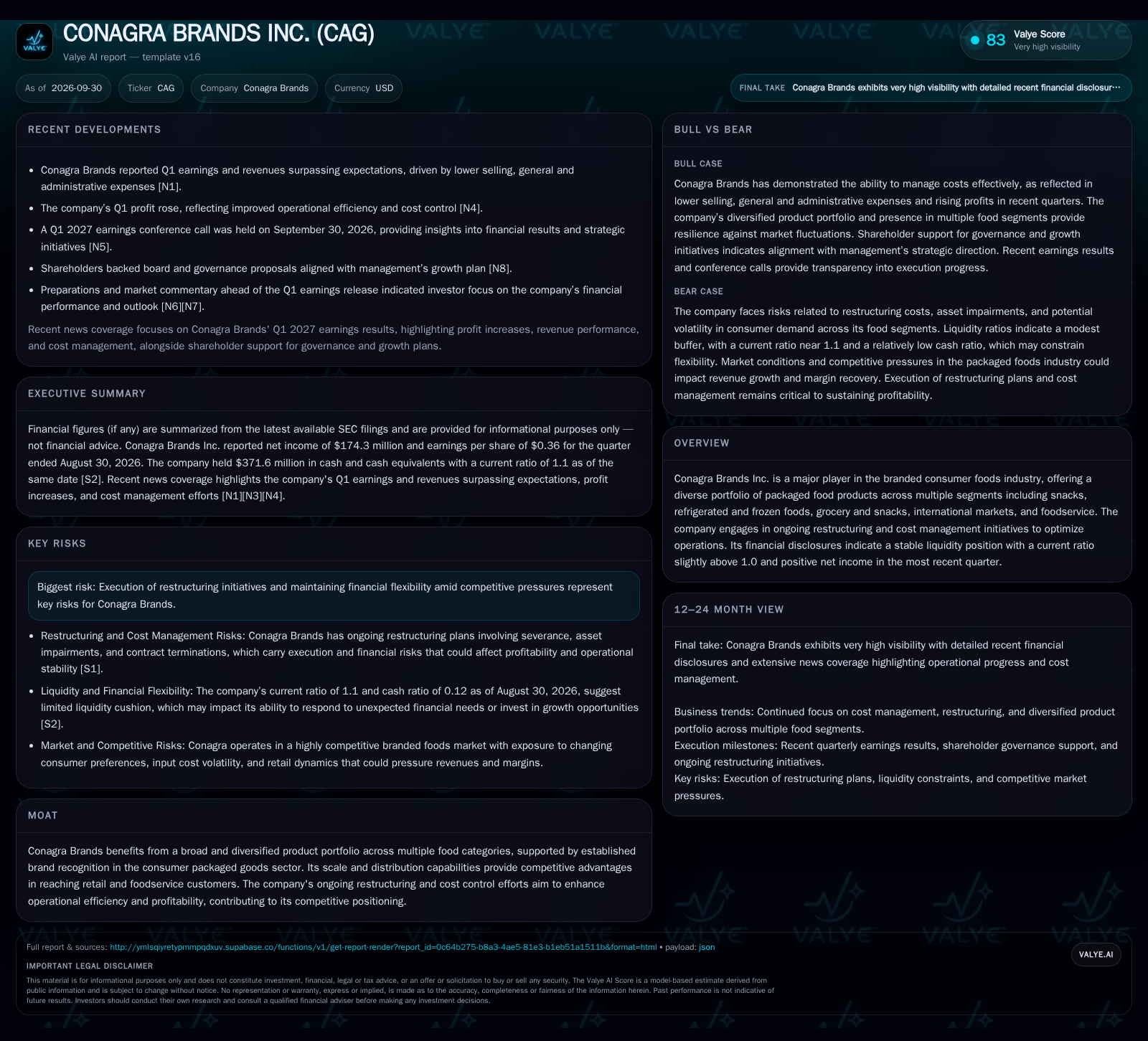
Conagra Brands posted $174.3 million in net income and continued to deliver on cost-reduction initiatives, with Q1 earnings beating expectations. [S2] [N1] [N8]
Conagra Brands stands at a critical juncture: recent quarters have brought improved profits and operational discipline, but the company’s margin rebuild is set against a backdrop of restructuring, reported liquidity position, and intensifying competition. With shareholders endorsing management’s latest growth plan and cost controls yielding tangible results, the forward story hinges on whether Conagra can convert efficiency gains into sustained brand strength, defend share in a crowded market, and judiciously navigate capital allocation as consumer tastes and input costs remain in flux.
Recent Results Reflect Operational Progress and Strategic Alignment
Conagra Brands reported net income of $174.3 million for the quarter ended August 30, 2026, with earnings per share of $0.36, highlighting a period of operational improvement and effective cost management. The company reported a current ratio of 1.1 for the period. Importantly, shareholders have recently approved board and governance proposals aligned with management’s growth strategy, providing a mandate for ongoing restructuring and operational changes. [S2] [N1] [N8]
How Conagra’s Portfolio Drives Margin and Scale
Conagra’s business economics are shaped by the interplay of branded product pricing, volume throughput, and cost discipline across its diverse segments—snacks, frozen and refrigerated foods, grocery, international, and foodservice. The company’s fixed cost base in manufacturing and distribution means that incremental volume growth can drive operating leverage, but only if pricing discipline and input cost management are sustained. Ongoing restructuring, including severance and asset impairments, signals an active approach to trimming inefficiencies, but also introduces near-term costs and execution risk. The company reported cash and liquidity metrics for the period; these figures do not by themselves establish operating runway, investment capacity, financial flexibility, or financing capacity. The combination of broad category participation and cost control offers potential for margin expansion if input costs stabilize and consumer demand holds up, but commodity price swings and promotional intensity remain key variables.
A deeper examination of Conagra’s cost structure reveals that the company’s fixed costs, particularly in manufacturing and logistics, create both opportunities and constraints. While fixed costs enable operating leverage as volumes increase, they also impose a baseline expense that must be covered regardless of sales fluctuations. Therefore, volume growth alone is insufficient; it must be accompanied by disciplined pricing strategies that preserve or improve margins. Additionally, the company’s ability to manage variable input costs—especially commodities and packaging materials—directly impacts gross margins. Hedging strategies and supplier negotiations become critical levers in this context. If Conagra can enhance supply chain efficiencies or secure more favorable input contracts, it could mitigate margin volatility tied to commodity price swings.
Moreover, the interplay between restructuring costs and long-term productivity gains warrants careful scrutiny. While restructuring can reduce overhead and improve cost efficiency, it often entails upfront charges and operational disruptions that can pressure near-term earnings. The success of such initiatives depends on precise execution and the ability to redeploy savings into growth drivers such as marketing and innovation. If cost reductions disproportionately impact brand-building activities or R&D, the company risks eroding competitive positioning. Therefore, a balanced approach that prioritizes sustainable cost discipline without compromising strategic investments is essential for maintaining both margin resilience and market relevance.
Brand Breadth and Scale: Strengths and Exposure in a Crowded Market
Conagra’s competitive position is underpinned by its scale, broad brand portfolio, and established retail and foodservice relationships. This diversity provides some insulation against demand shifts in any one category and allows for cross-category promotional strategies. However, the company faces intense competition from both multinational food conglomerates and agile private-label producers, especially as consumer preferences shift toward healthier, fresher, or premium offerings. While scale aids in negotiating with retailers and optimizing supply chains, it can also slow innovation and adaptation to niche trends. The ongoing restructuring and cost focus may help defend margins, but the risk is that cost cuts impede brand investment or innovation, leaving Conagra vulnerable to share loss if consumer habits shift faster than the company can respond. In this environment, the company’s ability to maintain brand relevance and shelf presence will be central to defending pricing power and volume.
If Cost Control and Brand Investment Fuel a Profitable Growth Cycle
The most favorable scenario would see Conagra converting recent cost savings into strategic brand reinvestment, supporting both margin expansion and top-line growth. If restructuring efforts yield sustainable SG&A reductions without eroding brand equity, Conagra could outpace peers in profitability, especially if consumer demand for core categories remains resilient and input costs stabilize. Confirmation of this scenario would come from continued outperformance versus analyst expectations, visible reinvestment in marketing and product innovation, and evidence of market share gains in key categories. Watch for positive trends in gross margin, marketing spend as a percentage of sales, and new product launches. Falsification would be signaled by declining brand metrics, stagnant or shrinking category share, or the need for further restructuring charges that offset operational gains.
Efficiency Gains Offset by Market Volatility and Incremental Growth
The most plausible path for Conagra is a steady, if unremarkable, trajectory: ongoing cost management and restructuring drive modest margin improvement, but competitive intensity and shifting consumer preferences limit top-line acceleration. Revenue growth may remain in line with industry averages, with operating margins gradually recovering as SG&A is brought into line. This would be confirmed by stable or slowly improving profitability metrics and continued shareholder support for management’s strategy. However, any deterioration in liquidity, unexpected input cost inflation, or evidence of share loss to private label or niche brands could undermine this equilibrium. The scenario would be falsified by a reversal in margin trends, renewed restructuring costs, or a negative inflection in category demand.
Restructuring Stumbles and Liquidity Constraints Amplify Competitive Threats
A more adverse scenario would see execution missteps in restructuring—such as higher-than-expected severance, asset impairments, or operational disruptions—eroding profitability and sapping management’s capacity to invest in brands. If liquidity remains tight or worsens, Conagra may be forced to curtail marketing or innovation, accelerating share losses to more nimble or better-capitalized rivals. Confirmation of this pathway would include rising restructuring charges, declining cash balances, or negative operating cash flow, alongside deteriorating brand or volume metrics. Falsification would require clear evidence of restructuring completion, stabilization in cash flow and margins, and renewed brand momentum.
Milestones That Will Shape Conagra’s Margin and Growth Thesis
Quarterly gross margin trends, as a signal of pricing discipline and input cost management.
Net working capital changes, especially inventory and payables, to gauge liquidity management and operational efficiency.
SG&A as a percentage of sales, which would indicate the sustainability of recent cost reductions.
Volume and market share data by core categories—if disclosed—to assess the impact of brand investment versus cost cuts.
Incremental restructuring charges or asset impairments, as these would test the company’s ability to execute its transformation plan.
Marketing and R&D spend trends, which would help determine whether cost savings are being reinvested for long-term growth.
New product launch cadence and success rates—if disclosed—as signals of innovation and responsiveness to evolving consumer preferences.
Disclaimer: This is research-only, informational analysis and not investment advice. It may include AI-generated interpretation and general industry context. Always verify important details using primary sources.

Comments