
Nova Minerals: From Exploration to Strategic Critical Minerals—Parsing the Pathways at Estelle
Nova Minerals Corp controls a vast resource in Alaska’s Tintina Gold Belt and is leveraging U.S. government support to build a domestic antimony supply chain. The company remains pre-revenue, with key development, permitting, and assay milestones ahead. Success depends on translating resources into reserves and overcoming typical exploration-stage risks.
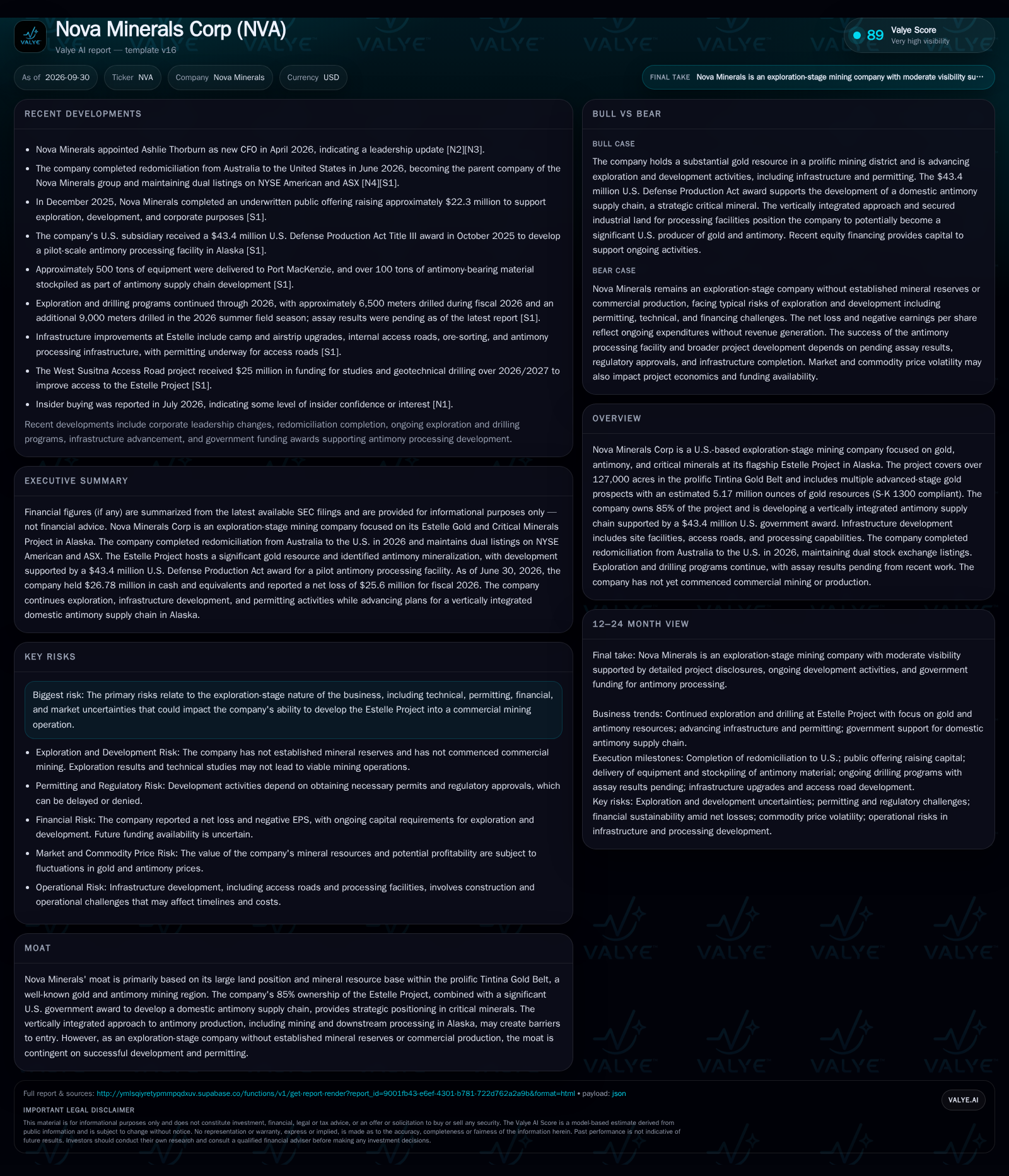
Nova Minerals owns 85% of the Estelle Project in Alaska, with 5.17 million ounces of gold resources and identified antimony occurrences. It received a $43.4 million U.S. government award to develop a pilot antimony processing facility and raised $22.3 million in late 2025. Still pre-commercial, Nova’s thesis hinges on converting resources to reserves, securing permits, and progressing infrastructure—amid commodity price and execution risks. [S1]
Nova Minerals Corp sits at a pivotal juncture in the North American mining landscape. With a commanding position in Alaska’s Tintina Gold Belt and 5.17 million ounces of gold resources, the company is aiming to parlay its vast land package into a dual gold and antimony play. A $43.4 million U.S. government award for antimony processing and recent financing have bolstered its development runway. Yet, Nova remains an exploration-stage company—pre-revenue, with no established mineral reserves, and subject to the high technical, permitting, and financial uncertainty that typifies early-stage mining ventures. The coming quarters will test whether Nova can convert potential into progress, as infrastructure, assay results, and regulatory milestones come to the fore.
Estelle’s Scale, U.S. Redomicile, and Antimony Backing Define 2026 Backdrop
Nova Minerals’ 85% interest in the Estelle Project encompasses 127,102 acres and 803 mining claims in Alaska’s prolific Tintina Gold Belt—a region known for both gold and antimony resources. As of September 2026, the project holds a S-K 1300-compliant mineral resource of 5.17 million ounces of gold (Measured, Indicated, and Inferred), with Nova’s attributable share at approximately 4.41 Moz. The company completed its redomicile to the U.S. in June 2026, maintaining dual listings on NYSE American and the ASX, signaling a strategic pivot to align with U.S. critical minerals policy. Crucially, Nova’s U.S. subsidiary received a $43.4 million Defense Production Act Title III award in late 2025 to build a pilot-scale antimony processing facility, and the company raised $22.3 million in an underwritten offering that December. While infrastructure development is underway, Nova has not commenced commercial mining or established proven mineral reserves. [S1] [N4]
Resource Conversion, Vertical Integration, and Funding Cycles: How Value May Be Created
Nova’s economic thesis is predicated on converting a substantial resource base into mineable reserves, then leveraging both gold and antimony production to generate revenue. The Estelle Project’s gold resource provides scale, but as with all exploration-stage companies, the transition from resource to reserve is contingent on successful drilling, technical studies, and regulatory approvals. The antimony angle—bolstered by government funding—could enable Nova to vertically integrate mining and downstream processing, potentially capturing higher margins and mitigating U.S. supply chain risk for this critical mineral.
The company’s cost structure is currently dominated by exploration, permitting, and infrastructure outlays, with no offsetting revenue. Fixed costs are likely to remain high until commercial production commences, and the operating leverage inherent in mining will only manifest if/when production ramps. The $43.4 million Title III award and the $22.3 million equity raise provide near-term capital, but Nova’s net loss of $25.6 million in FY2026 and ongoing negative cash flow underscore the need for continued access to external funding—especially given the multi-year timelines typical for permitting and construction. [S1]
If Nova achieves vertical integration in antimony processing, it could benefit from both government procurement incentives and potential offtake agreements, but these economic mechanics are not yet established. Gold revenue, if ultimately realized, would hinge on prevailing bullion prices, recovery rates, and cost control—factors subject to significant volatility and industry-wide cyclicality.
Strategic Land Package and Critical Minerals Focus versus Exploration-Stage Risks
Nova’s main competitive advantage is its large, contiguous landholding in a proven mineral belt and early-mover status in developing a U.S.-based antimony supply chain. The Tintina Gold Belt is host to several major mining operations, and the presence of both gold and antimony gives Nova exposure to two distinct value pools: precious metals and critical minerals. The $43.4 million government award for antimony processing is a differentiator, potentially creating barriers to entry for later-stage competitors lacking public-sector support.
Counterforces are significant. Nova remains pre-revenue and has not yet established mineral reserves, meaning it is exposed to the full suite of exploration-stage risks: unfavorable drilling results, permitting setbacks, technical hurdles, and capital market volatility. Competitor categories include established gold miners, critical minerals developers, and other exploration-stage juniors active in Alaska or North America. Technology substitution risk is low for gold but could rise for antimony if alternative supply chains or materials emerge. Ultimately, the company’s position will be determined by its ability to advance Estelle toward production faster or more efficiently than peers, secure long-term contracts or offtake agreements, and capitalize on its U.S. domicile for regulatory and market access advantages.
If Assays, Permitting, and Infrastructure Deliver: Nova as a Dual Gold–Antimony Producer
A favorable scenario sees Nova’s ongoing drilling and exploration convert a large share of its 5.17 Moz gold resource into proven and probable reserves, while pending assay results confirm commercially viable antimony grades and volumes. Successful permitting—facilitated by local and federal support—enables timely development of both mining and processing infrastructure, including the pilot antimony facility. The West Susitna Access Road project progresses on schedule, improving logistics and reducing operating costs.
In this scenario, Nova leverages its government-backed antimony processing capacity to secure offtake agreements or supply contracts with U.S. end-users, potentially benefiting from strategic procurement initiatives. Gold production, once commenced, generates positive operating cash flow, and the company is able to access lower-cost project or offtake financing. Confirmation would come from positive feasibility studies, reserve upgrades, definitive agreements for antimony sales, and clear regulatory progress. Falsification would be signaled by negative assay results, permitting denials, or project cost overruns that stall development.
Advancement Continues but Commercialization Remains Distant
The most plausible trajectory is that Nova continues to advance exploration and infrastructure at Estelle, but commercialization remains a multi-year prospect. Drilling and studies incrementally improve resource confidence, but not all ounces are upgraded to reserves. Antimony processing infrastructure moves forward, but full-scale production or offtake arrangements are not secured until further technical and regulatory milestones are met.
The company continues to rely on periodic equity raises or government grants to fund ongoing activities, and net losses persist. Gold and antimony prices remain volatile, influencing investor sentiment and funding conditions. Confirmation would be ongoing infrastructure and permitting progress, measured increases in resource confidence, and continued access to capital. Falsification would involve stalled development, inability to raise funds, or unsuccessful technical results from drilling and pilot processing.
Resource Conversion or Permitting Falters, Funding Window Narrows
In an adverse scenario, key assay results disappoint, failing to convert resources to reserves or to confirm commercial antimony grades. Permitting delays or denials—whether due to regulatory, environmental, or community opposition—stall infrastructure and mine development. The West Susitna Access Road project faces setbacks, further impeding logistics.
Without positive technical milestones or regulatory progress, Nova’s ability to raise additional funding erodes, forcing the company to curtail exploration, defer development, or seek dilutive financing on unfavorable terms. Confirmation would be negative or inconclusive assay results, major permitting obstacles, or significant cost overruns. Falsification would come from positive technical studies, successful permitting, or new strategic partnerships/financing that extend the company’s runway despite setbacks.
Milestones and Metrics That Will Determine Nova’s Trajectory
Publication of pending assay results from 2026 drilling—especially for antimony grades and continuity—would clarify resource viability.
Progress on permitting and regulatory approvals for mining, antimony processing, and infrastructure projects, including the West Susitna Access Road.
Updates on feasibility studies or technical reports that convert resources to reserves and clarify project economics.
Announcements of offtake agreements or supply contracts for antimony or gold, which would validate commercial demand.
Disclosure of capital expenditure forecasts, funding needs, or new financing arrangements to gauge runway and dilution risk.
Evidence of material increases in resource confidence (Measured/Indicated categories) or reserve establishment in future technical filings.
Advancement in construction and commissioning of the antimony processing facility, including timelines and initial output targets.
If disclosed, metrics on operating cost estimates, infrastructure buildout pace, and any strategic partnerships that could accelerate development.
Disclaimer: This is research-only, informational analysis and not investment advice. It may include AI-generated interpretation and general industry context. Always verify important details using primary sources.

Comments