
Borealis Foods: E-Commerce Growth Collides with Liquidity Strain and Governance Overhang
The company’s path forward hinges on resolving financing, shareholder approval, and Nasdaq compliance hurdles.
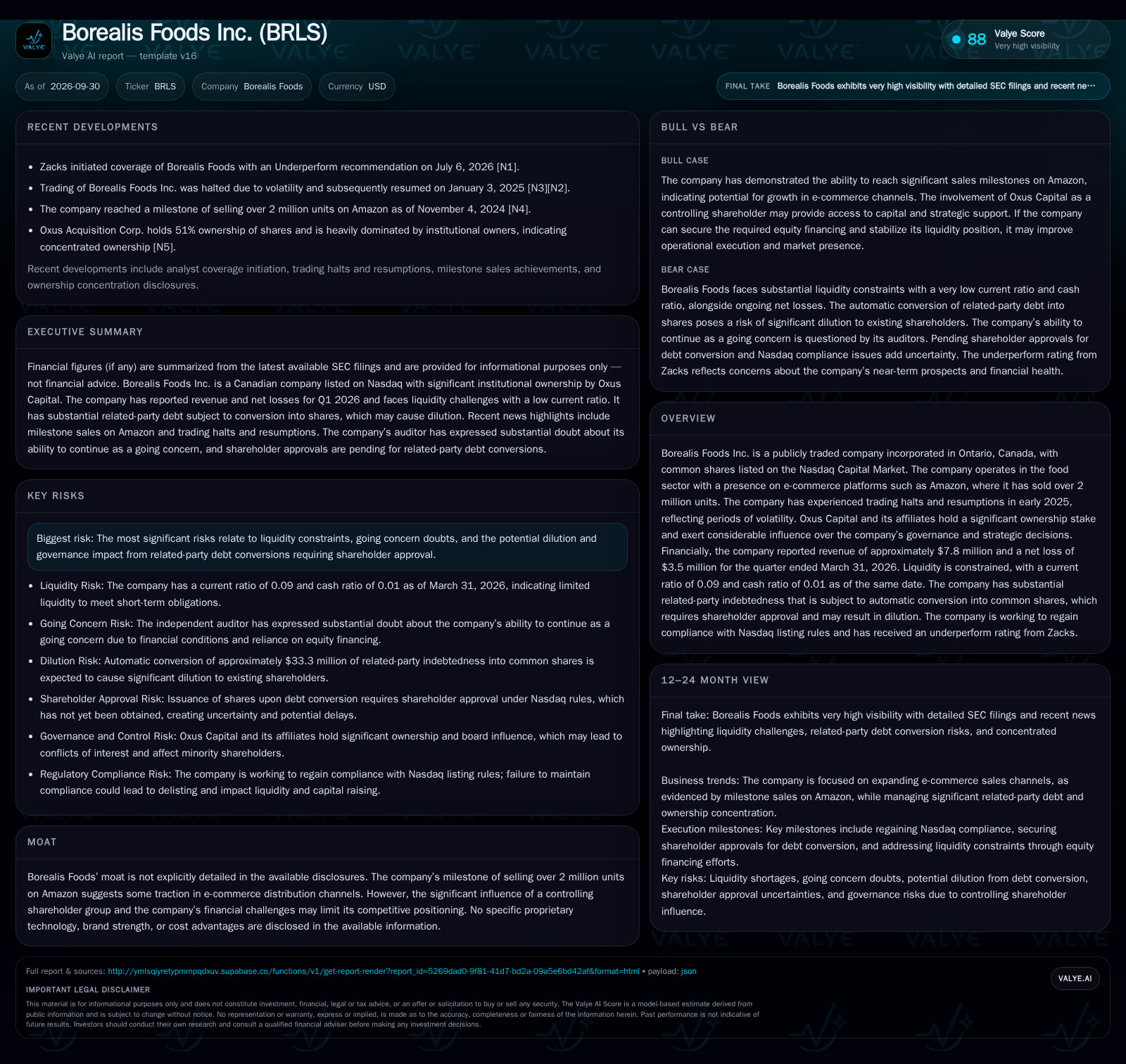
Borealis Foods has surpassed 2 million units sold on Amazon, indicating e-commerce momentum, yet its financial position is precarious with a current ratio of 0.09 and substantial related-party debt subject to conversion. Major shareholder Oxus Capital wields significant influence, and the company’s future depends on securing equity financing, managing dilution, and regaining Nasdaq compliance. An underperform rating and auditor going concern warning underscore the urgency of these challenges. [S2] [N1] [N4]
The automatic conversion of this debt—contingent on shareholder approval—threatens significant dilution, while concentrated ownership by Oxus Capital further complicates governance and strategic direction. With auditors questioning its ability to continue as a going concern and no firm commitments for a required $70 million equity raise, Borealis must urgently resolve its funding, compliance, and approval hurdles to remain a viable player in the food sector. [S2] [N1] [N4]
Liquidity Crisis, E-Commerce Milestone, and Shareholder Overhang Define 2026 Backdrop
As of March 31, 2026, Borealis Foods reported $7.8 million in quarterly revenue but suffered a net loss of $3.5 million. Its balance sheet reveals acute liquidity stress, with just $500,000 in cash and a current ratio of 0.09. The company faces approximately $33.3 million in related-party debt, scheduled for automatic conversion into equity pending shareholder approval—a move that would significantly dilute current shareholders. Meanwhile, the company has demonstrated e-commerce reach by surpassing 2 million units sold on Amazon as of November 2024. However, the auditor’s going concern warning and the absence of committed equity financing highlight the urgency of resolving both funding and governance issues. [S2] [N4]
How Borealis’ Model Could Scale—If Funding and Mix Shift
Borealis Foods’ economics reflect a typical low-margin, asset-light food distribution model, with a heavy reliance on volume growth to offset fixed costs and achieve operating leverage. The company’s e-commerce milestone on Amazon suggests traction in direct-to-consumer channels, which, if scaled efficiently, could offer better margins than traditional retail distribution—provided fulfillment and customer acquisition costs are managed. However, persistent net losses and a negative cash conversion cycle point to a business under strain, likely facing high working capital requirements and thin gross margins.
The capital structure is further complicated by the $33.3 million related-party debt, which, upon conversion, could reduce interest expense but at the cost of severe dilution. The requirement to raise $70 million in equity at a minimum $9 per share is a high hurdle, given the current share price of $1.38, signaling a likely need for renegotiation or alternative funding structures. Absent a dramatic shift in mix toward higher-margin products or a step-change in scale, the company’s economics appear structurally challenged and highly sensitive to cost discipline and funding access. [S2]
Scaling Borealis Foods’ e-commerce operations hinges critically on achieving operational efficiencies that can offset the inherent low-margin nature of food distribution. If the company can leverage data analytics to optimize inventory turnover and reduce fulfillment costs, it could improve its cash conversion cycle and gross margins. However, such improvements are conditional on investments in supply chain technology and logistics partnerships, which themselves require capital. Additionally, a shift toward premium or differentiated product lines with higher margins could materially alter unit economics, but this strategy demands successful brand positioning and consumer acceptance, which are uncertain and time-consuming to develop.
Competitive Leverage in E-Commerce—But No Clear Moat
Borealis’ ability to sell over 2 million units on Amazon demonstrates some operational competence and product-market fit within e-commerce, a channel that can bypass traditional distribution bottlenecks and reach a broad customer base. However, the food sector is intensely competitive, with low switching costs, entrenched incumbents, and a proliferation of private-label and challenger brands. Without evidence of proprietary technology, brand strength, patented formulations, or exclusive supply agreements, Borealis’ competitive position is precarious.
The influence of Oxus Capital offers potential access to capital and strategic direction but also introduces governance risks and potential misalignment with minority shareholders. Unless Borealis can establish clear differentiation—through brand, quality, or unique distribution agreements—its position in the value chain remains exposed to price competition and retailer power, especially as larger players increasingly invest in their own direct-to-consumer infrastructure.
The competitive landscape in e-commerce food retail is characterized by rapidly evolving consumer preferences and increasing pressure from large incumbents investing heavily in private labels and direct-to-consumer channels. Borealis’ ability to sustain growth will depend on its agility in responding to these dynamics, including adapting product offerings and pricing strategies. Moreover, the absence of proprietary assets or exclusive contracts means that the company must continuously innovate in marketing and customer engagement to maintain relevance. This environment also implies that any scale advantage achieved could be quickly eroded if competitors deploy superior technology or leverage deeper capital resources to undercut prices or enhance service levels.
If Borealis Secures Funding and Converts Amazon Traction into Broader Scale
In a favorable scenario, Borealis successfully raises the required $70 million in equity—potentially through renegotiated terms or a strategic investor—thereby stabilizing its balance sheet and regaining Nasdaq compliance. Shareholder approval is obtained for the related-party debt conversion, and the resulting dilution is offset by an accelerated growth trajectory. The company leverages its Amazon track record to expand into other e-commerce platforms and retail channels, driving higher volumes, improved gross margins through scale, and eventual operating profitability.
Evidence confirming this pathway would include the announcement and closing of a substantial equity raise, shareholder approval for debt conversion, news of major new distribution partnerships, and sequential improvements in revenue growth and gross margin. A rising share price toward or above the $9 threshold would further confirm renewed market confidence.
Operational Survival Hinges on Dilution, Cost Control, and Incremental Growth
The most plausible near-term outcome is that Borealis manages to secure only partial financing, possibly at a lower share price than contractually targeted, resulting in significant dilution for existing shareholders. The company implements aggressive cost controls and leverages its Amazon distribution to sustain moderate topline growth, but persistent margin pressure and high working capital needs keep profitability elusive. Shareholder approval for debt conversion is eventually obtained, but the process is contentious and protracted, further weighing on the stock.
Confirmation of this scenario would be piecemeal financing announcements, continued net losses, slow improvement in liquidity ratios, and only modest expansion beyond Amazon. If the company remains on Nasdaq but under continued compliance watch, this would reinforce the view that Borealis is treading water rather than scaling meaningfully.
Liquidity Exhaustion and Governance Gridlock Drive Value Erosion
In a more adverse case, Borealis fails to secure sufficient equity financing and cannot obtain timely shareholder approval for the debt conversion, leaving it unable to meet short-term obligations. Liquidity exhaustion leads to default risk, potential delisting from Nasdaq, and a sharp deterioration in supplier and customer confidence. The governance structure, dominated by Oxus Capital, may further complicate restructuring efforts, especially if minority shareholders resist heavy dilution or challenge board decisions.
Confirmation would come from missed payments, a Nasdaq delisting notice, resignation of key executives or board members, and public disputes among shareholders. In this scenario, value for public equity holders could be severely impaired, with restructuring or asset sales required to satisfy creditors.
Milestones That Will Determine Whether Borealis Can Transition from Survival to Scale
Announcement and successful closing of at least $70 million in equity financing, at or near the $9/share contractual threshold, or any revised terms that materially improve liquidity (if disclosed).
Shareholder approval for the conversion of related-party debt into common shares, including the size and structure of resulting dilution.
Confirmation of Nasdaq compliance or any formal delisting actions.
Quarterly revenue growth rates and gross margin trends, especially as they relate to e-commerce channel expansion (if disclosed).
Disclosure of new distribution agreements or entry into additional retail/e-commerce platforms beyond Amazon.
Cash flow from operations and working capital trends, particularly the ability to improve the cash conversion cycle (if disclosed).
Changes in board composition or ownership structure, especially any reduction or increase in Oxus Capital’s influence.
Updates from the company’s independent auditor regarding the going concern qualification in future filings.
Disclaimer: This is research-only, informational analysis and not investment advice. It may include AI-generated interpretation and general industry context. Always verify important details using primary sources.

Comments