
Longduoduo Co Ltd: Agency Model Exposed to Regulatory Friction and Single-Customer Dependence
Longduoduo’s commission-driven agency structure in China’s preventive healthcare sector delivers modest revenue but is heavily reliant on a single partner and vulnerable to evolving regulatory hurdles affecting cash flows and operational flexibility.
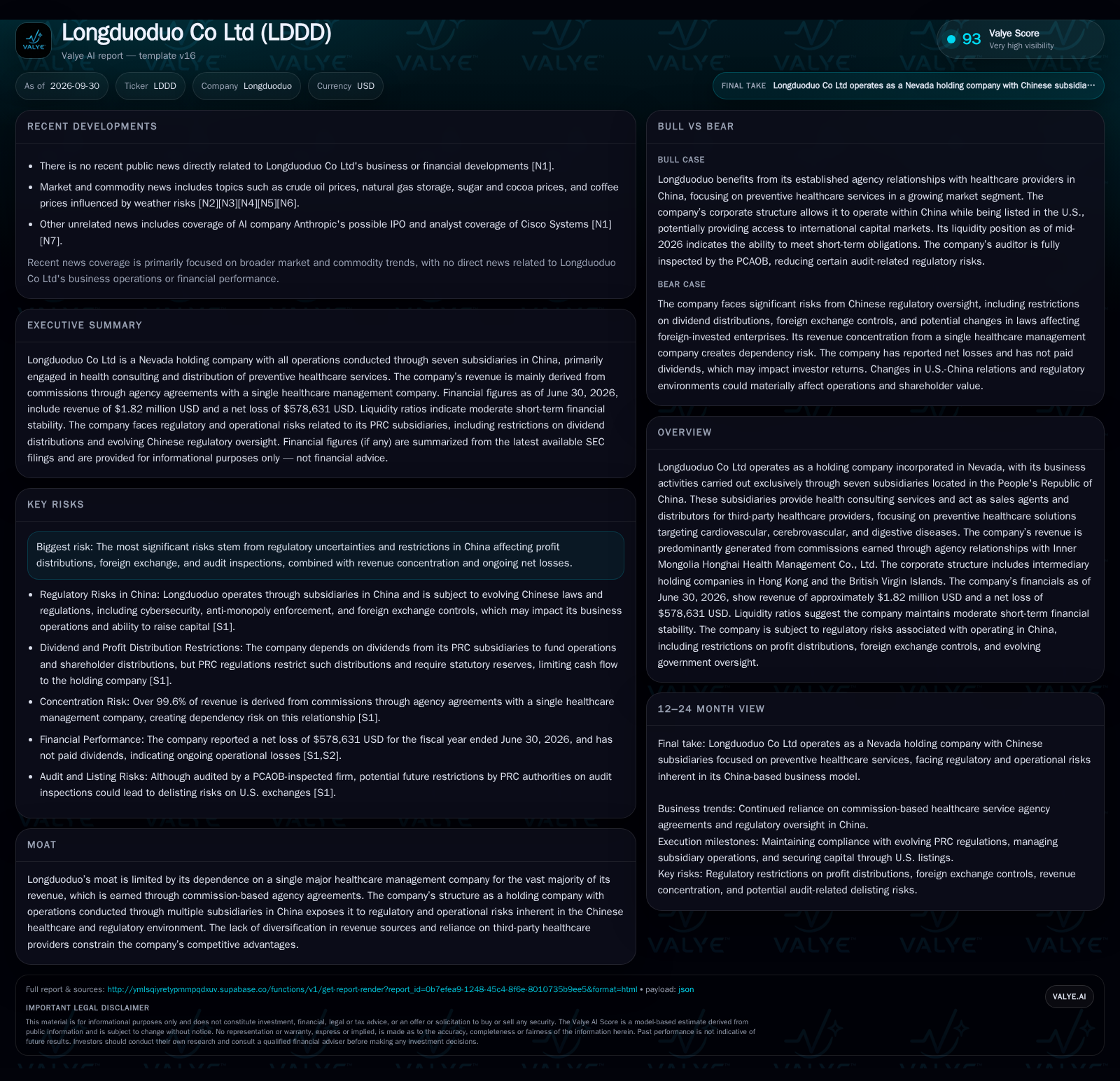
Longduoduo Co Ltd operates as a Nevada holding company with all revenue generated through Chinese subsidiaries acting as sales agents for third-party healthcare providers. Over 99.6% of its revenue depends on commissions from a single agency agreement, while the company carries a net loss and has not paid dividends.
Longduoduo Co Ltd’s business design is a classic example of a U.S.-listed holding company operating exclusively through subsidiaries in China’s healthcare sector. Its agency-focused model delivers all revenues from commission arrangements, but this streamlined approach comes with heightened risks: near-total dependence on a single partner, structural barriers to upstreaming cash, and exposure to regulatory turbulence in China. While the company’s short-term reported liquidity position, the combination of ongoing net losses and external restrictions shapes a fragile pathway forward for both operations and investors.
Concentration, Compliance, and Losses Define the Latest Operating Reality
Longduoduo Co Ltd’s financial and operational profile is defined by three material facts as of June 2026. First, the company’s entire revenue is earned through agency commissions, with over 99.6% tied to a single partner—Inner Mongolia Honghai Health Management Co., Ltd.—under agreements expiring in 2029 [S1]. Second, Longduoduo reported $1.82 million in revenue and a net loss of $578,631 USD for the period ended June 30, 2026, reflecting ongoing operational losses [S1] [S2]. Third, no dividends or distributions have been made by any subsidiary to the parent or by the parent to shareholders, underscoring the persistent challenge of extracting cash from China due to regulatory and statutory barriers [S1].
How the Commission-Driven Agency Model Shapes Revenue, Margins, and Cash Flows
Longduoduo’s core economics are those of a sales agency and distributor for third-party healthcare services. The company does not own clinical facilities or proprietary healthcare IP; instead, it earns commissions for connecting patients or customers to preventive health solutions, particularly for cardiovascular and digestive disorders [S1]. This model is typically asset-light, with revenue recognized as a percentage of sales generated for the principal healthcare provider. Such agency structures can scale rapidly with volume but offer limited pricing power, as commissions are often set by the principal and subject to renegotiation.
Operating leverage is structurally constrained: fixed costs are relatively low, but so are gross margins, and the company’s dependence on a single provider means that volume and pricing are not diversified. Capital needs are modest, as the business does not require heavy investment in physical assets or R&D, but persistent net losses may eventually require external funding if cash burn continues. The ability to upstream cash to the U.S. parent is further compromised by PRC regulations and statutory reserve requirements, making capital allocation and shareholder returns challenging absent regulatory change or improved profitability.
The commission-driven agency model inherently limits Longduoduo’s negotiating leverage with its principal healthcare provider. Since commissions are typically predetermined and subject to periodic renegotiation, the company faces limited ability to improve margins unilaterally. This dynamic constrains both top-line growth and profitability, as any increase in commissions would require alignment with the principal’s strategic priorities and regulatory allowances. Moreover, the agency structure restricts Longduoduo’s capacity to differentiate its offerings beyond volume-driven incentives, making it vulnerable to pricing pressure and competitive encroachment from other intermediaries or direct sales models.
Cash flow generation within this model is also tightly coupled to collection cycles and regulatory compliance. Given the preventive healthcare context, payment timing may be influenced by patient enrollment patterns, reimbursement policies, and service delivery schedules, which can introduce variability in commission inflows. Additionally, PRC foreign exchange controls and mandatory reserves impose structural friction on transferring earnings to the U.S. parent, reducing potential financial flexibility. The cited source reports dividend-related activity; that disclosure alone does not establish dividend-policy continuity, management confidence, or a material constraint on capital flexibility.
Vulnerabilities in a Fragmented, Heavily Regulated Healthcare Services Market
Longduoduo operates in a Chinese healthcare services sector characterized by fragmentation, regulatory oversight, and growing demand for preventive care. As an intermediary, the company’s competitive position is inherently weak: it lacks proprietary technology, branding, or direct patient relationships, and its revenue stream is almost entirely dependent on a single upstream healthcare management company [S1]. This lack of diversification leaves Longduoduo exposed to contract renegotiation risk, termination, or adverse shifts in partner strategy.
Potential substitutes include direct-to-consumer health platforms, hospital-owned outreach programs, and other agency/distribution networks. In China, regulatory compliance and local relationships are critical, but these are not unique to Longduoduo and do not create durable competitive moats. Its U.S. listing and PCAOB-inspected auditor may offer some credibility with foreign investors, but these factors do not mitigate the core business fragility or the difficulty of extracting profits from the PRC system.
If Agency Volume Surges and Regulatory Barriers Loosen, Profitable Scale Could Emerge
A favorable outcome for Longduoduo would require a confluence of higher agency volumes, improved commission terms, and a relaxation of regulatory barriers to cross-border cash flow. If the company’s agency agreements drive a substantial increase in patient referrals or healthcare service sales—either through organic growth in preventive care demand or through new partnerships—operating leverage could improve, and net losses could turn to profit. Should PRC regulators ease restrictions on dividend or profit distributions, Longduoduo might finally be able to return capital to shareholders, improving its investment case.
Confirmation of this scenario would include sustained revenue growth, a shift to operating profitability, disclosure of new or diversified agency agreements, and the announcement of successful upstreaming of profits to the U.S. parent. Falsification would be evident in continued revenue concentration, persistent losses, or further tightening of PRC regulatory controls.
Continued Single-Partner Dependence and Regulatory Friction Keep Growth and Returns Constrained
The most plausible near-term outcome is that Longduoduo continues as a commission agent for its single major healthcare partner, maintaining modest revenue but struggling to achieve profitability or scale. Regulatory barriers will likely persist, limiting the ability to upstream profits and pay dividends, and the company’s lack of diversification means that any disruption to the core agency agreement would materially impact results.
Evidence confirming this scenario would include ongoing dependence on one agency partner, stable but low-margin revenue, continued net losses, and no change in the regulatory environment regarding profit distributions. Falsification would require either a meaningful shift in revenue mix (e.g., new partners or business lines) or regulatory reforms enabling cross-border cash flows.
Agency Agreement Disruption or Regulatory Clampdown Could Trigger Sudden Revenue Collapse
Downside risk is acute: if Longduoduo’s relationship with its sole revenue-generating partner is terminated, not renewed, or materially altered, the company could see a near-complete collapse in revenue. Regulatory changes—such as stricter enforcement of foreign exchange controls, new restrictions on foreign listings, or retroactive compliance demands—could further impair operations or lead to forced delisting from U.S. exchanges.
Confirmation would come from loss of the agency agreement, sudden revenue declines, new or intensified regulatory actions, or adverse changes in the company’s audit status. Falsification would require evidence of contract renewal, regulatory forbearance, or successful business diversification.
What Will Test Longduoduo’s Fragile Business Model in the Next 12–24 Months?
Disclosure of any new agency agreements or major partnerships that would diversify the revenue base beyond Inner Mongolia Honghai Health Management Co., Ltd.
Quarterly trends in revenue concentration—if disclosed—specifically the percentage of total revenue still derived from the core agency relationship.
Any announcement regarding the ability to upstream profits or pay dividends from PRC subsidiaries to the U.S. parent company.
Sustained improvement in net income or a shift to operating profitability, as shown in future filings.
Material changes in PRC regulatory policy affecting foreign-invested enterprises, profit distributions, or audit requirements.
Changes in agency commission rates or contract terms that could impact gross margin.
Disclosure of external financing events, such as capital raises or credit facility drawdowns, that may be required to support ongoing operations.
Updates on PCAOB audit status or any communications regarding compliance with U.S. listing requirements.
Disclaimer: This is research-only, informational analysis and not investment advice. It may include AI-generated interpretation and general industry context. Always verify important details using primary sources.

Comments