
Recon Technology: Oilfield Services, Environmental Diversification, and the Realities of Persistent Losses
Recon Technology, Ltd stands at a strategic crossroads—balancing legacy oilfield equipment and services in China with recent forays into environmental tech and energy additives. While the company has stabilized its Nasdaq listing and narrowed losses, persistent operational challenges and shifting sector dynamics raise questions about whether diversification can meaningfully offset ongoing financial pressures.
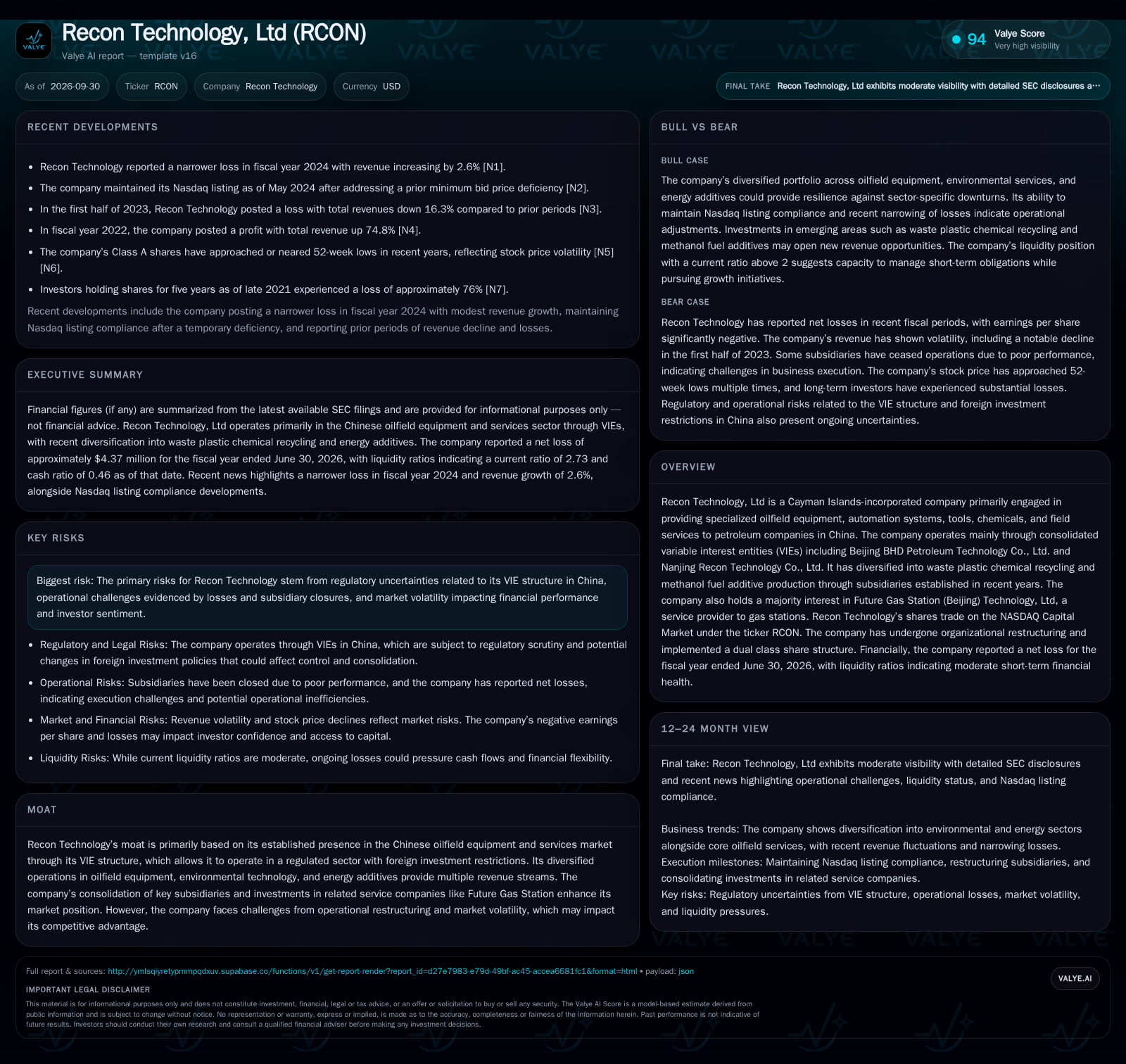
Recon Technology, Ltd remains anchored in the Chinese oilfield equipment market but is attempting to diversify into environmental and energy-adjacent sectors. Despite a recent narrowing of losses and maintaining Nasdaq compliance, the company continues to post net losses and faces volatility in both revenue and share price. The core question is whether its diversified bets and operational adjustments can reverse persistent financial underperformance in the face of sector headwinds and execution risks. [S1] [N1] [N2]
Recon Technology, Ltd faces a pivotal period as it attempts to evolve from a traditional oilfield equipment and services provider in China to a more diversified industrial player. While recent quarters have seen some operational improvements—most notably, a narrowing of losses and the stabilization of its Nasdaq listing—the company continues to struggle with persistent net losses, revenue volatility, and a stock price that has repeatedly flirted with multi-year lows. The company’s moves into waste plastic chemical recycling and methanol fuel additives reflect a strategic push to diversify revenue streams and reduce reliance on the cyclical oil sector. The central issue is whether these efforts can overcome the headwinds of operational complexity, regulatory constraints, and long-standing financial underperformance.
Recent Financial Performance and Strategic Shifts
Recon Technology reported a net loss of approximately $4.37 million for the fiscal year ended June 30, 2026, despite a modest 2.6% increase in revenue for fiscal 2024. Following a Nasdaq notification in May 2026 for failing to maintain a minimum $1.00 bid price, Recon regained compliance by September 2026. These developments matter because they underscore both the company’s operational fragility and its ability to make near-term adjustments to avoid the most acute financial or regulatory consequences. [S1] [S2] [N1]
Revenue Streams, Cost Structure, and Economic Levers
Recon Technology’s core business remains the provision of specialized oilfield equipment, automation systems, tools, chemicals, and field services to petroleum companies in China, primarily conducted through variable interest entities (VIEs). This model is characterized by project-based revenues, lumpy order cycles, and exposure to the capital spending patterns of large oil and gas clients. Margins in oilfield services can be volatile, often fluctuating with utilization rates and pricing power, which are themselves driven by broader oil sector investment cycles.
The company’s diversification into waste plastic chemical recycling and methanol fuel additives represents an attempt to create new, potentially higher-margin and less cyclical revenue streams. However, these newer business lines likely involve substantial upfront investment, uncertain customer adoption curves, and unproven economics at scale. Environmental remediation and chemical recycling in China are highly competitive and often subject to regulatory scrutiny. If these initiatives gain traction, fixed-cost leverage could improve, but persistent net losses suggest that Recon has yet to achieve sufficient scale or pricing power in its new segments.
Operating leverage remains a double-edged sword: while asset-heavy segments could amplify earnings if utilization rises, ongoing losses indicate Recon’s current revenue base cannot cover its cost structure, especially with subsidiary closures and restructuring expenses. Access to capital—and the terms on which it can be raised given persistent losses and share price volatility—will influence the pace and success of further diversification.
Industry Positioning: Incumbency, Diversification, and Barriers
Recon Technology’s established presence in China’s oilfield equipment and services sector provides some degree of customer familiarity and operational know-how, especially through its VIE structure, which enables participation in sectors restricted to foreign direct investment. This incumbency, however, is not a guarantee of durable advantage, as the sector is characterized by periodic overcapacity, price competition, and shifting procurement priorities among state-owned and large private oil companies.
Diversification into environmental services and energy additives exposes Recon to new sets of competitors, including specialized environmental tech firms, chemical companies, and state-backed enterprises with deeper pockets and stronger regulatory relationships. The company’s ability to carve out durable niches in these markets will depend on differentiated technology, cost efficiencies, or regulatory advantages—none of which are established in the current factual record.
The consolidation of Future Gas Station (Beijing) Technology, Ltd. could provide some incremental data and service capabilities, but it is unclear whether this investment translates into recurring, high-margin revenues or simply broadens exposure to another low-margin, competitive segment.
How Diversification Could Offset Oilfield Cyclicality
The bull case for Recon Technology rests on the successful scaling of its environmental and energy-additive segments, creating new sources of growth and margin expansion that are less tied to oil sector capex cycles. If waste plastic chemical recycling or methanol additive products achieve commercial adoption—supported by favorable regulatory trends or customer wins—these businesses could deliver operating leverage and stabilize cash flows.
Success would be confirmed by a sustained shift in revenue mix toward environmental and new energy segments, improving gross margins, narrowing operating losses, and a reversal of subsidiary closures. Announcements of multi-year contracts in environmental remediation, regulatory approvals for new chemical products, or large-scale customer adoption would also support the upside case.
Falsification would come from continued revenue stagnation or declines in non-oilfield segments, persistent net losses, and further closures or divestitures of newly launched subsidiaries.
Incremental Adjustments Amid Persistent Headwinds
The most plausible path for Recon Technology is one of gradual operational adjustment but continued struggle to achieve consistent profitability. The company may succeed in stabilizing core oilfield services revenue while realizing modest growth from environmental or energy-adjacent initiatives. However, these segments are unlikely to rapidly offset the scale and margin pressures of the legacy business, especially if capital constraints or execution missteps persist.
Evidence for this scenario would include continued moderate revenue growth, periodic narrowing of losses without a clear return to profitability, and ongoing restructuring or portfolio adjustments. The maintenance of Nasdaq compliance and avoidance of acute liquidity crises would indicate successful navigation of near-term risks, but not a decisive break from the company’s historical pattern of volatility and underperformance.
When Diversification Fails to Deliver: Erosion and Exit Risks
The bear case materializes if Recon’s diversification efforts fail to deliver scale or profitability, and core oilfield services continue to face pressure from sector overcapacity, declining investment, or technological substitution. Persistent net losses could erode remaining liquidity, forcing further asset sales, subsidiary closures, or dilutive capital raises.
Downside confirmation would include accelerating revenue declines, widening losses, repeated Nasdaq compliance issues, and the shuttering of recently established subsidiaries in environmental or energy segments. Regulatory changes impacting VIE structures or foreign listings could further amplify risk, potentially forcing a delisting or restructuring event.
What Will Determine Whether Recon’s Pivot Gains Traction?
Quarterly revenue breakdowns by segment—especially environmental and new energy businesses—would help test whether diversification is delivering material growth (if disclosed).
Gross margin trends and operating expense ratios for both legacy and new business lines will indicate progress toward profitability and cost discipline.
Announcements of large, recurring contracts or regulatory approvals in recycling or energy additives would signal commercial momentum.
Updates on subsidiary closures, asset sales, or further restructuring moves would reveal execution risks and capital allocation priorities.
Disclosure of customer concentration in oilfield services or new segments would clarify risk exposure and reliance on key clients.
Nasdaq listing status and any further notifications or compliance events will remain a litmus test for capital market viability.
Cash burn rates and any new financing or capital raise announcements will show how much runway remains to execute on the diversification thesis.
Regulatory changes in China affecting VIE structures or foreign company operations could rapidly reshape Recon’s operating environment.
Disclaimer: This is research-only, informational analysis and not investment advice. It may include AI-generated interpretation and general industry context. Always verify important details using primary sources.

Comments