
Dogness (International) Corp: Minimal Revenue, Deep Losses, and the Search for Viable Business Leverage
Dogness (International) Corp faces acute profitability and operating challenges, with modest revenues and substantial net losses despite management’s cost-control gestures and ongoing Nasdaq listing. The company’s ability to pivot its business model or unlock latent value remains unproven amid persistent market volatility and limited operational disclosure.
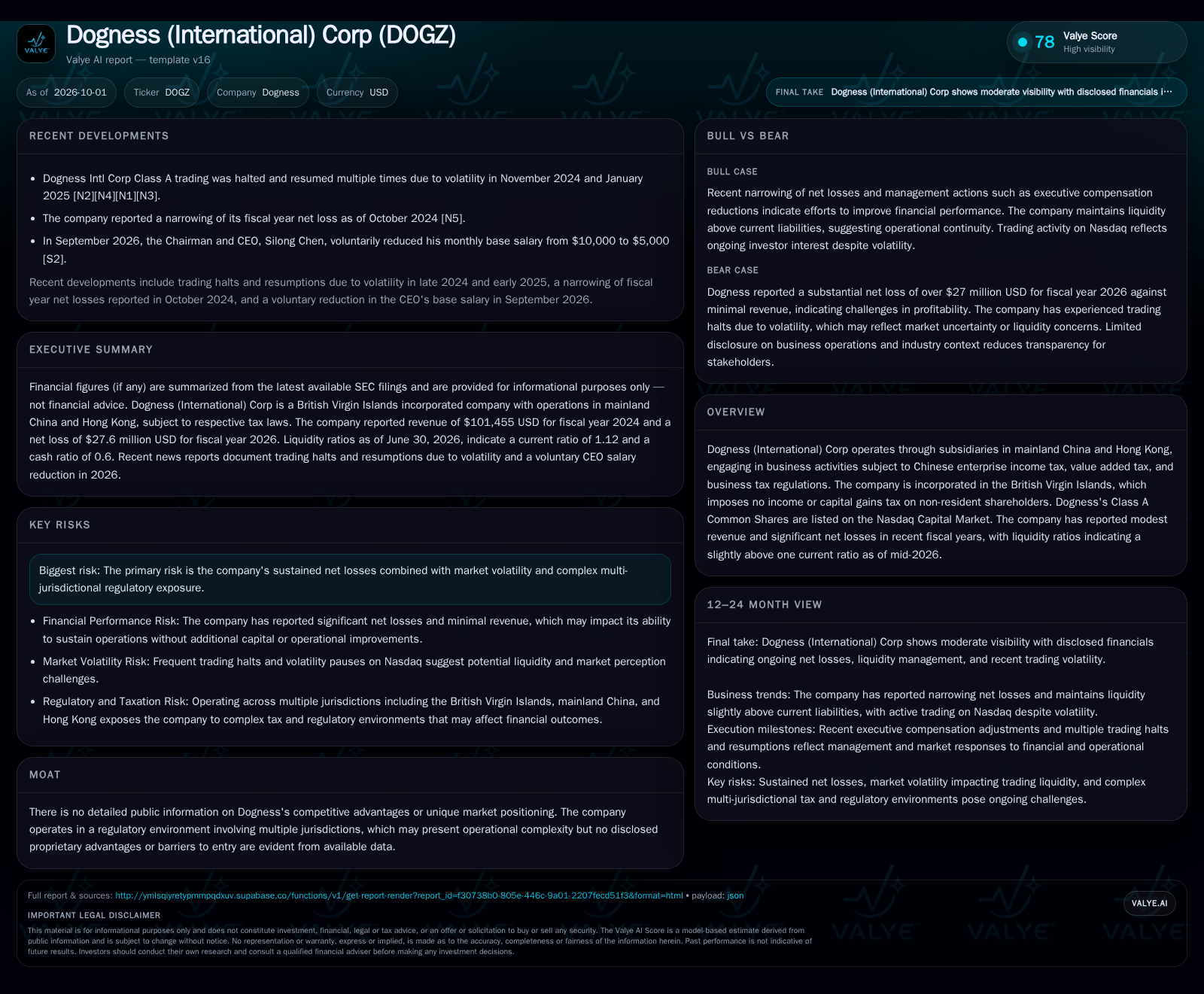
Dogness reported just $101,455 in revenue for fiscal 2024 and a net loss exceeding $27 million for fiscal 2026, underscoring a severe disconnect between topline generation and cost structure. While liquidity ratios remain marginally above minimum thresholds and the CEO implemented a voluntary pay cut, the business lacks visible traction or a clear path to sustainable economics. Ongoing trading volatility and regulatory complexity further cloud the outlook, putting the onus on management to demonstrate a credible turnaround or strategic shift. [S1] [S2] [N1] [N2] [N3] [N4] [N5]
Dogness (International) Corp stands at a precarious juncture, with its recent financials laying bare a business struggling to generate meaningful revenue while absorbing persistent, outsized losses. Despite maintaining Nasdaq listing and liquidity just above minimal thresholds, the company’s cost structure and market positioning remain deeply misaligned. Recent management actions, including a CEO pay cut, reflect efforts at financial discipline, but without a visible pivot in strategy or operations, the company’s prospects hinge on its ability to fundamentally reset or reinvent its business model.
Recent Results Highlight Severe Revenue Shortfall and Persistent Losses
For the fiscal year ended June 30, 2024, Dogness reported revenue of only $101,455, while for the fiscal year ended June 30, 2026, it recorded a net loss of $27,629,171 and negative earnings per share of -$1.55. As of June 30, 2026, the company held cash and cash equivalents of $4,486,907, with current assets of $8,496,595 and current liabilities of $7,600,401, producing a current ratio of 1.12 and a cash ratio of 0.6. These metrics highlight a business operating with minimal topline inflow but absorbing substantial fixed or overhead costs, raising urgent questions about the sustainability of operations without a dramatic improvement in commercial traction or cost structure. The CEO’s voluntary salary reduction in September 2026 further underscores management’s recognition of financial strain. [S1] [S2]
Revenue Model and Cost Structure: Disconnects and Capital Constraints
Dogness’s revenue base is negligible relative to its cost structure, as evidenced by the $101,455 revenue versus a $27.6 million net loss. This suggests that either the company’s business model is in a dormant state, or it is incurring fixed overheads (such as R&D, administrative, or regulatory costs) that are not supported by current operations. The absence of disclosed business lines, recurring contracts, or high-margin products in public filings makes it difficult to ascertain the intended economic engine.
Under typical circumstances, a company with such a low revenue base would be expected to operate with minimal expenses, unless maintaining intellectual property, regulatory licenses, or infrastructure in anticipation of future growth. Without a reset in operating leverage—either via revenue growth or steep cost cuts—Dogness faces ongoing capital needs, and its ability to self-fund or attract new investment appears increasingly tenuous.
From a capital allocation perspective, the persistence of large net losses without corresponding revenue growth raises questions about the efficiency of resource deployment. If the company is investing heavily in areas such as research and development or regulatory compliance, the lack of disclosed milestones or patents weakens the argument for long-term value creation. Conversely, if overhead costs are predominantly administrative or legacy expenses, a strategic cost rationalization could be warranted. However, without clear visibility into fixed versus variable cost components, it is challenging to model potential breakeven scenarios or assess the scalability of any future revenue streams.
Market Standing: Absence of Differentiation and Exposure to Regulatory Complexity
There is no evidence of a unique competitive advantage, proprietary technology, or strong customer relationships for Dogness. The company operates subsidiaries in mainland China and Hong Kong and is incorporated in the British Virgin Islands, exposing it to multi-jurisdictional tax and regulatory regimes. While this structure may offer certain tax efficiencies or market access, it also introduces operational complexity without an apparent moat.
Given the lack of disclosed product traction, recurring revenue, or visible partnerships, Dogness may be at risk from both local and international competitors with stronger distribution, brand, or technology. The company’s ability to withstand pricing pressure, attract new customers, or defend market share is not established, suggesting its position is vulnerable to both direct competition and substitute offerings. The trading volatility of its shares further implies a lack of investor conviction in a differentiated business model.
The multi-jurisdictional corporate structure, while potentially advantageous for tax planning, also introduces operational risks that can dilute focus and increase compliance costs. In industries where regulatory environments are rapidly evolving, companies without a differentiated product or service offering may find it difficult to justify the overhead associated with cross-border operations. Additionally, the absence of recurring revenue or subscription-based models limits predictability and heightens vulnerability to market fluctuations. This lack of a stable revenue base often necessitates a reliance on capital markets, which can be volatile and unforgiving for companies without clear growth narratives or defensible market positions.
What a Credible Turnaround Would Require—and How It Could Be Recognized
A plausible upside scenario would involve Dogness either revitalizing a dormant commercial line (e.g., launching a new product, securing a distribution partnership, or entering a high-margin niche) or drastically reducing its cost base to align with current revenue realities. Evidence supporting this would include a rapid inflection in revenue—such as several consecutive quarters of material topline growth, new customer wins, or disclosed contracts with recurring terms.
Alternatively, if Dogness were to announce or execute a strategic transaction (e.g., asset sale, licensing deal, or business combination), this could unlock value or create a new business model foundation. Confirmation would come from disclosed deal terms, improved gross margins, or guidance pointing to future operating leverage. The upside case is contingent on visible operational or strategic change—mere cost discipline without revenue growth is unlikely to suffice.
Stagnation and Incremental Cost Control Amid Ongoing Losses
The most plausible near-term scenario is continued marginal operations, with management implementing incremental cost controls (as signaled by the CEO’s pay cut) but failing to materially improve revenue or restructure the business. Under this scenario, Dogness would likely report persistent net losses, maintain liquidity just above minimum thresholds, and periodically experience trading volatility due to thin float and low investor confidence.
Evidence confirming this scenario would be continued low revenue, stagnant or declining operating expenses, and a lack of new commercial disclosures. Falsification would require either a step-change in revenue or a major restructuring announcement. The risk is that, absent a pivot, the company could face eventual delisting or be forced to seek additional capital on unattractive terms.
Deterioration: Liquidity Erosion, Regulatory Risks, and Potential Delisting
The negative case centers on further revenue stagnation, continued heavy net losses, and gradual erosion of the company’s liquidity position. Should cash and current assets fall below liabilities, Dogness could face solvency pressure, inability to meet obligations, or forced asset sales. Regulatory or compliance lapses—given the cross-jurisdictional structure—could further exacerbate risks or trigger penalties.
Nasdaq trading halts and volatility already signal fragile market confidence; further deterioration could prompt delisting proceedings or restrict access to capital markets. Confirmation of this scenario would include declining liquidity ratios, auditor going-concern warnings, or public notices of regulatory or listing compliance issues.
Operational and Strategic Benchmarks That Will Define Dogness’s Future
Quarterly revenue growth or new product/contract announcements—if disclosed—would provide evidence of a commercial rebound.
Gross margin trends, if available, would indicate whether any incremental sales are translating into improved economics.
Disclosure of new strategic partnerships, asset sales, or business combinations would be critical in testing the turnaround narrative.
Nasdaq compliance updates, including notices of minimum bid price or market cap violations, would help gauge listing risk.
Management commentary on business model evolution or restructuring efforts would clarify strategic direction.
Changes in operating expense structure—particularly R&D or SG&A—would reveal the depth of cost control measures.
Any regulatory or tax-related disclosures regarding operations in China or Hong Kong could materially affect the risk profile.
Disclaimer: This is research-only, informational analysis and not investment advice. It may include AI-generated interpretation and general industry context. Always verify important details using primary sources.

Comments