
TD SYNNEX: Scaling Integration and Solutions Amid Industry Shifts and Margin Expansion
TD SYNNEX’s recent growth reflects a strategic pivot toward higher-value solutions, AI infrastructure momentum, and the integration of cloud commerce platforms. As the IT distribution landscape evolves, the company’s ability to leverage operating scale, manage margin pressures, and orchestrate complex vendor-customer relationships will determine the durability of its moat and future economic upside.
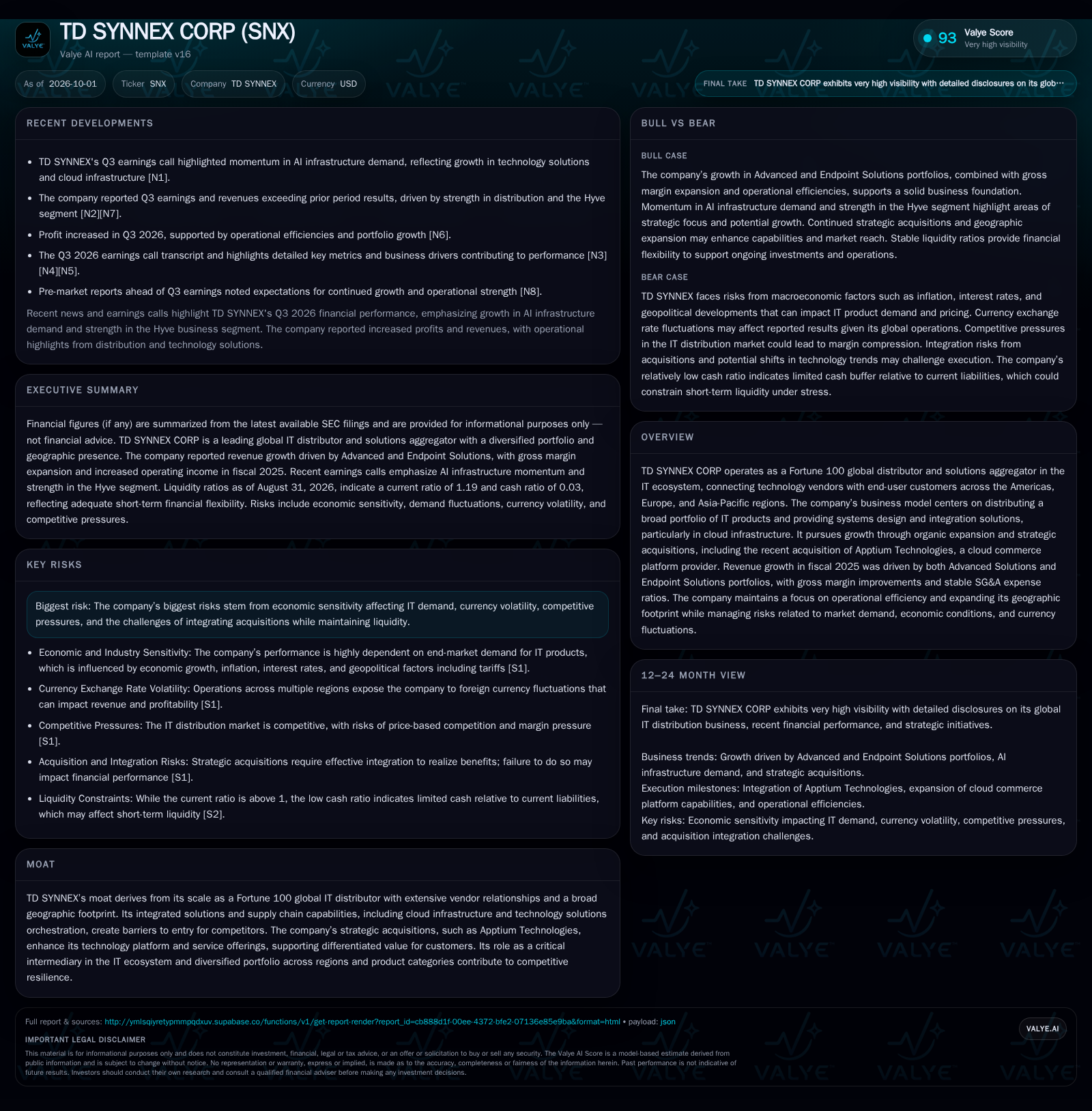
TD SYNNEX posted fiscal 2025 revenue of $62.5 billion (up 6.9%), with gross margin expanding to 6.99% and operating income up 18.5%, driven by strength in Advanced and Endpoint Solutions and AI infrastructure demand. The core thesis hinges on TD SYNNEX’s ability to sustain margin gains and capitalize on new IT consumption models amid intensifying competition and shifting vendor-customer dynamics. [S1] [S2] [N1] [N2]
TD SYNNEX, a Fortune 100 global IT distributor and solutions aggregator, has navigated a period of notable growth and strategic transformation. Fiscal 2025 saw both revenue and margin expansion, fueled by momentum in advanced IT solutions and the rising demand for AI infrastructure. The company’s acquisition of Apptium Technologies signals a move to deepen its role as a technology orchestrator, integrating cloud commerce capabilities. The company’s future will depend on its ability to leverage scale, execute acquisitions, and adapt to evolving IT consumption models.
Recent Performance Highlights Strategic Shifts and Growth Drivers
TD SYNNEX reported fiscal 2025 revenue of approximately $62.5 billion, up 6.9% year-over-year, with gross margin expanding to 6.99% from 6.81%. Operating income increased 18.5% to $1.41 billion, and non-GAAP operating income rose 9.7% to $1.78 billion, indicating improved profitability and operational leverage [S1]. The company attributed revenue growth to strong performance in its Advanced Solutions and Endpoint Solutions portfolios, partially offset by product mix changes that negatively impacted reported revenue growth due to net revenue presentation [S1].
The acquisition of Apptium Technologies in July 2025 marks a strategic step into cloud commerce platforms, aligning with TD SYNNEX’s vision of technology solutions orchestration [S1]. Recent Q3 2026 results and earnings calls highlight momentum in AI infrastructure demand and robust performance in the Hyve segment, reinforcing the company’s positioning in high-growth IT infrastructure areas [N1] [N2].
As of August 31, 2026, TD SYNNEX held $749 million in cash and equivalents, with current assets of $32.9 billion and current liabilities of $27.6 billion, resulting in a current ratio of 1.19 and a cash ratio of 0.03 [S2]. These metrics reflect adequate, though not ample, short-term liquidity.
How Scale, Mix, and Integration Shape Profitability
TD SYNNEX’s core business model is built on high-volume, low-margin distribution of IT hardware, software, and services, augmented by value-added solutions and integration services. The company earns revenue primarily through the sale of IT products sourced from original equipment manufacturers (OEMs) and increasingly through bundled solutions that incorporate cloud, AI, and managed services.
Gross margin expansion to 6.99% in fiscal 2025 suggests that TD SYNNEX is successfully shifting its revenue mix toward higher-value offerings, such as Advanced Solutions, which typically command better margins than commodity hardware [S1]. The integration of Apptium Technologies may further enable TD SYNNEX to capture recurring revenue streams from cloud commerce platforms and software-driven orchestration, although the commercial structure and contribution of these services remain to be fully disclosed.
Operating leverage is evident in the 18.5% increase in operating income on 6.9% revenue growth, indicating that incremental sales from higher-margin solutions flow more efficiently to the bottom line [S1]. However, the business remains capital-intensive, with significant working capital requirements to support inventory and receivables. [S2]
Barriers, Differentiation, and Evolving Threats in IT Distribution
TD SYNNEX’s competitive position is underpinned by its scale, global reach, and extensive vendor relationships, which enable it to offer a broad portfolio of products and solutions spanning the IT ecosystem. As a Fortune 100 distributor, it acts as a critical intermediary, aggregating demand for vendors and providing integration, logistics, and support services for customers.
The recent focus on advanced solutions, cloud, and AI infrastructure differentiates TD SYNNEX from pure-play commodity distributors and positions it to compete for higher-value, more complex integration projects. Strategic acquisitions, such as Apptium Technologies, can deepen this differentiation by enabling orchestration of multi-vendor cloud and commerce platforms.
However, the industry remains highly competitive, with margin compression risks driven by price-based competition and the growing presence of alternative distribution channels, including direct sales and cloud marketplaces. Technology vendors are increasingly experimenting with direct-to-customer models, and hyperscalers may bypass traditional distributors for some solutions. The company’s ability to maintain its moat will depend on continuing to add value beyond logistics—through integration, lifecycle services, and platform capabilities.
Unlocking Value Through Solutions Orchestration and AI-Driven Demand
A favorable trajectory for TD SYNNEX would see sustained growth in advanced solutions and cloud commerce platforms, with the Apptium Technologies acquisition accelerating the company’s transition to a technology orchestrator. In this scenario, AI infrastructure demand continues to surge, driving higher-margin opportunities in data center, hyperscale, and enterprise integration projects.
If TD SYNNEX can deepen its role as a trusted aggregator and integrator—offering bundled solutions, managed services, and early engagement in the customer lifecycle—it could capture a greater share of IT spend and improve retention. Gross margin could further expand if recurring revenue streams from software and services become more material.
Evidence that would confirm this scenario includes continued gross margin expansion, growth in the Hyve and cloud platform segments, and disclosure of rising recurring or services-based revenue as a share of the total. Announcements of large, multi-year integration deals or expanded strategic partnerships with leading AI and cloud vendors would also provide confirmation.
Sustaining Growth Amid Margin Pressures and Cyclical Demand
The most plausible outcome is that TD SYNNEX maintains modest top-line growth driven by ongoing IT refresh cycles, incremental gains in advanced solutions, and selective integration wins. Gross margin remains stable to slightly improving as the company balances traditional distribution with higher-value services, but competitive pressures and price-based rivalry constrain the pace of expansion.
The integration of Apptium Technologies and other recent acquisitions delivers operational synergies, but the overall contribution to profitability is gradual rather than transformative. Working capital needs remain high, and short-term liquidity is managed carefully. The company continues to navigate cyclical end-market demand and currency volatility, leading to periodic fluctuations in reported results.
This scenario would be confirmed by revenue and gross margin trends that track close to recent historical levels, stable SG&A ratios, and no material change in the mix of recurring versus transactional revenue. Modest increases in services or solutions revenue, without a dramatic shift in business model, would support this base case.
Margin Compression and Disintermediation Risks in a Changing Channel
A negative chain of events could be set in motion by a downturn in IT spending, triggered by macroeconomic contraction, persistent inflation, or geopolitical disruptions. Such a scenario would likely pressure both revenue and margins, as vendors and customers become more price-sensitive and competition intensifies among distributors.
Margin compression could accelerate if large OEMs or hyperscalers expand direct sales channels or if cloud marketplaces further disintermediate traditional distribution. Integration risks from recent acquisitions might lead to higher costs or operational missteps, undermining the anticipated benefits of platform expansion.
Liquidity could become a more acute concern if cash generation weakens during a downturn, given the company’s reported cash balance relative to current liabilities. This scenario would be confirmed by declining gross margin, shrinking operating income, rising SG&A as a percentage of gross profit, or evidence of lost major vendor or customer relationships.
Milestones and Metrics That Will Test TD SYNNEX’s Strategic Evolution
Gross margin trends by segment—continued improvement would support the thesis of a higher-value solutions mix.
Revenue growth rates in the Advanced Solutions, Endpoint Solutions, and Hyve segments, if disclosed, to assess contribution from higher-margin areas.
Recurring revenue or services-based revenue as a percentage of total, if disclosed, to monitor progress toward platform and orchestration goals.
Integration milestones and disclosed synergies from Apptium Technologies and other acquisitions, including cost savings and new service launches.
Vendor concentration and customer retention rates—any material changes could signal risk of disintermediation or loss of strategic relationships.
Working capital efficiency metrics, such as days sales outstanding and inventory turnover, to track operational discipline in a capital-intensive model.
Announcements or disclosures regarding new strategic partnerships or large, multi-year integration contracts in AI/cloud infrastructure.
Disclaimer: This is research-only, informational analysis and not investment advice. It may include AI-generated interpretation and general industry context. Always verify important details using primary sources.

Comments