
Global Asset Management Group: Asset Acquisitions, Liquidity Strain, and the Search for Economic Viability
The real test is whether its acquisition-driven model can overcome financial headwinds and unlock sustainable value before funding options narrow further.
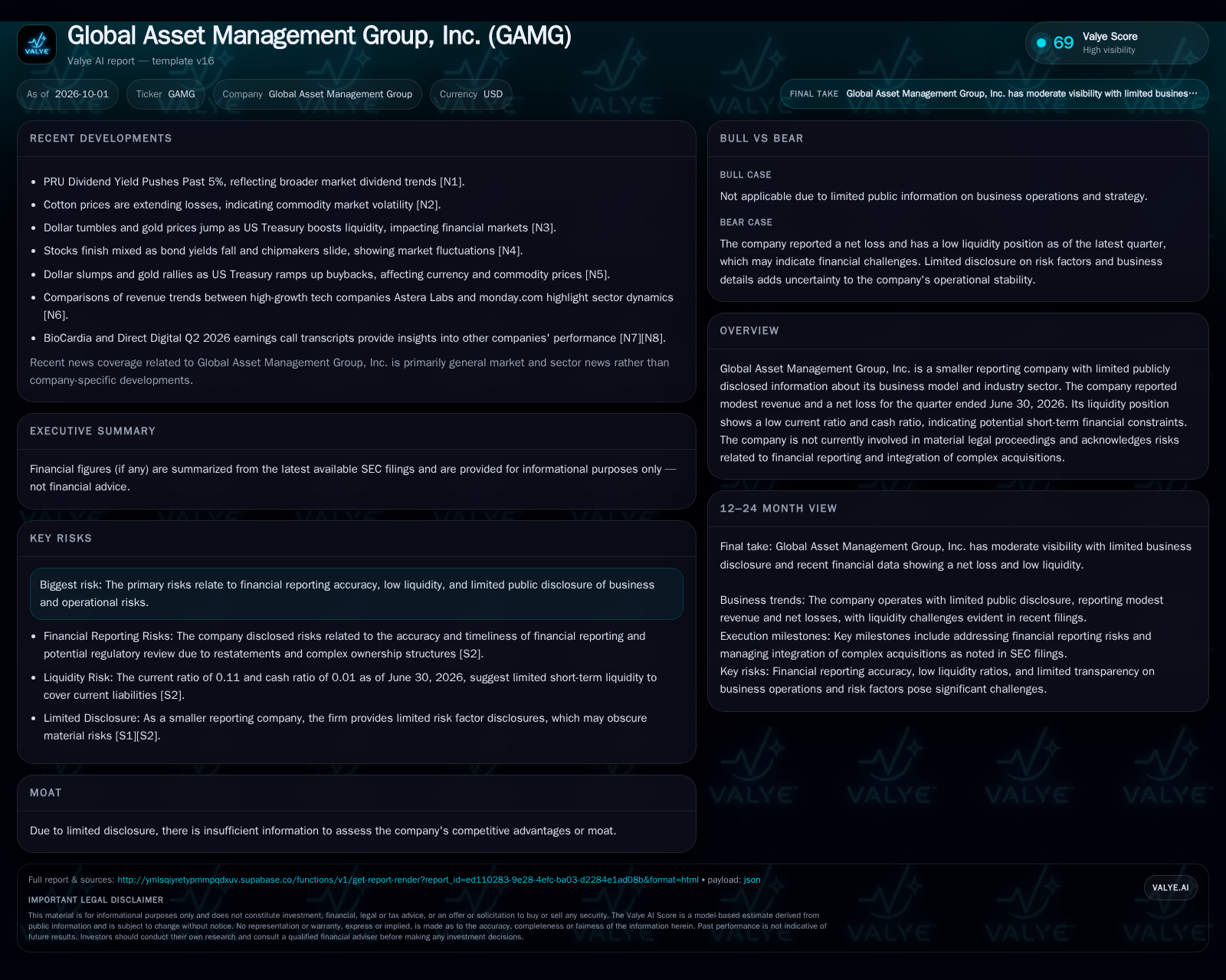
Global Asset Management Group, Inc. reported modest revenue and a significant net loss for the quarter ended June 30, 2026. Despite completing four asset acquisitions in early 2026, the company’s liquidity position remains extremely tight, with a current ratio of 0.11 and substantial convertible debt. [S2]
Global Asset Management Group, Inc. (GAMG) is navigating a period of aggressive asset accumulation amid persistent financial strain. Having completed four asset acquisitions in rapid succession—primarily funded through stock issuance and promissory notes—GAMG’s future now hinges on whether these newly acquired assets can be integrated effectively and generate sufficient cash flows to stabilize operations. The company’s strategy and financial structure pose unresolved questions about sustainability and risk.
Recent Acquisitions and Financial Strain Define the Current Landscape
Global Asset Management Group reported $236,261 in revenue and a net loss of $735,998 for the quarter ending June 30, 2026, signaling ongoing operating losses despite recent expansion. During the first half of 2026, the company completed four significant asset acquisitions—including AMT Management LLC, Sustainable Properties, LLC, RI Property Holdings, Inc., and Memorial Real Estate Group LLC—using a mix of stock and convertible promissory notes rather than cash. As a result, current assets of $1.54 million are dwarfed by current liabilities of $13.99 million, producing a current ratio of just 0.11 and a cash ratio of 0.01. Notes payable, primarily convertible debentures and related-party loans, now total $12.36 million. These facts underscore that GAMG is betting heavily on asset roll-ups, but is under acute liquidity and solvency pressure. [S2]
Asset Aggregation Model: Promise and Pitfalls
GAMG’s business model appears to center on acquiring real estate and management entities, likely aiming to generate income from property operations, management fees, or asset appreciation. However, the lack of disclosed operating details—such as asset-level revenue, occupancy, or management contracts—clouds visibility into the actual earnings potential of the acquired businesses. The company reported cash and liquidity metrics for the period; these figures do not by themselves establish operating runway, investment capacity, financial flexibility, or financing capacity. Fixed costs likely rise as more assets are consolidated, but without scale-driven revenue gains or margin expansion, operating leverage could turn negative.
The scalability of GAMG's asset aggregation model critically depends on its ability to realize operational synergies across acquired entities. This includes consolidating back-office functions, streamlining property management, and leveraging unified technology platforms. However, such integration efforts often require upfront investment and carry execution risks, particularly when acquisitions vary in size, geographic location, or operational maturity. Furthermore, the model’s success hinges on the stability and predictability of underlying cash flows; volatile rental incomes or management fees could undermine financial projections and strain liquidity. Evaluating the model’s robustness would benefit from metrics such as pro forma EBITDA margins post-acquisition and the pace of cost synergy realization.
Another dimension to consider is the capital structure implications of relying heavily on convertible notes and equity issuance to fund acquisitions. While this approach preserves cash in the short term, it introduces dilution risk and increases financial leverage, potentially constraining future financing options. The interplay between debt covenants, interest obligations, and equity dilution creates a complex capital management environment. If asset performance does not meet expectations, the company may face refinancing challenges or forced asset disposals to meet obligations. A useful metric to assess potential financial flexibility would be the ratio of operating cash flow to total debt service requirements over multiple quarters.
Strategic Positioning and Sector Challenges
Without robust disclosure, it is difficult to assess GAMG’s competitive differentiation. The company’s asset aggregation and roll-up approach is common in real estate and asset management, where scale can unlock synergies, bargaining power, and operational efficiencies—if integration is well executed. However, the company faces several counterforces: reported liquidity position restricts its ability to invest in or upgrade properties, while the use of convertible debt and equity may dilute existing shareholders. In sectors such as real estate, competition is fierce, with established players enjoying access to lower-cost capital, better deal flow, and operational expertise. Should GAMG fail to realize cost synergies or asset appreciation, it risks being outcompeted or forced to divest assets at unfavorable terms.
GAMG’s competitive positioning is also influenced by its ability to differentiate service offerings and asset quality within a crowded real estate management sector. Achieving scale through acquisitions can unlock bargaining power with vendors and tenants, but only if the company can maintain or improve asset quality and tenant satisfaction. Failure to do so may result in higher vacancy rates or downward pressure on rents, eroding anticipated revenue streams. Additionally, the company’s capital constraints may limit its capacity to invest in property improvements or technology enhancements that competitors use to attract and retain clients. Thus, the competitive edge depends not only on scale but also on effective capital allocation and operational excellence.
Sector-wide challenges such as fluctuating interest rates, regulatory changes, and shifting market demand patterns further complicate GAMG’s strategic positioning. Rising interest rates, for example, can increase borrowing costs and reduce property valuations, affecting both the company’s balance sheet and its ability to refinance debt. Regulatory compliance costs and evolving tenant preferences towards sustainability and technology integration require ongoing investment. If GAMG cannot adapt quickly due to liquidity constraints, it risks losing market share to more agile competitors. Close monitoring of macroeconomic indicators and sector trends would help anticipate these external pressures and inform strategic adjustments.
Unlocking Value Through Integration and Asset Performance
A favorable scenario would see GAMG successfully integrate its recent acquisitions, with the new assets generating positive cash flow and offsetting corporate overhead. If the company can stabilize occupancy, increase rental yields, or realize appreciation on acquired properties, revenue and operating margins could improve. Access to refinancing or new equity capital at reasonable terms would provide runway to execute integration plans and reduce liquidity risk. Confirmation of this scenario would come from rising rental or management income, evidence of asset disposals at gains, improved cash flow from operations, or new capital raised on non-punitive terms. Disclosure of stabilized asset performance and progress on debt reduction would further validate the positive trajectory.
Navigating Tight Liquidity While Seeking Operational Stability
Modest revenue growth may be offset by debt service and integration costs, keeping the company in a loss-making position. The need for bridge financing or asset sales could arise if operating cash flows prove insufficient. Evidence supporting this scenario would include persistently low cash balances, new short-term borrowings, or asset sales at book value rather than at a premium. Failure to demonstrate improving unit economics or integration synergies would confirm the ongoing struggle for stability.
Liquidity Crunch and Dilution Risks Escalate
In a more adverse scenario, GAMG’s liquidity position deteriorates further as operating losses persist and debt service obligations mount. Inability to refinance or raise additional capital could force distressed asset sales, further dilution through emergency equity issuance, or even restructuring. Warning signs would be continued negative cash flow, acceleration of debt maturities, or default notices. Lack of transparency around asset performance and integration progress would compound investor uncertainty. The risk of value destruction increases if assets must be sold at a discount or if convertible debt triggers massive dilution at low share prices.
Milestones That Will Determine Whether GAMG’s Acquisition Strategy Succeeds
Disclosure of asset-level revenue, occupancy rates, or management fee income—if provided—would help gauge whether acquisitions are generating expected cash flows.
Updates on refinancing or new capital raised, with terms and dilution impact, will show if the company can extend its financial runway.
Trends in operating cash flow from acquired entities are critical to assessing whether integration is yielding operational leverage.
Asset sales or revaluations, especially if reported at a premium to book value, would indicate potential for value realization.
Changes in debt structure—including conversions, maturities, or new borrowings—will signal the evolving balance between liquidity and dilution risk.
Disclosure of integration costs, synergies achieved, or restructuring charges would clarify progress on operational consolidation.
Restatements or delays in financial reporting, or auditor concerns, could be red flags for underlying business or reporting risks.
Any changes in management composition or strategy updates may reflect a response to liquidity or integration challenges.
Disclaimer: This is research-only, informational analysis and not investment advice. It may include AI-generated interpretation and general industry context. Always verify important details using primary sources.

Comments