
Karman Line Acquisition Corp.: SPAC Structure, Liquidity Strain, and the Search for a Viable Business Combination
With no operating business and a depleted cash position as of mid-2026, Karman Line Acquisition Corp. illustrates both the structural strengths and acute vulnerabilities of SPACs in a constrained capital environment. The company’s future hinges entirely on sourcing and executing a value-creating merger before funding runs out.
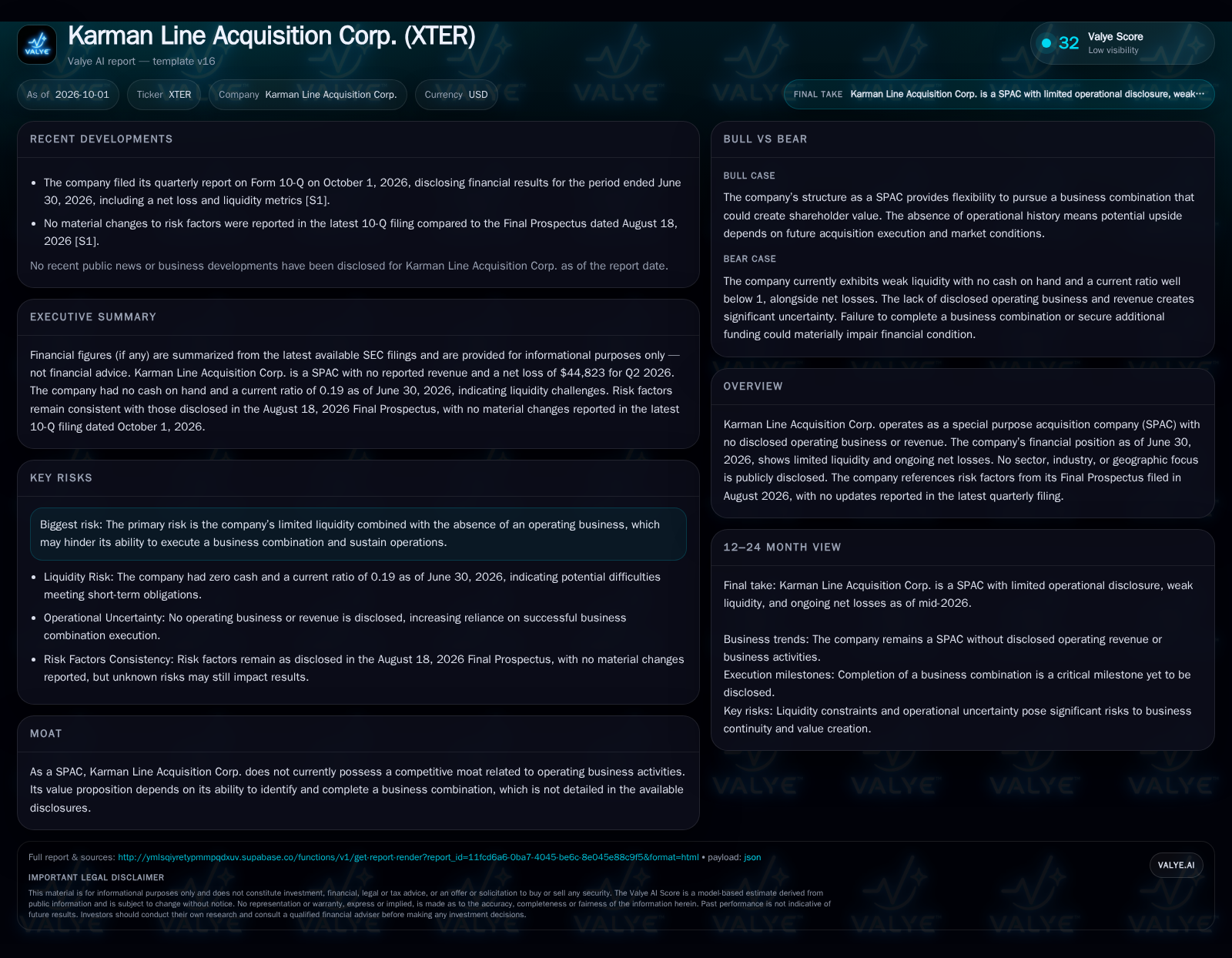
Karman Line Acquisition Corp. is a newly formed SPAC, reporting no revenue and a net loss of $44,823 for Q2 2026. The absence of any disclosed target or sector focus means its future depends wholly on its ability to identify and complete a business combination before its limited resources are exhausted. [S1]
Karman Line Acquisition Corp. (XTER) exemplifies the binary nature of SPAC investing: the company is a capital shell with no disclosed business operations, sector focus, or acquisition progress as of mid-2026. With no announced targets and no sector clarity, the company’s future is wholly dependent on securing a business combination before its limited resources are exhausted—a race against time in a challenging capital market environment. [S1]
Liquidity Squeeze and Absence of Business Progress Define Current State
As of June 30, 2026, Karman Line Acquisition Corp. reported cash and cash equivalents of $0 and current assets of just $18,500, with current liabilities of $99,272, producing a current ratio of 0.19. The company has not disclosed any revenue or identified an operating business, and the most recent filings confirm a net loss of $44,823 for Q2 2026, driven by formation and administrative expenses. No new business developments, sector focus, or acquisition targets have been disclosed as of the October 1, 2026, filing. [S1]
How SPACs Like Karman Line Could Create Value—Or Destroy It
Karman Line Acquisition Corp. has no revenue-generating operations; its economic purpose is to identify and merge with a promising private company. In theory, a successful SPAC can create value by providing a faster, more flexible path to public markets for acquisition targets, often with less regulatory friction than a traditional IPO. The economics hinge on sourcing a target whose future cash flows and growth prospects justify a public valuation greater than the SPAC’s trust value, net of dilution and transaction costs.
However, with no cash on hand and ongoing expenses, the company faces negative operating leverage: fixed costs persist despite zero revenue. If no transaction is completed before funds are exhausted, the SPAC could be forced to liquidate, returning any remaining trust proceeds to shareholders—often at a loss once costs are factored in. The capital structure typically includes founder shares and warrants, which can dilute public shareholders significantly if a deal is completed. In the current environment, with limited cash and no trust proceeds referenced in the latest filings, raising additional capital or completing a deal quickly becomes critical.
Should a business combination occur, future economics would depend on the target’s revenue model, margin profile, and capital requirements, none of which are currently knowable given the lack of target disclosure.
SPAC Competition: Sourcing Targets in a Crowded, Cautious Market
Karman Line Acquisition Corp. competes indirectly with dozens of other SPACs and private equity vehicles seeking attractive acquisition targets. The primary competitive factors are sponsor reputation, access to deal flow, speed, and the ability to structure a deal that appeals to both the target and public investors. In recent years, competition for high-quality targets has increased, while regulatory scrutiny and investor skepticism have also grown.
Without a disclosed sector focus, the company’s flexibility could be a double-edged sword: it may allow pursuit of a wider range of targets but also signals a lack of differentiation or strategic edge. The absence of a sector anchor may make it harder to win competitive deals against sector-focused SPACs or strategic buyers who can offer more than just capital—such as industry expertise, operational support, or synergistic integration.In addition, with no cash on hand and a reported current ratio, Karman Line’s ability to pay for due diligence and deal execution may be constrained compared to better-capitalized peers.
Value Creation If a High-Quality Target Is Secured and Funded
The most favorable outcome for Karman Line Acquisition Corp. would be the rapid identification and successful merger with a high-growth, well-managed private company. In this scenario, the announcement of a deal could drive positive investor sentiment and enable capital inflows, either through PIPE (private investment in public equity) financing or warrant exercise. A compelling target—especially one in a market with strong secular tailwinds—could justify a premium valuation, enabling sponsor and public shareholder gains.
Evidence that would confirm this scenario includes the disclosure of a letter of intent or definitive merger agreement with a credible target, the announcement of committed PIPE financing, and a rebound in trading volume or share price. Conversely, if no such deal is announced or if the target is perceived as low quality or overvalued, the upside case would be quickly undermined.
Most Likely Path: Ongoing Expense Burn While Searching for a Deal
Absent any disclosed business combination progress, the most plausible scenario is continued administrative expense burn as Karman Line seeks a viable target. With no cash and a current ratio of 0.19, the company will likely need to secure bridge financing, sponsor loans, or cost deferrals to remain solvent while pursuing a transaction. The timeline for most SPACs to identify a target is typically 18–24 months post-IPO, but the absence of trust proceeds or additional funding raises the risk of a forced liquidation if no deal is found or if costs cannot be covered.
Confirmation of this scenario would come from continued net losses, further sponsor loans or working capital advances, and a lack of deal announcements. Falsification would require the company to announce a credible target or secure new funding that materially extends its runway.
Liquidity Exhaustion and Forced Liquidation Risk Loom Large
If Karman Line Acquisition Corp. is unable to secure additional funding or identify a business combination in the near term, it faces the prospect of being unable to meet its short-term obligations. This could force the company to liquidate, with any remaining assets (after expenses) returned to shareholders, often at a loss. The absence of trust proceeds in the most recent financials suggests that funds may already be depleted or encumbered, amplifying this risk.
Downside confirmation would include continued zero cash balances, increasing unpaid liabilities, sponsor withdrawal, or a formal liquidation announcement. Any indication that the company is unable to pay vendors or regulatory fees would further validate this adverse scenario.
Milestones and Disclosures That Will Determine Karman Line’s Outcome
Disclosure of a letter of intent, memorandum of understanding, or definitive agreement with a business combination target would be a critical inflection point.
Announcement of new funding—whether via sponsor loans, PIPE commitments, or other bridge financing—would materially affect liquidity risk.
Updates on cash balances and current liabilities in future 10-Q or 10-K filings would help gauge solvency and operational runway.
Any change in sponsor commitment, such as additional capital infusions or the withdrawal of support, would signal confidence or distress.
Filing of proxy or registration statements related to a proposed merger would confirm deal progress.
If disclosed, details on trust account balances or redemption rates at the time of a proposed transaction would provide insight into dilution and deal viability.
A useful metric would be the timeline remaining before SPAC charter-imposed liquidation deadlines or extension votes.
Material changes to risk factor disclosures or going-concern language in financial filings would provide early warning of distress.
Disclaimer: This is research-only, informational analysis and not investment advice. It may include AI-generated interpretation and general industry context. Always verify important details using primary sources.

Comments