
Datasea Inc.: Explosive Revenue Growth Meets Persistent Losses and Funding Hurdles in Acoustics AI
Datasea Inc.
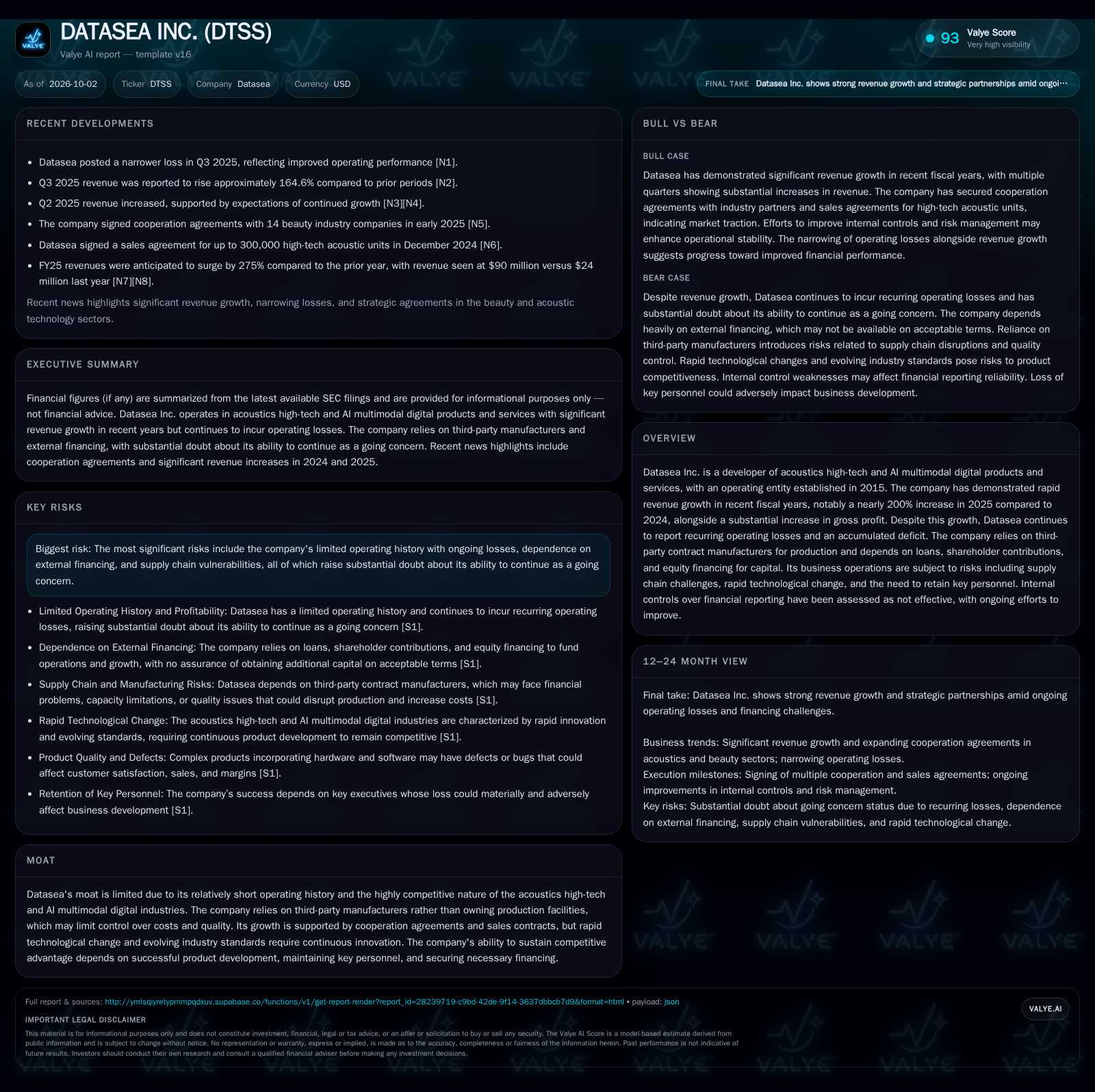
Datasea Inc. posted a 198.7% revenue increase in fiscal 2025 and narrowed net losses, supported by large sales and cooperation agreements in the beauty and acoustics sectors. Future outcomes hinge on Datasea’s capacity to convert growth into sustainable profitability and secure reliable access to capital in a rapidly evolving tech landscape. [S1] [S2] [N1] [N2] [N5] [N6]
Datasea Inc. has delivered headline-grabbing revenue growth—nearly tripling its top line in fiscal 2025 and winning sales agreements that point to robust demand for its acoustics and AI-enabled offerings. As Datasea pushes to convert high growth into lasting profitability, investors must weigh the promise of expanding industry partnerships against the reality of negative working capital, ongoing net losses, and unresolved internal control weaknesses. The next phase will test whether Datasea’s business model can evolve fast enough to outpace its risks. [S1] [S2] [N5] [N6]
Recent Growth, Partnerships, and Persistent Operating Losses Define Datasea’s Current State
Datasea Inc. reported fiscal 2025 revenue of $71.6 million, marking a 198.7% increase over the prior year and a 415.5% jump in gross profit, underscoring intense recent demand for its acoustics high-tech and AI multimodal digital products. This surge was supported by major commercial developments, including cooperation agreements with 14 beauty industry companies and a sales deal for up to 300,000 high-tech acoustic units. Despite these advances, the company remains unprofitable, with a net loss of $5.09 million in FY25 and an accumulated deficit of $44.53 million as of June 2025. Liquidity is strained: as of December 2025, cash and equivalents were $2.24 million, current liabilities exceeded current assets, and the current ratio stood at just 0.6. These figures highlight a business at the crossroads—successful in growing revenue but still fundamentally challenged by recurring losses and the need for ongoing external funding. [S1] [S2] [N5] [N6]
How Datasea’s Revenue Model and Cost Structure Shape Its Path to Profitability
Datasea’s business is built on developing and marketing acoustics high-tech and AI multimodal digital products—likely a mix of hardware, embedded software, and digital services. The company’s recent revenue surge suggests strong demand, but the lack of detailed disclosure on unit economics, pricing, or contract terms leaves open questions about gross margin sustainability and customer concentration risk. The increase in gross profit, which outpaced revenue growth in FY25, hints at some operating leverage or improved product mix, but persistent net losses indicate high fixed costs (R&D, SG&A, or sales/marketing) or insufficient unit margins.
Production is outsourced to third-party contract manufacturers, making variable costs sensitive to supply chain dynamics and limiting Datasea’s control over manufacturing economics. This model can facilitate rapid scaling but exposes the company to input cost volatility and potential quality lapses. Fixed costs in R&D may remain high given the need for continuous innovation in acoustics and AI, while customer acquisition in B2B and B2C channels could be expensive and slow to scale efficiently. Funding needs are ongoing: negative working capital and recurring losses mean Datasea depends on external capital, loans, or equity financing, which may dilute existing shareholders or constrain growth if capital markets tighten.
Competitive Pressures and the Challenge of Building Defensible Differentiation in Acoustics AI
Datasea operates in fiercely competitive markets—acoustics high-tech and AI digital solutions—where barriers to entry are moderate and technological change is rapid. The company’s reliance on third-party manufacturing limits its ability to differentiate on cost or proprietary production techniques. Product innovation and speed-to-market are critical, especially as larger, better-capitalized competitors and startups vie for share with similar AI-powered offerings. The recent cooperation agreements and high-volume sales pact suggest Datasea is gaining initial commercial traction, but it remains unclear whether these translate into recurring revenue, customer lock-in, or sustainable pricing power.
Switching frictions may be low if customers can easily evaluate competing platforms or if Datasea’s offerings are not deeply integrated into clients’ workflows. That said, early partnerships in the beauty sector could open niche defensible positions if Datasea can tailor its solutions to industry-specific needs or embed proprietary technology. Ultimately, the company’s ability to sustain competitive advantage depends on continuous product innovation, retaining key technical personnel, and building a robust customer ecosystem before commoditization pressures erode margins.
Pathway to Self-Sustaining Growth: When Revenue Expansion Could Translate into Profitable Scale
The most bullish scenario for Datasea envisions the company converting rapid sales growth into operating leverage, with rising gross profits eventually outpacing fixed costs and driving the business toward profitability. If recent partnership wins in the beauty industry and the high-tech acoustic unit sales agreement translate into substantial repeat business or foster cross-selling opportunities, Datasea could build a base of recurring, higher-margin revenue. Success in improving internal controls and financial reporting would enhance transparency and investor confidence, potentially unlocking new sources of funding on better terms.
Evidence confirming this scenario would include: further acceleration in gross profit margins, a sustained narrowing of net losses (or transition to net profitability), increased disclosure of recurring revenue contracts, and successful execution or renewal of major sales agreements. Falsification would come from continued net losses despite revenue growth, customer churn after initial contracts, or failure to demonstrate improved cash flow generation.
Scaling Revenue but Wrestling with Margins: The Most Likely Outcome Absent Structural Reform
The most plausible path is that Datasea continues to grow its top line, leveraging recent commercial partnerships and sales agreements for further expansion. However, persistent operating losses, limited working capital, and the need for frequent external funding mean the company may struggle to reach sustainable profitability in the near term. The current business model—outsourced production, high R&D spending, and rapid market evolution—suggests that margin improvement will be incremental, not transformative.
Confirmation of this scenario would be additional revenue growth paired with only modest improvement in net losses, ongoing negative cash flow from operations, and continued reliance on loans or equity raises. Falsification would require either a sharp, sustained improvement in operating margins or a sudden inability to secure external funding, leading to operational retrenchment or restructuring.
Funding Constraints and Execution Risks Could Derail Datasea’s Growth Story
If Datasea cannot convert revenue growth into sustainable cash generation, the company faces a scenario where ongoing losses and thin liquidity lead to a cash crunch. Failure to secure new funding—whether due to tighter capital markets, investor fatigue, or deteriorating financial metrics—could force Datasea to curtail operations, delay R&D, or even consider distressed asset sales. Supply chain disruptions or quality issues from third-party manufacturers could further erode customer trust and increase costs, while lapses in internal controls may trigger regulatory scrutiny or impair access to capital.
This scenario would be confirmed by a widening gap between revenue and net income, shrinking cash balances, unsuccessful or dilutive financing attempts, or public disclosures of missed contract deliveries or quality problems. Falsification would require Datasea to secure a substantial capital injection, demonstrate improved cost control, or evidence strong customer retention and repeat orders.
Metrics and Milestones That Will Reveal Whether Datasea’s Growth Is Sustainable
Gross profit margin trends: Sustained improvement would indicate the business is achieving scale benefits or selling higher-margin products.
Operating cash flow (if disclosed): Positive or improving cash flow from operations would signal that revenue growth is translating into real financial health.
Execution of the 300,000-unit acoustic sales agreement: Updates on fulfillment, customer acceptance, and payment terms would help assess revenue quality and visibility.
Renewal, upsell, or expansion of cooperation agreements in the beauty sector: Evidence of repeat business or deeper integration would suggest customer stickiness.
Access to new funding: Announcements of debt, equity, or strategic investment would address near-term liquidity risk.
Progress on internal control remediation: Timely updates on internal audit effectiveness and reporting reliability would reduce operational risk.
Retention of key technical and commercial personnel: Disclosures of executive departures or hiring would be material, given the company’s dependence on specialized talent.
Supply chain stability: Reports of production bottlenecks, cost overruns, or quality issues from contract manufacturers would directly impact gross margins and customer satisfaction.
Disclaimer: This is research-only, informational analysis and not investment advice. It may include AI-generated interpretation and general industry context. Always verify important details using primary sources.

Comments