
Taylor Devices: Backlog Expansion Provides Stability Despite Sector Volatility and Margin Pressure
Despite a sharp earnings decline driven by weakness in aerospace and construction, Taylor Devices' expanding backlog and industrial sector growth suggest resilience—yet margin pressure and working capital trends highlight persistent structural challenges.
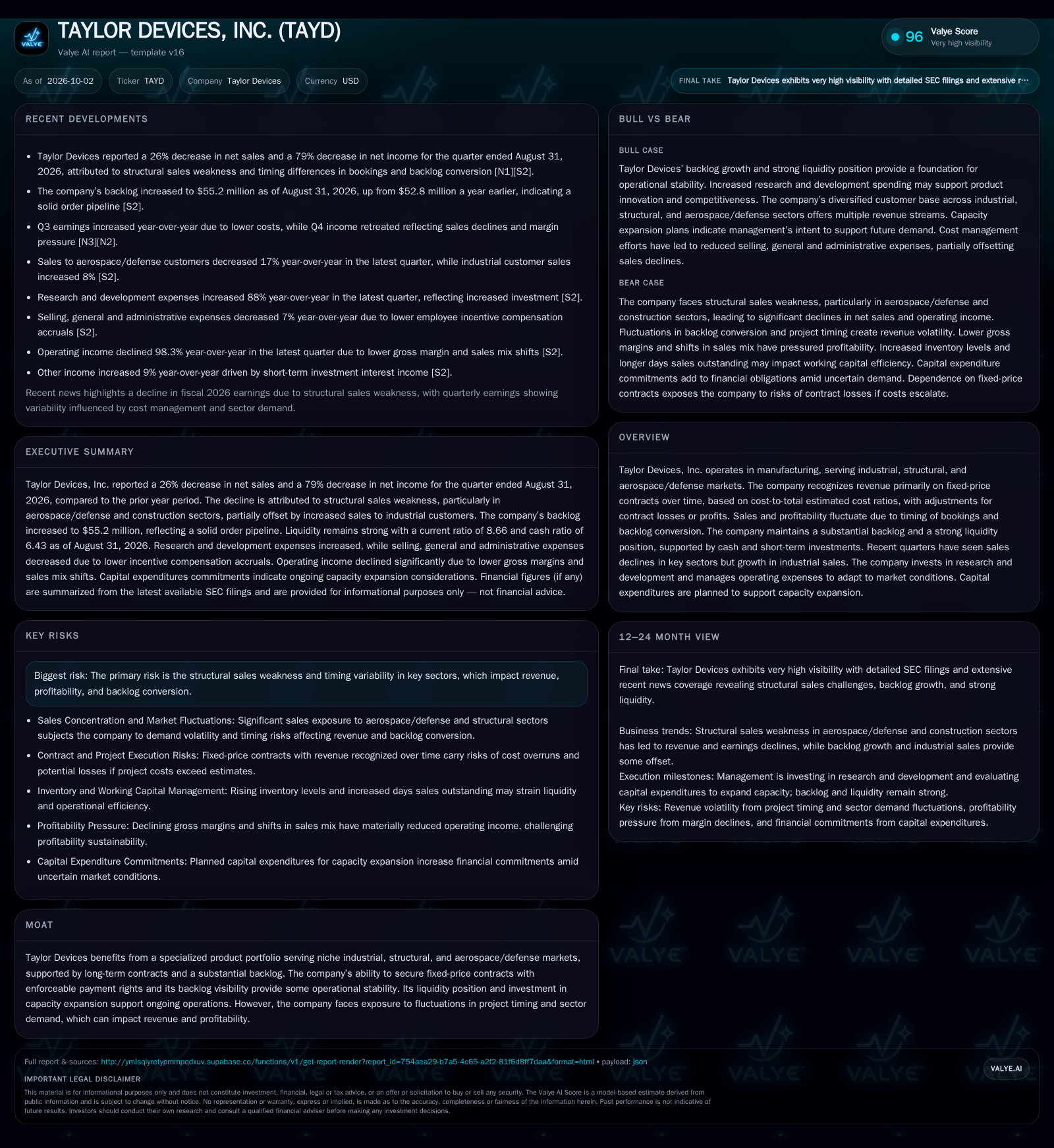
Taylor Devices reported a 26% drop in net sales and a 79% decline in net income for the quarter ended August 31, 2026, primarily due to reduced demand in aerospace/defense and construction. However, backlog grew to $55.2 million, and industrial sales rose 8%. The outlook hinges on backlog conversion, sector recovery, and the ability to defend margins while managing capital commitments. [S2]
Taylor Devices, Inc. is navigating a period of pronounced volatility, with sharp year-over-year declines in both sales and profitability for the quarter ended August 31, 2026. While the aerospace/defense and construction segments have struggled, a growing backlog and resilience in industrial sales offer a measure of stability. The next chapter for Taylor Devices will be defined by how effectively it converts backlog to revenue, manages capital commitments, and adapts to shifting sectoral demand. [S2]
Recent Results: Sharp Downturn in Earnings Meets Backlog Expansion
For the quarter ended August 31, 2026, Taylor Devices reported a 26% decline in net sales to $7.3 million and a 79% drop in net income compared to the same period last year. The downturn was most acute in aerospace/defense (-17%) and construction (-49%), though industrial sales increased 8%. Gross profit fell 51%, and operating income plummeted by 98.3% to just $38,000. Despite these pressures, backlog rose to $55.2 million, including a $19.0 million non-project order with deliveries scheduled through 2030, and the number of open sales orders grew from 127 to 151. Liquidity remains high, with $3.6 million in cash, $45.5 million in short-term investments, and a current ratio of 8.66. Inventory increased 24% year-over-year, with most classified as work-in-process. [S2]
Revenue Recognition, Fixed-Price Contracts, and the Margin Squeeze
Taylor Devices primarily operates on fixed-price contracts, recognizing revenue over time based on cost-to-total estimated cost ratios. This model can provide earnings visibility when project costs and scopes are predictable, but exposes the company to risks if input costs rise or project execution falters. The recent gross margin compression—driven by lower sales, unfavorable mix, and possibly increased project costs—has sharply reduced operating income. The company’s capital requirements are moderate, with recent capex of $242,000 and $1.93 million committed over the next year toward potential capacity expansion.
Operating leverage in this business can be significant: when sales volumes dip, fixed manufacturing and SG&A expenses weigh more heavily on margins. Conversely, a rebound in sector demand or faster backlog conversion could quickly restore profitability. Increased R&D spending (up 88% year-over-year) suggests management is investing to support future growth and product innovation, but this also adds to fixed overhead. The increase in inventory and days sales outstanding may indicate working capital is being locked up in ongoing projects, which could constrain agility if not carefully managed. [S2]
Specialized Markets, Project Timing, and Competitive Exposure
Taylor Devices competes in niche markets—industrial, structural, and aerospace/defense—where technical requirements, long project cycles, and customer qualification processes can create barriers to entry. The company’s backlog and long-term project base provide some insulation from short-term competitive threats, particularly for complex or mission-critical applications. However, exposure to cyclical end-markets like construction and government-driven aerospace/defense means demand can be highly variable, with competitor categories ranging from large diversified industrials to specialized engineering firms.
Fixed-price contract structures can be a double-edged sword: they offer order visibility but limit pricing flexibility if costs rise. The company’s ability to win and execute large, multi-year projects (such as the $19 million order in backlog) is a sign of customer trust, but also increases dependence on a small number of large contracts. Switching costs for customers may be moderate to high for engineered solutions, but competitive pressure can intensify when sector demand is soft, potentially forcing price concessions or margin sacrifice.
A Backlog-Driven Rebound: What Would Signal a Turnaround
A favorable scenario unfolds if Taylor Devices efficiently converts its expanded backlog into revenue, especially if sector demand in aerospace/defense and construction stabilizes or recovers. The large non-project order, with deliveries through 2030, provides medium-term revenue visibility and could support smoother production planning and margin recovery. If R&D investments yield new or improved products that win incremental orders—particularly in the growing industrial segment—the company could regain sales momentum and leverage its fixed cost base for rapid profit rebound.
Confirmation would come from sequential increases in net sales and gross margin, acceleration in backlog conversion rates, and evidence that new project wins are supporting diversified end-market growth. Declining inventory levels and stable or improving days sales outstanding would suggest working capital efficiency is being restored. Conversely, persistent margin erosion or further sales declines would challenge this scenario.
Navigating Volatility: Expecting Fluctuating Results Amid Structural Shifts
The most plausible outlook is one of continued volatility: Taylor Devices is likely to experience lumpy revenue and earnings as backlog conversion, project timing, and sector-specific cycles drive quarter-to-quarter variability. Industrial sales may provide a partial offset to aerospace/defense and construction weakness, but overall growth will remain constrained if sector headwinds persist.
Margins may remain compressed due to unfavorable sales mix and ongoing cost pressures, though cost control (as seen in lower SG&A) and operational discipline could limit further downside. Capital commitments for capacity expansion will need to be justified by actual order conversion and sustainable backlog replenishment. Evidence supporting this middle path would include stable or gradually improving sales, backlog levels remaining elevated, and working capital metrics not deteriorating further.
Backlog Conversion Fails to Materialize: Risks of Prolonged Margin Pressure
A negative scenario would see continued sector weakness—especially in aerospace/defense and construction—leading to slow or stalled backlog conversion, further sales declines, and sustained margin compression. If cost overruns emerge on fixed-price contracts or if new orders fail to replace completed projects, the backlog could shrink and order visibility deteriorate.
Rising inventory and lengthening days sales outstanding could tie up cash, while capital expenditures for capacity expansion may become a drag if not matched by demand. In this scenario, profitability could remain near break-even or turn negative, and liquidity, though currently strong, could be eroded over time if cash flow does not recover. Confirmation would come from ongoing declines in net sales, backlog, and further increases in working capital needs.
What Will Determine Taylor Devices’ Trajectory Over the Next Year
Sequential quarterly net sales and gross margin trends: Sustained improvement would indicate backlog conversion and sector stabilization, while further declines would flag ongoing demand weakness.
Backlog evolution: Monitoring both total backlog and the pace of order intake versus revenue conversion will clarify whether future visibility is strengthening or eroding.
Industrial segment sales growth: Continued expansion here could diversify the revenue base and offset aerospace/defense cyclicality.
Inventory and days sales outstanding: Stabilization or reduction would suggest improved working capital management; further increases could signal operational or demand issues.
Operating income and net income trajectory: A return to historical profitability levels would support a recovery thesis; persistent near-break-even or losses would reinforce structural concerns.
R&D output and new product wins: If disclosed, growth in new product revenue or customer adoption would indicate that innovation investments are paying off.
Capital expenditure alignment with demand: Actual utilization of expanded capacity versus order flow will test the rationale for ongoing investments.
Gross margin by end-market (if disclosed): Shifts here would illuminate whether mix changes or pricing pressure are driving profitability swings.
Disclaimer: This is research-only, informational analysis and not investment advice. It may include AI-generated interpretation and general industry context. Always verify important details using primary sources.

Comments