
Lennar: Land-Lighter Strategy Tested as Housing Market Headwinds Intensify
Lennar's operational flexibility and scale face renewed scrutiny amid a housing market slowdown, cost inflation, and rising interest rates. The land-lighter approach and diversified rental operations provide tools for resilience, but cyclical risks and margin pressures demand close attention to execution and market dynamics.
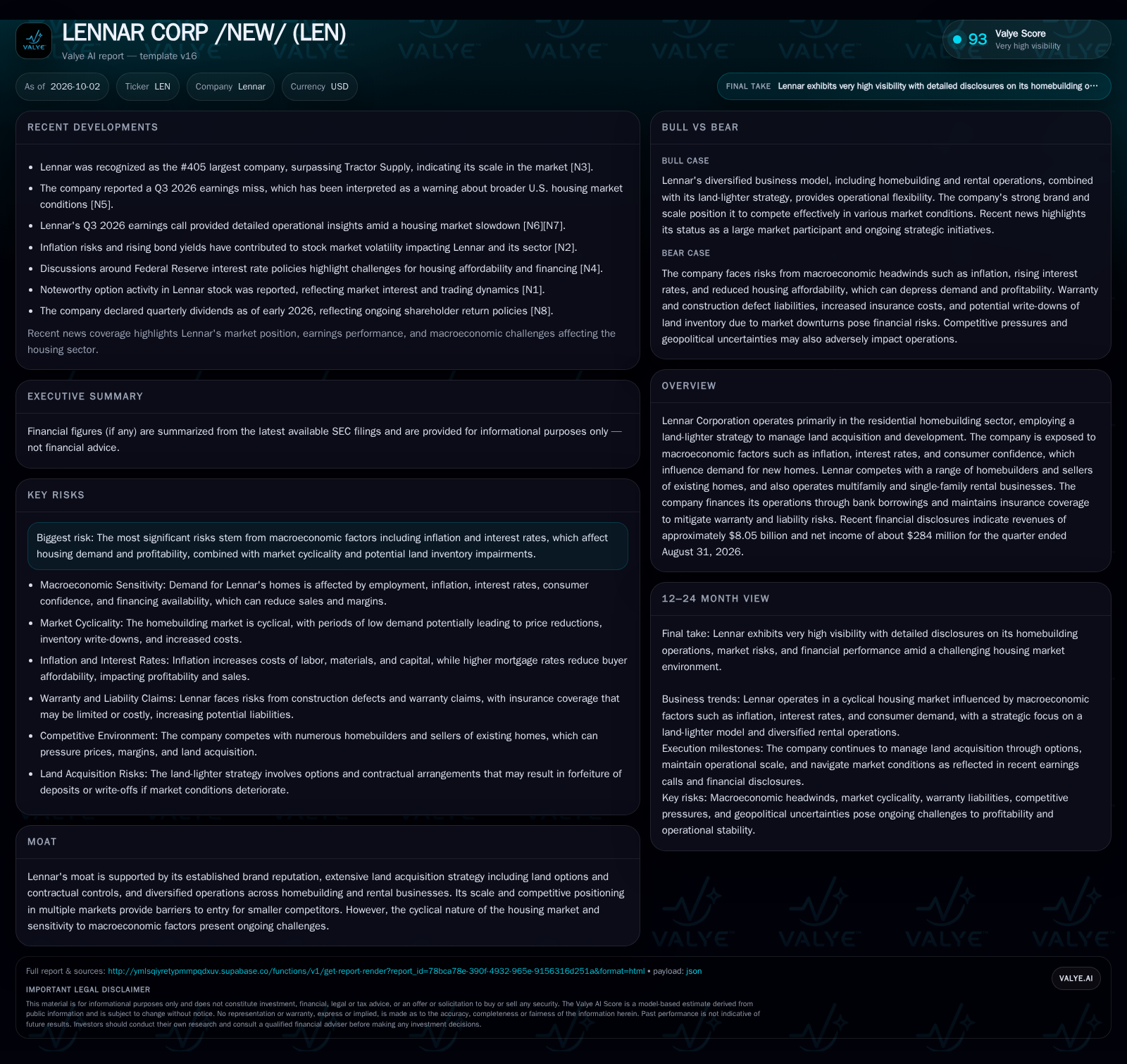
Lennar reported $8.05 billion in revenue and $284 million in net income for Q3 2026, but missed earnings expectations—a result that has fueled concerns about the broader housing market. Its land-lighter strategy and presence in both homebuilding and rentals offer adaptive advantages, yet the company remains exposed to high mortgage rates, affordability pressures, and competitive intensity. Monitoring backlog, cancellation rates, and cost trends will be critical as macroeconomic volatility persists. [S2] [N5] [N6] [N7]
Lennar, one of America’s largest homebuilders, is navigating a challenging environment marked by elevated interest rates, persistent inflation, and a cooling housing market. The company’s Q3 2026 results—$8.05 billion in revenue and $284 million in net income—underscore its scale, but also highlight the pressure on margins and sales momentum. With an earnings miss that spooked markets and raised broader concerns about housing demand, Lennar’s land-lighter strategy and diversified rental operations are under the microscope. The company’s ability to adapt to shifting macroeconomic conditions, manage costs, and retain competitive advantages will determine how well it weathers the current cycle. [S2] [N5] [N6] [N7]
Earnings Miss and Market Signals: What Lennar’s Latest Results Reveal
Lennar reported approximately $8.05 billion in revenue and $284 million in net income for the quarter ended August 31, 2026, reflecting substantial scale but also thinner margins than some market watchers expected. The Q3 earnings miss has been interpreted as a warning about broader U.S. housing market conditions, with concerns about affordability, demand, and profitability echoing through the sector. Lennar’s recognition as the 405th largest U.S. company by market cap highlights its national reach, but also increases its exposure to macroeconomic swings. Recent option activity in Lennar stock points to heightened investor uncertainty as the market weighs whether the company’s land-lighter strategy and rental diversification can offset the drag of high interest rates and inflation. [S2] [N3] [N5] [N6] [N7] [N1]
How Lennar Makes Money: The Economics of Land-Light Homebuilding
Lennar’s core business is residential homebuilding, where profitability is driven by the spread between build costs (land, labor, materials) and home sale prices. The company’s land-lighter strategy seeks to limit balance-sheet risk by controlling land through options and contracts rather than outright ownership, aiming to reduce exposure to land value write-downs in downturns. This approach can lower capital needs and improve return on equity—but often comes at the price of higher option premiums or forfeited deposits if lots go unused.
The company's revenue mix is supplemented by multifamily and single-family rental businesses, which provide recurring cash flows and can partially offset the cyclicality of for-sale housing. However, these rental operations compete for capital and may have lower returns on invested capital compared to peak homebuilding cycles.
Operating leverage is a double-edged sword: in robust markets, fixed overhead spread across higher volumes can drive strong margins, but in slowdowns, declining sales can quickly erode profitability. Lennar’s reliance on external borrowings—including revolving credit and term loan facilities—means interest expense is a material input, especially as rates rise. Inflation in labor, materials, and insurance costs further compresses margins, challenging management to find efficiencies or pass costs to buyers in a price-sensitive environment.
Competitive Dynamics: Scale, Reputation, and the Threat of Substitutes
Lennar’s national scale, recognized brand, and operational breadth provide meaningful advantages over smaller or regional builders, particularly in land negotiation, supply chain access, and marketing reach. The land-lighter model, if executed well, can allow Lennar to pivot more quickly in response to local market changes, potentially avoiding the deep inventory losses that have hobbled competitors in past cycles.
However, the competitive field is crowded: Lennar faces pressure from other large public builders, regional players, and the resale market—which becomes more attractive to buyers when mortgage rates are high and new-home premiums widen. Additionally, the company's rental businesses must contend with institutional landlords and alternative investment opportunities for capital. As housing affordability erodes, buyers may increasingly turn to rentals or delay home purchases, further intensifying competition.
The company’s reputation for construction quality and fulfillment of warranty obligations is a moat, but not an unassailable one—negative publicity, defect claims, or social media backlash could undermine buyer confidence. Finally, Lennar’s ability to source land efficiently and control build costs will be a key differentiator as macro pressures persist.
Resilience Through Flexibility: How Lennar Could Outperform in a Volatile Market
If mortgage rates moderate and inflation pressures recede, Lennar’s land-lighter strategy could enable it to ramp up production quickly, capturing market share from less agile competitors. Improved affordability would likely revive demand for new homes, while the company’s national footprint and brand could allow it to selectively deploy capital into higher-margin geographies.
Rental operations could provide a stable earnings base, especially if homebuying remains out of reach for many households. If Lennar can contain build costs and limit warranty liabilities, margin recovery is plausible even if revenues grow modestly.
Evidence supporting this scenario would include a rebound in backlog, declining cancellation rates, stabilization or improvement in gross margins, and signs of renewed price power in key markets. Confirmation would also come from management commentary on disciplined land acquisition and positive trends in rental occupancy and yields.
Navigating Prolonged Softness: Adapting to a Stagnant Housing Cycle
In a more likely scenario, U.S. mortgage rates remain elevated while inflation moderates only gradually. Lennar’s sales volumes may stagnate or decline modestly, with pricing power limited by affordability constraints and competition from existing homes and rentals. The land-lighter model helps avoid deep inventory write-downs, but higher option costs and occasional forfeited deposits weigh on margins.
Rental operations cushion some of the impact, but are not large enough to fully offset weakness in for-sale housing. Cost inflation in labor, materials, and insurance continues to pressure profitability, and any efficiency gains are largely consumed by these headwinds.
The critical evidence here would be steady—but not growing—backlog, persistently high cancellation rates, and flat or slightly declining gross margins. Management would likely emphasize operational discipline, cost controls, and selective capital deployment. Dividend payments may continue, but with less headroom for increases or buybacks.
Cyclical Downturn Risks: Where Lennar Could Lose Ground
If interest rates rise further or the U.S. economy enters a recession, Lennar could face a sharp drop in new-home demand, forcing price cuts and triggering a spike in cancellations. The land-lighter strategy, while reducing inventory risk, could still result in significant option deposit losses and impairments if market conditions deteriorate rapidly.
Margin compression would be exacerbated by persistent cost inflation and limited ability to pass costs to buyers. Warranty claims or construction defects—especially if insurance costs rise or coverage becomes constrained—could further erode profitability. The rental portfolio could see higher vacancies or rent concessions if the broader housing market weakens sharply.
Signs confirming this scenario would include a rapid decline in backlog, a surge in cancellation rates, material impairments or write-downs of land options, and management commentary signaling defensive cash preservation and curtailed capital expenditures. Dividend reductions or suspensions would also likely follow.
Factors That Will Shape Lennar’s Performance Through the Housing Cycle
Quarterly trends in backlog and the ratio of cancellations to new orders—if disclosed—will provide early signals of demand strength or weakness.
Gross margin evolution, especially in the face of cost inflation, will test Lennar’s ability to manage pricing and build costs.
Updates on land option utilization rates and associated forfeited deposits would clarify the real-world impact of the land-lighter strategy.
Trends in rental occupancy and yield in both multifamily and single-family portfolios—if disclosed—will indicate whether rental diversification is cushioning homebuilding cyclicality.
The pace and terms of land acquisition and option contract renewals will reveal management’s outlook and risk appetite.
Warranty and construction defect claim trends, as well as changes to insurance costs or coverage, could materially affect future liabilities.
Macroeconomic data on mortgage rates, housing affordability, and consumer sentiment will serve as external barometers for housing demand.
Disclaimer: This is research-only, informational analysis and not investment advice. It may include AI-generated interpretation and general industry context. Always verify important details using primary sources.

Comments