
OceanLight Acquisition Corp: Merger with AIRE Inc. Sets the Stage for Post-SPAC Value Creation—or Execution Risk
With its $115 million IPO and a newly inked merger agreement with AIRE Inc., OceanLight Acquisition Corp enters a pivotal phase. The transition from blank-check shell to operating company now hinges on regulatory approvals, integration success, and the true quality of its chosen target.
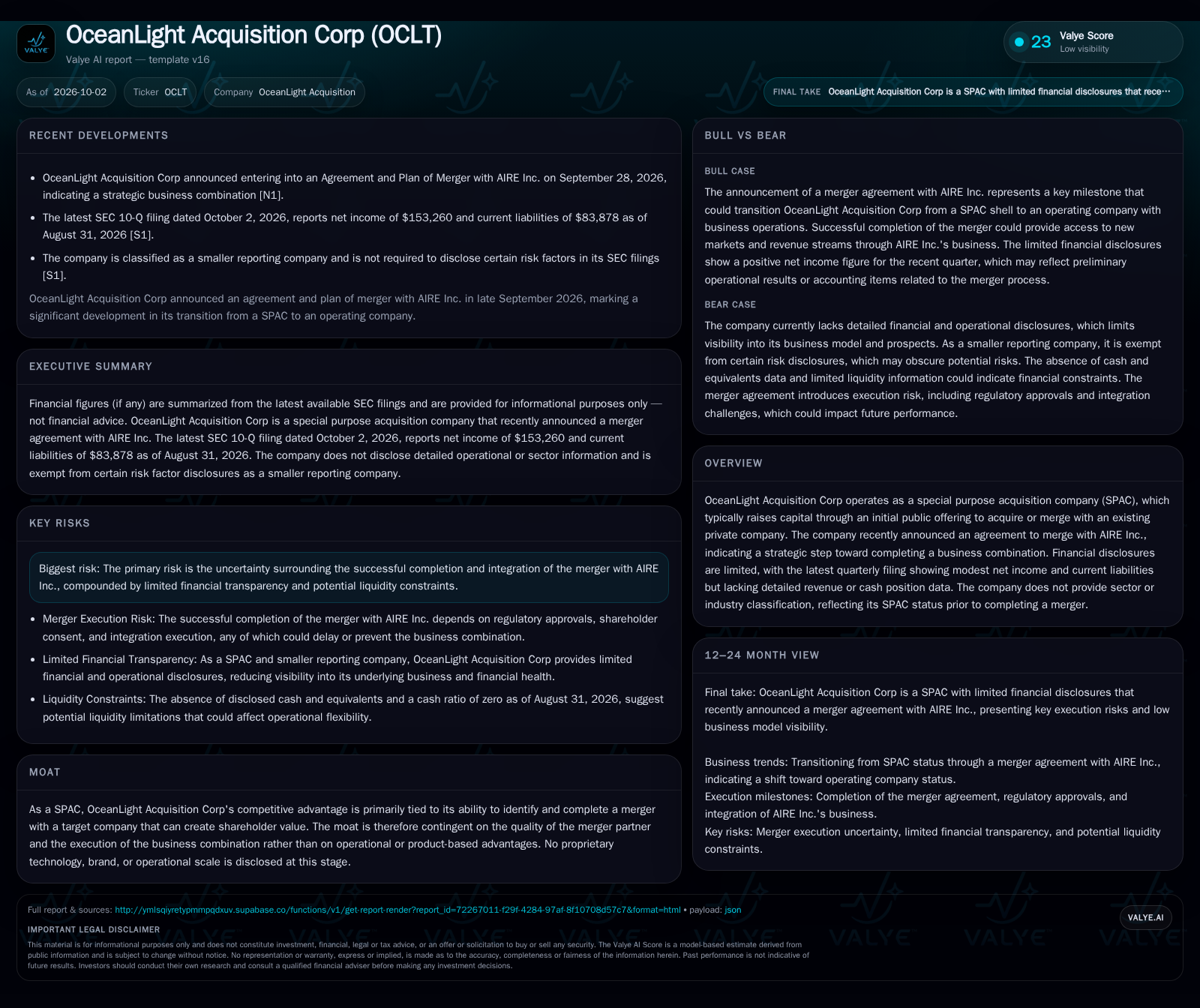
OceanLight Acquisition Corp has announced a merger with AIRE Inc., shifting from SPAC status to a potential operating business. The company recently completed its IPO and over-allotment, raising $115 million in gross proceeds. As of August 31, 2026, it reported modest net income and $83,878 in current liabilities, but disclosed no operational revenues or cash data. The business model, future financial trajectory, and merger execution risks remain opaque until the transaction closes and AIRE’s business is revealed. [S1] [N1]
OceanLight Acquisition Corp’s journey as a special purpose acquisition company (SPAC) has entered a decisive new chapter with the announcement of its merger agreement with AIRE Inc. The company’s recent $115 million IPO provides the financial foundation for this business combination, but critical details about AIRE Inc.’s business, sector, and financials remain undisclosed. As OceanLight navigates the complex transition from a blank-check entity to a publicly traded operating company, the ultimate value for shareholders will depend on the quality of the merger execution, regulatory outcomes, and the substance of its chosen target.
OceanLight’s Merger and Recent Funding: What Has Changed
The most material recent development for OceanLight Acquisition Corp is the announcement of a merger agreement with AIRE Inc. on September 28, 2026, marking the company’s transition attempt from a shell SPAC to a functioning operating entity. This follows the successful completion of its IPO and full over-allotment in August 2026, raising $115 million in gross proceeds—capital earmarked for the business combination and subsequent operational launch. As of August 31, 2026, OceanLight reported net income of $153,260 and current liabilities of $83,878, but disclosed no operating revenues, cash or equivalents, or sector focus. The absence of cash data and operational disclosures underscores the company’s pre-merger shell status and highlights the importance of the pending business combination for determining its future direction. [S1] [N1]
Post-Merger Economics: From Trust Proceeds to Operating Leverage
OceanLight’s business model is set to evolve dramatically pending the close of the AIRE Inc. merger. Until now, its economics have been typical of a SPAC: earning nominal non-operating income from trust proceeds, with no operating revenue or active business. Upon completion of the merger, the combined entity’s economics will be dictated by AIRE Inc.’s underlying business model, which remains undisclosed. Key questions include whether AIRE operates in a capital-light, high-margin sector (such as software or digital services) or a capital-intensive, lower-margin industry (such as manufacturing or infrastructure).
The $115 million in IPO and over-allotment proceeds provides initial funding, but the durability of this capital depends on AIRE’s working capital needs, growth investments, and potential for positive operating cash flow. If AIRE’s business exhibits operating leverage—where incremental revenue growth outpaces cost increases—the merged entity could scale profitably. Conversely, if integration costs, capital expenditures, or customer acquisition expenses are high, the initial capital may be rapidly consumed. The company reported cash and liquidity metrics for the period; these figures do not by themselves establish operating runway, investment capacity, financial flexibility, or financing capacity. [S1]
A critical dimension in assessing post-merger economics lies in understanding the capital structure and potential financing flexibility of the combined entity. If AIRE’s business model requires substantial upfront capital expenditure or sustained working capital investment, the company may need to access additional financing beyond the initial trust proceeds. The availability and terms of such financing will depend on the perceived creditworthiness of the merged company, its asset base, and projected cash flows. Conversely, if AIRE operates a subscription-based or recurring revenue model, this could enhance predictability of cash inflows, thereby reducing financing risk and enabling more efficient capital deployment. Understanding these dynamics is essential to evaluating the sustainability of the merged entity’s growth trajectory.
Competitive Position Hinges on AIRE’s Sector and Strategic Assets
Prior to the merger, OceanLight’s competitive profile is functionally neutral, as is typical for SPACs. Its future positioning, competitive advantages, and defendability will depend entirely on AIRE Inc.’s business fundamentals. If AIRE operates in a fragmented, high-growth market and brings proprietary technology, customer relationships, or regulatory moats, the merged entity could carve out a sustainable edge. Alternatively, if AIRE enters a commoditized or highly regulated industry with entrenched incumbents and low switching costs, the competitive landscape would be far tougher.
Without details on AIRE’s product portfolio, customer base, or sector, it is not possible to assess whether the new company will enjoy pricing power, network effects, or scale advantages. The broad flexibility of OceanLight’s SPAC mandate means its post-merger fate—whether as an industry disruptor or a marginal player—will only be clarified upon public disclosure of AIRE’s operating metrics and strategy.
Another pivotal factor influencing competitive positioning is the regulatory environment surrounding AIRE’s industry. If AIRE operates in a sector subject to stringent regulatory oversight, compliance costs and approval timelines could materially impact operational agility and cost structures. Conversely, sectors with evolving regulatory frameworks may present opportunities for first-mover advantage or regulatory arbitrage, provided the company can navigate compliance effectively. Additionally, the presence of network effects or ecosystem lock-in mechanisms could create defensible competitive moats, enabling premium pricing or customer retention even in commoditized markets. Without clarity on these strategic assets, the merged company’s ability to sustain competitive advantages remains uncertain.
Value Creation if AIRE Delivers Scalable, High-Margin Growth
The most favorable outcome for OceanLight shareholders would occur if AIRE Inc. proves to be a business with strong organic growth prospects, an attractive margin profile, and a differentiated value proposition in its target market. In this scenario, the $115 million in trust proceeds could be leveraged to accelerate expansion, invest in product development, or pursue strategic acquisitions.
Confirmation of this scenario would require post-merger disclosures showing robust revenue growth, high gross margins, and evidence of customer stickiness or unique technology. Falsification would come from post-close reports of weak revenue traction, high churn, or margin pressure, or if the business proves capital intensive with slow scaling.
Most Likely Trajectory: Execution Risks and Gradual Transparency
The most plausible near-term path is one of uncertainty and incremental information flow. The merged company will face a period of regulatory review, shareholder voting, and integration planning. Initial post-merger disclosures are likely to be limited, with greater transparency emerging only after the transaction closes and AIRE’s business is integrated into public company reporting. During this period, investor sentiment may be volatile, as market participants attempt to price the quality and prospects of AIRE’s business based on partial information.
Indicators supporting this scenario would be steady progress through regulatory milestones, timely completion of the merger, and gradual release of operating metrics (such as revenue, gross margin, and customer pipeline). Signs of delay, regulatory pushback, or persistent opacity would suggest increased risk and uncertainty.
When Execution Falters: Regulatory, Integration, or Target Quality Risks
The adverse scenario for OceanLight is one where the merger with AIRE Inc. is delayed, fails to receive regulatory or shareholder approval, or AIRE’s business proves weaker than anticipated. SPACs face acute risk if their target is overvalued, lacks operating scale, or faces post-merger integration challenges—particularly with limited cash or high burn rates.
Evidence confirming the downside would include public announcements of regulatory or shareholder obstacles, missed closing deadlines, or post-merger revelations of weak financials, poor product-market fit, or high customer churn. Falsification would require successful, timely merger completion and early evidence of commercial traction from AIRE’s business.
Integration risk extends beyond operational alignment to cultural and organizational fit, which can significantly influence post-merger performance. If AIRE’s corporate culture or management practices diverge substantially from those of OceanLight’s leadership or investor expectations, friction could arise, impeding strategic execution and employee retention. Furthermore, the timing and effectiveness of integrating IT systems, sales channels, and operational processes will affect the realization of anticipated synergies. Delays or cost overruns in these areas often erode projected financial benefits and can undermine investor confidence. Therefore, assessing integration complexity and management’s track record with similar transactions is critical to gauging downside risk.
Specific Merger Milestones and Disclosures That Will Shape OceanLight’s Outcome
Progress through regulatory approvals and successful completion of the merger with AIRE Inc. will be the primary near-term milestone.
Disclosure of AIRE Inc.’s business model, sector, and target market will clarify the merged entity’s competitive positioning and growth potential.
Post-merger financials—such as revenue, gross profit, operating expenses, and cash flow—will be critical for evaluating sustainability and scalability.
Customer acquisition metrics, retention rates, or backlog (if provided) would illuminate demand quality and recurring revenue potential.
Integration cost disclosures and execution updates will be necessary to assess whether synergies or unexpected challenges are emerging.
Any changes in leadership, strategy, or capital allocation policy post-merger would indicate management’s confidence and direction.
Disclaimer: This is research-only, informational analysis and not investment advice. It may include AI-generated interpretation and general industry context. Always verify important details using primary sources.

Comments