
iPower’s Crypto Treasury Pivot: Strategic Ambition Meets Volatility and Execution Hurdles
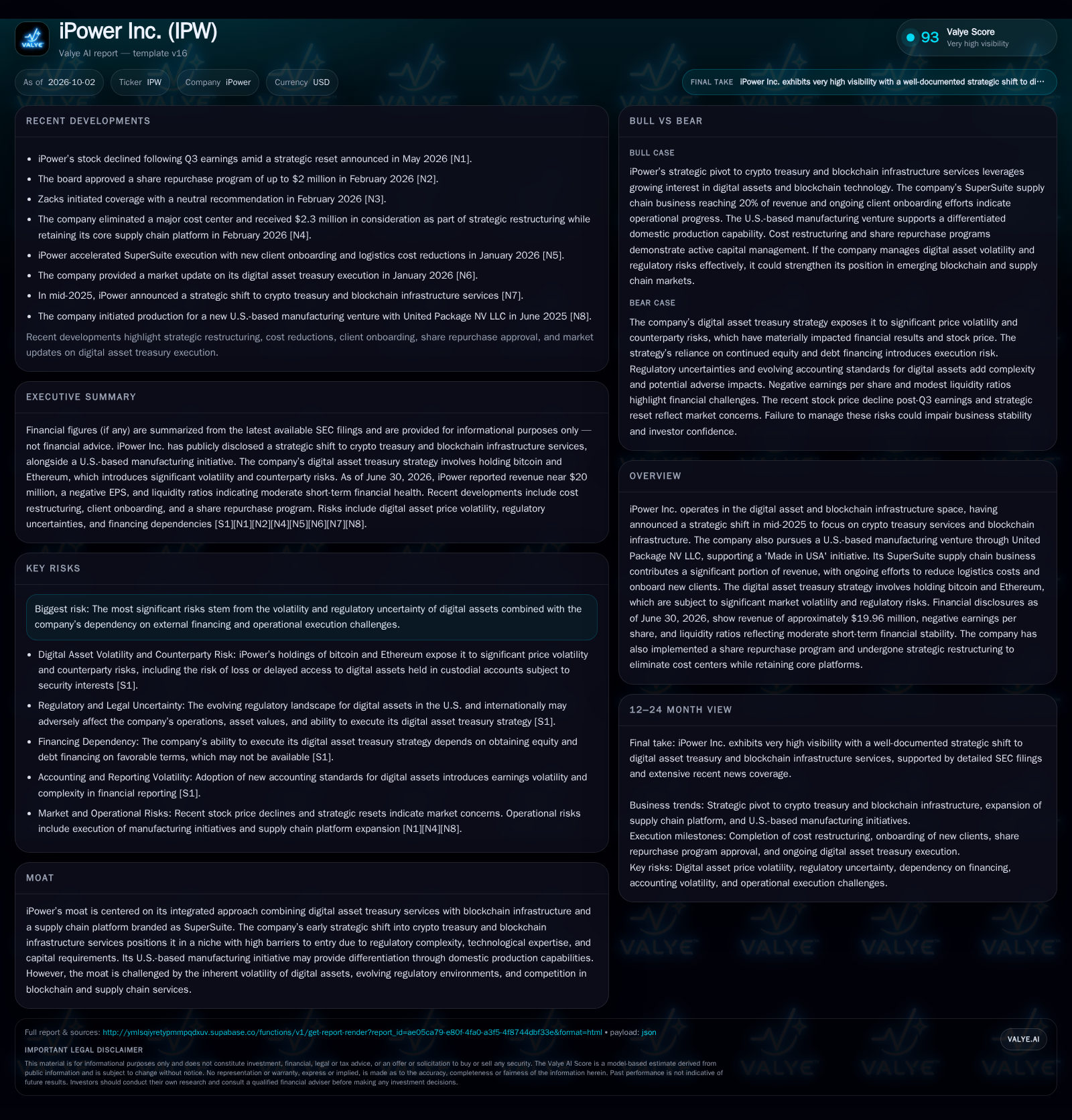
iPower Inc. has reoriented its business around digital asset treasury and blockchain infrastructure services, supplementing this with a new U.S.-based manufacturing initiative. The company’s exposure to bitcoin and Ethereum introduces material volatility and financing dependence, even as recent restructuring and platform investments aim to stabilize its core operations.
iPower is now a digital asset and blockchain infrastructure company, holding bitcoin and Ethereum as part of a treasury strategy and launching U.S.-based manufacturing. While recent cost reductions and platform retention offer some operational continuity, the business is highly exposed to crypto market swings and needs favorable financing to execute its plans. The company’s reported liquidity position, and its new strategy remains untested across full market cycles. Key watchpoints include digital asset fair-value swings, regulatory developments, and actual traction in both manufacturing and blockchain services. [S1] [N4] [N7] [N8]
iPower Inc.’s transformation from a traditional supply chain platform to a crypto treasury and blockchain infrastructure player marks a high-stakes strategic reset. The company now holds bitcoin and Ethereum as core assets, exposing it to both upside from digital asset appreciation and downside from market and regulatory shocks. Its new U.S.-based manufacturing venture signals a bid for diversification and domestic relevance, but execution risk remains high.
Strategic Reset: Digital Assets, Platform Retention, and Manufacturing Expansion
iPower’s most consequential current developments are its strategic shift to digital asset treasury and blockchain infrastructure services, the launch of a U.S.-based manufacturing initiative, and a major cost restructuring that both eliminated a significant expense center and secured $2.3 million in consideration. The company reported cash and liquidity metrics for the period; these figures do not by themselves establish operating runway, investment capacity, financial flexibility, or financing capacity. Critically, its digital asset holdings (bitcoin and Ethereum) are subject to a first-priority security interest, limiting flexibility and increasing counterparty risk. These developments collectively define iPower’s risk/reward profile: high potential if crypto markets and blockchain demand surge, but with real vulnerability to market swings, regulatory shocks, and financing constraints. [S1] [N4] [N7] [N8]
The strategic pivot to digital asset treasury management inherently intertwines iPower’s financial health with the broader crypto ecosystem's dynamics, making macroeconomic factors such as interest rate changes, inflation expectations, and global monetary policy critical to its valuation and liquidity. For instance, rising interest rates may dampen speculative appetite for digital assets, potentially compressing iPower’s asset valuations and increasing borrowing costs. Conversely, accommodative monetary policy could stimulate crypto market rallies, enhancing asset values but also possibly inflating risk exposure. Additionally, the company's reliance on pledged digital assets as collateral introduces counterparty risk, as any deterioration in the creditworthiness or operational stability of the collateral agent could constrain asset liquidity, further complicating capital management and operational flexibility.
How iPower’s Crypto Treasury and Manufacturing Moves Could Drive (or Erode) Value
iPower’s revenue generation now depends on three pillars: digital asset treasury operations, blockchain infrastructure services, and a nascent U.S.-based manufacturing venture. The digital asset treasury strategy is inherently volatile—returns hinge on the fair-value appreciation of bitcoin and Ethereum, which can dramatically swing quarterly results and reported equity. While this approach can deliver outsized gains in bull markets, it exposes the company to sharp markdowns and impaired capital in bear cycles.
Blockchain infrastructure services, if delivered as SaaS or managed platforms, could offer margin leverage and recurring revenue, but commercial mechanics are not fully disclosed; the stickiness and pricing power of these offerings remain to be proven. The U.S.-based manufacturing initiative could unlock higher-margin domestic supply chain contracts or command a premium for 'Made in USA' goods, but will likely require significant working capital and operational ramp-up. The elimination of a major cost center provides some near-term margin relief, but negative EPS and modest cash ratios highlight the need for improved profitability or further capital infusions. Importantly, the company’s digital assets are not freely available for operational needs, as they are pledged against convertible notes, constraining potential financial flexibility. [S1] [N4] [N8]
The interplay between digital asset volatility and operational cash flow generation creates a complex risk-return profile for iPower. While digital asset appreciation can bolster balance sheets and provide capital for reinvestment, the timing mismatch between asset price cycles and operational cash needs may force the company into suboptimal financing decisions, such as dilutive equity raises during downturns or costly debt issuance. Furthermore, the blockchain infrastructure segment’s success hinges on the company’s ability to demonstrate scalable, secure, and compliant platforms that resonate with enterprise clients, which often demand rigorous service-level agreements and integration capabilities. The manufacturing initiative, while promising diversification, requires careful capital allocation and operational expertise to avoid margin dilution, especially given the capital-intensive nature of domestic manufacturing and the competitive pressures from established players with economies of scale.
Positioning Against Crypto Natives, Blockchain Platforms, and U.S. Manufacturers
iPower now competes across several fronts: against established digital asset management firms, specialized blockchain infrastructure providers, and traditional U.S.-based manufacturers. The company’s integrated approach—blending digital asset holdings, blockchain infrastructure, and supply chain technology—could offer a differentiated proposition, particularly if it can demonstrate seamless integration and compliance. However, crypto-native firms often have deeper technical expertise and capital, while established manufacturers have scale and entrenched relationships. Regulatory complexity and technological change in the blockchain sector create both barriers and risks; the company’s early strategic pivot may give it a head start, but execution and capital sufficiency will determine whether it can build durable switching costs or network effects.
iPower’s competitive positioning depends not only on its multi-pronged business model but also on its capacity to navigate regulatory scrutiny and technological evolution. Crypto-native firms benefit from deep technical talent pools and established community trust, enabling rapid innovation and network effects, whereas traditional manufacturers leverage long-standing supplier relationships and production efficiencies. iPower’s hybrid model may create unique value if it can effectively integrate blockchain solutions with manufacturing processes, thereby offering end-to-end transparency and traceability that appeal to regulatory-conscious clients. However, this integration demands substantial cross-domain expertise and robust governance frameworks, as missteps could undermine credibility and invite regulatory penalties. The company’s ability to build proprietary technology or secure exclusive partnerships will be pivotal in differentiating itself and establishing defensible market positions.
If Crypto Markets Rally and Blockchain Adoption Accelerates, iPower’s Model Could Deliver Leverage
In a favorable scenario, rising bitcoin and Ethereum prices boost iPower’s balance sheet, enabling the company to tap equity or debt on attractive terms. If blockchain infrastructure offerings gain traction with enterprise or supply chain customers, recurring revenue could increase and operating leverage could improve. The U.S. manufacturing venture, if executed well, could capture demand from domestic supply chain reshoring trends or government incentives. Confirmation would come from sustained revenue growth outpacing crypto price appreciation (indicating traction beyond passive asset holding), margin expansion, and evidence of recurring blockchain or manufacturing contracts. Strong fair-value gains on digital assets, successful refinancing, and positive cash flow from operations would further validate the upside thesis. [S1] [N7] [N8]
Sustaining Operations Amid Crypto Volatility and Incremental Platform Progress
The most plausible near-term outcome is that iPower continues to operate with reported liquidity position, experiencing revenue and equity swings tied primarily to the volatility of its digital asset holdings. Blockchain and manufacturing initiatives may yield incremental progress but are unlikely to offset crypto-driven earnings volatility in the short run. The company may need to periodically raise capital, with the terms dependent on prevailing crypto market sentiment and risk appetite. Confirmation would include flat to modest revenue growth, persistent negative EPS, and a stable or slowly reported liquidity-ratio trends. Watch for limited but steady client onboards to the blockchain platform, and gradual ramp-up in domestic manufacturing output. [S1] [N4] [N5] [N8]
Prolonged Crypto Market Decline and Financing Constraints Threaten Viability
If bitcoin and Ethereum prices fall sharply or remain depressed, iPower’s reported equity and borrowing capacity could erode, possibly triggering covenant breaches or liquidity shortfalls. The company’s digital assets are pledged as collateral, so any impairment may restrict flexibility to meet obligations or fund operations. If blockchain infrastructure and manufacturing ventures fail to gain commercial traction, fixed costs could outpace gross profit, driving continued losses. In this scenario, the company could face restructuring or asset sales to preserve value. [S1] [N1] [N4]
Milestones and External Shocks That Will Define iPower’s Strategic Outcome
Quarterly fair-value changes in bitcoin and Ethereum holdings, as reported in SEC filings, will directly impact reported equity and test the resilience of the digital asset treasury strategy.
Evidence of recurring revenue contracts or multi-year agreements in blockchain infrastructure or manufacturing, if disclosed, would help confirm traction beyond passive asset holding.
Updates on the encumbrance, release, or re-pledging of digital assets—especially if the collateral arrangement with the Collateral Agent changes—would materially affect potential financial flexibility. [S1]
Announcements of new client onboarding or meaningful platform adoption metrics for the supply chain/blockchain platform would validate product-market fit.
Progress updates or revenue contributions from the U.S.-based manufacturing venture, including any government contracts or anchor customers, would clarify diversification success.
Any regulatory changes or enforcement actions affecting digital asset treasuries or blockchain infrastructure providers could materially alter the risk profile.
Disclosures of debt covenant compliance or breaches, and the terms of any new equity or debt financings, will reveal the company’s ability to sustain its strategic initiatives.
Disclaimer: This is research-only, informational analysis and not investment advice. It may include AI-generated interpretation and general industry context. Always verify important details using primary sources.

Comments