
NIKE’s Strategic Reset: Margin Gains, Pace Program, and the Quest to Revive Growth
NIKE’s flat revenues and margin improvements mask deeper regional and channel stress, as the company bets on a sweeping cost-reduction program and organizational overhaul to restore profitability and reignite momentum. The next phase hinges on execution in digital, inventory management, and recovery in China and Converse.
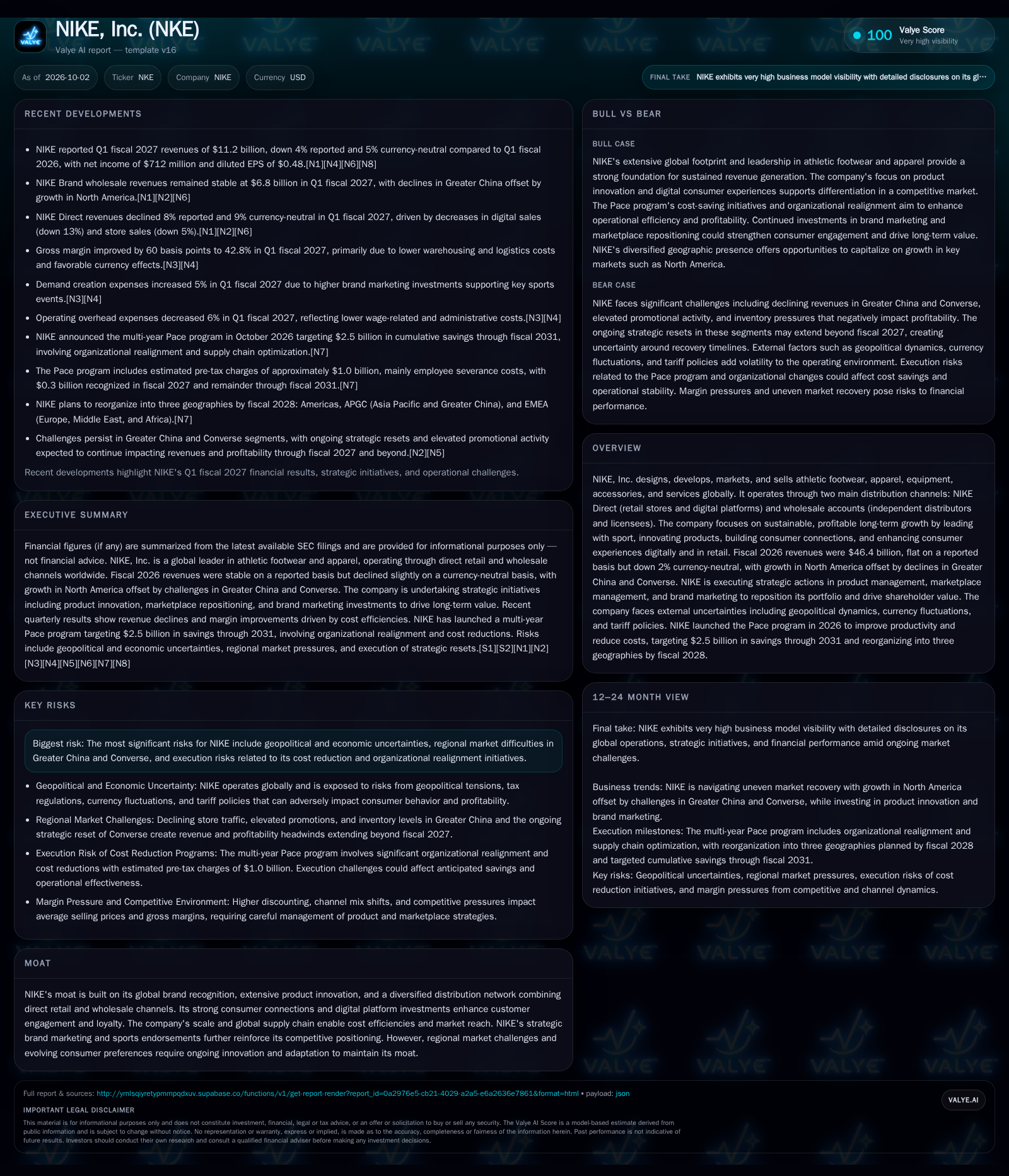
Despite a flat topline and ongoing challenges in Greater China and Converse, NIKE improved gross margins and launched a multi-year Pace program targeting $2.5 billion in savings by 2031. Direct-to-consumer sales remain under pressure, while wholesale is stabilizing in North America. Execution of cost cuts, inventory discipline, and digital recovery will determine whether NIKE can return to sustainable growth and defend its brand leadership amid global uncertainty.[S1] [S2] [N1] [N2] [N3] [N4] [N5] [N6] [N7] [N8]
NIKE stands at a strategic crossroads as its core revenue base stagnates, with topline pressures in Greater China and Converse offsetting modest North American growth. The company has responded with a sweeping cost-cutting and organizational overhaul—the Pace program—aimed at extracting $2.5 billion in savings by 2031. While margin improvements offer near-term relief, persistent declines in direct-to-consumer and digital sales, coupled with ongoing regional headwinds, raise the stakes for execution. The path forward will be shaped by how NIKE manages inventory, reignites digital engagement, and navigates geopolitical and competitive volatility.
Flat Revenues, Margin Gains, and a Major Cost-Cutting Initiative Define the Current Moment
NIKE reported fiscal 2026 revenues of $46.4 billion, flat on a reported basis and down 2% currency-neutral versus the prior year, as growth in North America was neutralized by persistent declines in Greater China and the Converse segment.[S1] [S2] The first quarter of fiscal 2027 saw revenues fall 4% reported and 5% currency-neutral, with NIKE Direct revenues (including digital and physical stores) down 8% and digital sales specifically down 13%.[N1] [N2] [N6] Gross margin improved by 60 basis points to 42.8% in Q1 2027, driven by lower logistics costs and currency tailwinds, even as promotional activity remained elevated.[N3] [N4] In response to structural pressures, the company launched the Pace program in October 2026, targeting $2.5 billion in cumulative savings through 2031 via supply chain optimization, organizational realignment, and cost reductions. Pre-tax charges of $1.0 billion are expected, with $0.3 billion recognized in fiscal 2027 and the remainder through 2031.[N7]
Where NIKE’s Profits Are Made—and Threatened: Channel, Mix, and Margin Dynamics
NIKE’s business model historically combines high-margin branded product sales through both wholesale partners and its own direct-to-consumer (DTC) channels, including digital platforms and NIKE-owned stores. The DTC channel, while offering higher per-unit margins and stronger customer data, also exposes NIKE to higher fixed costs and operational risk, particularly as digital traffic and engagement decline. The recent drop in digital sales (down 13% in Q1 2027) highlights the vulnerability of this channel to consumer sentiment, changing online behavior, and possible digital marketing fatigue.
Gross margin improvements in the latest quarter stemmed from lower warehousing and logistics costs, suggesting that recent inventory discipline and supply chain adjustments are paying off. However, persistent promotional activity and inventory liquidations—especially in challenged markets—signal that underlying demand remains fragile and that full-price sell-through is under pressure.
The Pace program’s targeted $2.5 billion in savings is significant, but with $1.0 billion in pre-tax charges (largely employee severance and restructuring), the net benefit will depend on execution and the ability to reinvest savings into growth opportunities. NIKE’s scale allows for some operating leverage, but with revenues flat to down, the risk is that cost-cutting could undermine innovation or brand strength if not carefully managed.
Brand Power, Distribution Breadth, and the Threat from Regional and Digital Disruption
NIKE’s enduring competitive advantage rests on its global brand equity, product innovation, and a diversified channel mix—balancing wholesale distribution, owned retail, and digital commerce. This multi-channel approach has historically provided resilience against regional shocks and consumer shifts. However, the recent reversal in DTC momentum and persistent challenges in Greater China expose NIKE to both local competitors and global rivals that are more agile in digital or regionally attuned in product and marketing.
In China, domestic brands have increasingly captured consumer mindshare, fueled by national sentiment, faster product cycles, and digital-native marketing. The elevated promotions and declining store traffic in Greater China suggest that NIKE’s premium positioning and Western brand cachet may be less effective in the current environment. Meanwhile, global competitors continue to invest heavily in digital, sustainability, and athlete partnerships, raising the bar for innovation and consumer engagement. The planned organizational realignment into three global geographies could streamline decision-making and local responsiveness, but execution will be critical to closing competitive gaps.
How Operational Discipline and Digital Revival Could Reignite Growth
The bull case for NIKE hinges on several reinforcing dynamics: successful execution of the Pace program delivers material cost savings without eroding brand equity or innovation capacity; digital and DTC traffic stabilize and then return to growth, perhaps aided by new product launches or refreshed digital engagement strategies; and inventory management resets allow for higher full-price sell-through, reducing the need for promotions and restoring gross margins.
A recovery in Greater China, potentially triggered by normalized consumer sentiment or effective localized marketing, could provide a step-change in regional profitability. Evidence for this scenario would include a sustained rebound in digital and store traffic, a return to growth in DTC revenues, stabilization or improvement in Greater China segment EBIT, and a visible reduction in promotional intensity. Confirmation would also come from successful new product launches resonating with core consumer segments and improved inventory turns without margin dilution.
Incremental Progress, Ongoing Headwinds: The Most Likely Course for NIKE
The most plausible outcome is that NIKE experiences a slow, uneven recovery. North America remains a relative bright spot, with wholesale stabilizing and some improvement in retail traffic, but DTC and digital continue to underperform historical norms. The Pace program delivers on some cost savings, but much of the benefit is offset by ongoing promotional activity and the slow pace of recovery in Greater China and Converse.
Gross margins remain above recent lows thanks to supply chain and logistics improvements, but top-line growth is tepid. NIKE continues to invest in marketing and product innovation, but competitive and regional challenges prevent a return to robust growth. Confirmation of this scenario would be a continued mix of modest margin gains, flat to low-single-digit revenue growth, and ongoing commentary from management about market-specific resets and the need for further promotional discipline.
If Regional Weakness and Digital Erosion Deepen: A Path to Margin Compression and Share Loss
The bear case materializes if Greater China and Converse remain structurally impaired, with no recovery in store or digital traffic, and if DTC channels continue to decline or stagnate. Without a rebound in digital engagement, NIKE is forced to rely more heavily on wholesale and promotions, eroding average selling prices and gross margins. Meanwhile, the Pace program’s cost cuts either fail to deliver the targeted savings or undermine NIKE’s ability to innovate and support the brand.
Competitive intensity increases, especially from digitally native and regional brands, leading to further share loss in key growth markets. Confirmation of this scenario would come from further declines in DTC and digital revenues, worsening EBIT in Greater China and Converse, persistent inventory overhang, and evidence that cost savings are coming at the expense of demand creation or product innovation.
Benchmarks for NIKE’s Turnaround: What Will Distinguish Success from Stagnation
Quarterly trends in NIKE Direct revenues, especially digital sales growth/decline by region, will be crucial for assessing whether the DTC reset is working or stalling further (if disclosed).
Gross margin progression and the mix of margin drivers—whether improvements are sustained by full-price sell-through versus continued reliance on logistics savings or promotions—will help test the health of underlying demand.
Inventory levels and turnover rates, particularly in challenged regions and segments, will indicate whether supply/demand discipline is improving or if liquidation pressures persist.
Segment EBIT trends in Greater China and Converse will show if regional resets are stabilizing or if losses are deepening.
Execution milestones for the Pace program, including realized cost savings versus planned, and any updates on severance or restructuring charges, will clarify the net financial impact.
Trends in demand creation (marketing) spend and its effectiveness in driving traffic, engagement, and sell-through, especially around major product launches or sports events.
Wholesale revenue growth by region, as a signal of channel health and potential shifts in partner relationships.
Management commentary and external signals on competitive response, consumer sentiment, and the effectiveness of organizational realignment into three global geographies.
Disclaimer: This is research-only, informational analysis and not investment advice. It may include AI-generated interpretation and general industry context. Always verify important details using primary sources.

Comments