
Nocera, Inc.: Liquidity Strength Versus Equity Deficit—A Crossroads for a Diversified International Operator
Nocera’s reported liquidity position and recent capital-raising initiatives stand in tension with persistent net losses and a negative equity position that threaten its Nasdaq listing. The company’s multi-segment, cross-border structure could offer diversification upside, but sustainable value creation hinges on restoring listing compliance and clarifying business model economics.
The company’s $50 million shelf registration signals intent to raise capital, but future success likely depends on achieving profitability and clarifying the economics of its diversified international operations. [S2] [N1]
Nocera, Inc. finds itself at a strategic inflection point: despite a reported liquidity position cushion and access to potential new capital via a $50 million shelf registration, the company’s persistent net losses and negative equity cast a shadow over its continued Nasdaq listing. With international operations spanning Taiwan and Japan and activities across fish trading, e-commerce, and other segments, Nocera’s business model offers theoretical diversification—but its lack of segment-level transparency and ongoing regulatory risk demand a closer look at its underlying economics and future pathways. Investors and stakeholders must weigh whether capital-raising and operational improvements can overcome structural deficits and restore sustainable value.
Liquidity Strength and Listing Risk Define the Present
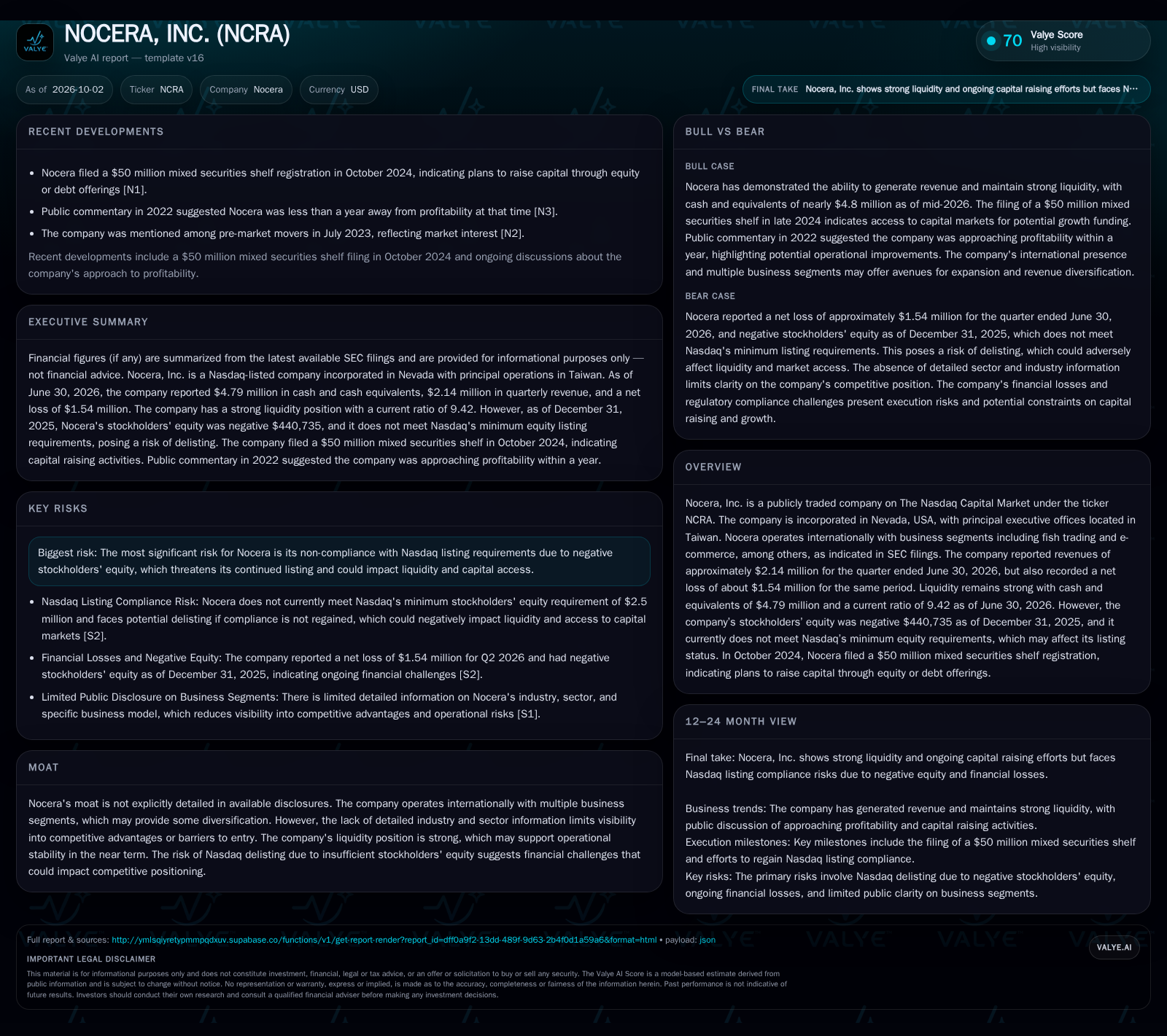
As of June 30, 2026, Nocera reported cash and equivalents of $4.79 million, with total current assets of $5.11 million against current liabilities of just $542,068. The company reported cash and liquidity metrics for the period; these figures do not by themselves establish operating runway, investment capacity, financial flexibility, or financing capacity. However, the company also reported a net loss of $1.54 million for the quarter and negative stockholders’ equity of $440,735 as of December 31, 2025, placing it below Nasdaq’s $2.5 million minimum equity threshold. The risk of delisting is now a central issue, potentially limiting market access and investor confidence. [S2]
The October 2024 filing of a $50 million mixed securities shelf registration underscores management’s intent to access capital markets, whether for working capital, growth initiatives, or shoring up the balance sheet. [N1]
Nocera operates internationally, with principal executive offices in Taiwan and business segments spanning fish trading, e-commerce, and other activities. This international and multi-segment profile may diversify revenue streams, but also introduces complexity and potential regulatory friction. [S1]
How Nocera’s Business Model Could Deliver—or Deter—Profits
Nocera’s reported quarterly revenue of $2.14 million reflects active commercial operations, but the continued net loss of $1.54 million raises questions about cost structure, gross margins, and scalability. Without detailed segment disclosures, it is unclear whether losses stem from thin margins in fish trading, investments in e-commerce infrastructure, or overhead from operating across multiple geographies. If fish trading is a high-volume, low-margin business, profitability would require significant scale or vertical integration, whereas e-commerce could theoretically offer higher margins if logistics and customer acquisition costs are controlled.
However, persistent operating losses will eventually erode this cushion unless either margin expansion or top-line growth materializes. The October 2024 shelf registration points to anticipated funding needs—whether to cover ongoing losses, invest in growth, or meet regulatory capital requirements. [N1]
Operating leverage could become favorable if fixed costs are high and incremental revenues can be added without proportional increases in expenses. However, the lack of segment-level data makes it difficult to estimate the company’s break-even point or assess whether any business unit is on the verge of profitability.
Diversification Versus Focus: Nocera’s Competitive Standing
Nocera’s multi-segment, international footprint could provide some insulation from geographic or sector-specific shocks. Competing in fish trading, for example, typically involves large-scale commodity players, while e-commerce exposes the company to both regional logistics firms and global digital marketplaces. Diversification might reduce revenue volatility, but can also dilute focus and slow progress toward establishing a defendable niche.
Without evidence of proprietary technology, exclusive sourcing, or significant network effects, Nocera’s competitive advantages remain unproven. In fish trading, price competition is often fierce and switching costs are low, while e-commerce success tends to require strong brand recognition or supply chain advantages. The absence of recurring revenue disclosures or customer retention metrics leaves open the question of whether any segment has developed meaningful switching frictions or customer loyalty.
If Nocera can leverage local relationships in Taiwan and Japan, it may mitigate some competitive pressures. However, scaling internationally also increases exposure to regulatory differences, currency fluctuations, and operational complexity.
Unlocking Value Through Profitability and Regulatory Compliance
The most favorable scenario for Nocera involves a successful capital raise—potentially under the $50 million shelf registration—combined with cost discipline or revenue growth sufficient to achieve and sustain profitability. Regaining compliance with Nasdaq’s equity requirements would remove the immediate delisting risk, restoring access to public capital markets and potentially improving investor sentiment.
Operationally, if one or more business segments demonstrate operating leverage—where incremental revenue drives disproportionately higher profit—Nocera could quickly move into positive net income territory. A material improvement in gross margins, customer retention, or average order value (if in e-commerce) would help validate this scenario.
Confirmation would come from future filings showing positive quarterly net income, a return to positive stockholders’ equity, and a successful equity or debt raise that strengthens the balance sheet without excessive dilution. Falsification would be signaled by continued losses, failure to raise capital, or inability to regain listing compliance.
Sustained Losses, Capital Infusions, and Operational Uncertainty
The most plausible near-term outcome is that Nocera continues to operate at a loss while drawing on its liquidity buffer and seeking to access new capital markets via the shelf registration. Management may pursue incremental cost controls or targeted growth investments but will face rising pressure to demonstrate a credible path to profitability.
If the company is able to raise capital, it might temporarily shore up its balance sheet and regain compliance, but without a structural improvement in operating economics, the risk of future deficits and regulatory risk would persist. The company could remain in a cycle of episodic fundraising and regulatory negotiations unless it discloses and achieves segment-level profit improvements.
Confirmation of this scenario would be continued net losses, repeated capital-raising announcements, and only incremental improvement in equity or profitability. Falsification would require either a sharp swing to profitability or a failure to raise needed capital, forcing more drastic restructuring.
Delisting and Erosion of Strategic Options
A negative chain of events would see Nocera unable to raise sufficient capital or return to positive equity, leading to Nasdaq delisting. Loss of listing could sharply reduce liquidity for existing shareholders, increase the cost of future capital, and undermine supplier and customer confidence.
If operating losses accelerate and the liquidity buffer is exhausted, the company could face more severe restructuring or even insolvency, especially if its core businesses are structurally unprofitable or if international operations introduce unforeseen costs or legal hurdles.
This scenario would be confirmed by a Nasdaq delisting notice, failure to close new capital raises, rapid cash burn, or disclosures of insolvency risk. Falsification would require clear evidence of operational turnaround or regulatory relief.
Benchmarks for Testing Nocera’s Turnaround and Value Thesis
Quarterly net income or loss trends—persistent losses or a transition to profitability would directly test the viability of the business model.
Reported stockholders’ equity levels—restoration to positive equity and compliance with Nasdaq requirements are critical milestones.
Execution and outcome of any equity or debt issuance under the $50 million shelf registration—terms, dilution, and use of proceeds would illuminate management’s plan.
Segment-level revenue and margin disclosure (if provided)—clarity here would reveal which business lines are driving performance and where improvement is possible.
Nasdaq regulatory communications—updates on listing status or compliance plans would serve as early warnings or reassurances.
Cash burn rate and projected runway—a useful metric would be management guidance on how long current liquidity will last at the present rate of losses.
Evidence of recurring revenue, customer retention, or long-term contracts—if disclosed, these would signal improving business quality and potential for operating leverage.
Material changes in international regulatory or market environments that could affect operations, especially in Taiwan and Japan.
Disclaimer: This is research-only, informational analysis and not investment advice. It may include AI-generated interpretation and general industry context. Always verify important details using primary sources.

Comments