
Darden Restaurants: Brand Portfolio Adjustments and Margin Pressures Shape the Next Phase
Darden Restaurants reported Q1 fiscal 2027 sales growth of 5.1% year-over-year, driven by new openings and higher average checks, but faced lower guest counts in some segments and rising costs from inflation and marketing.
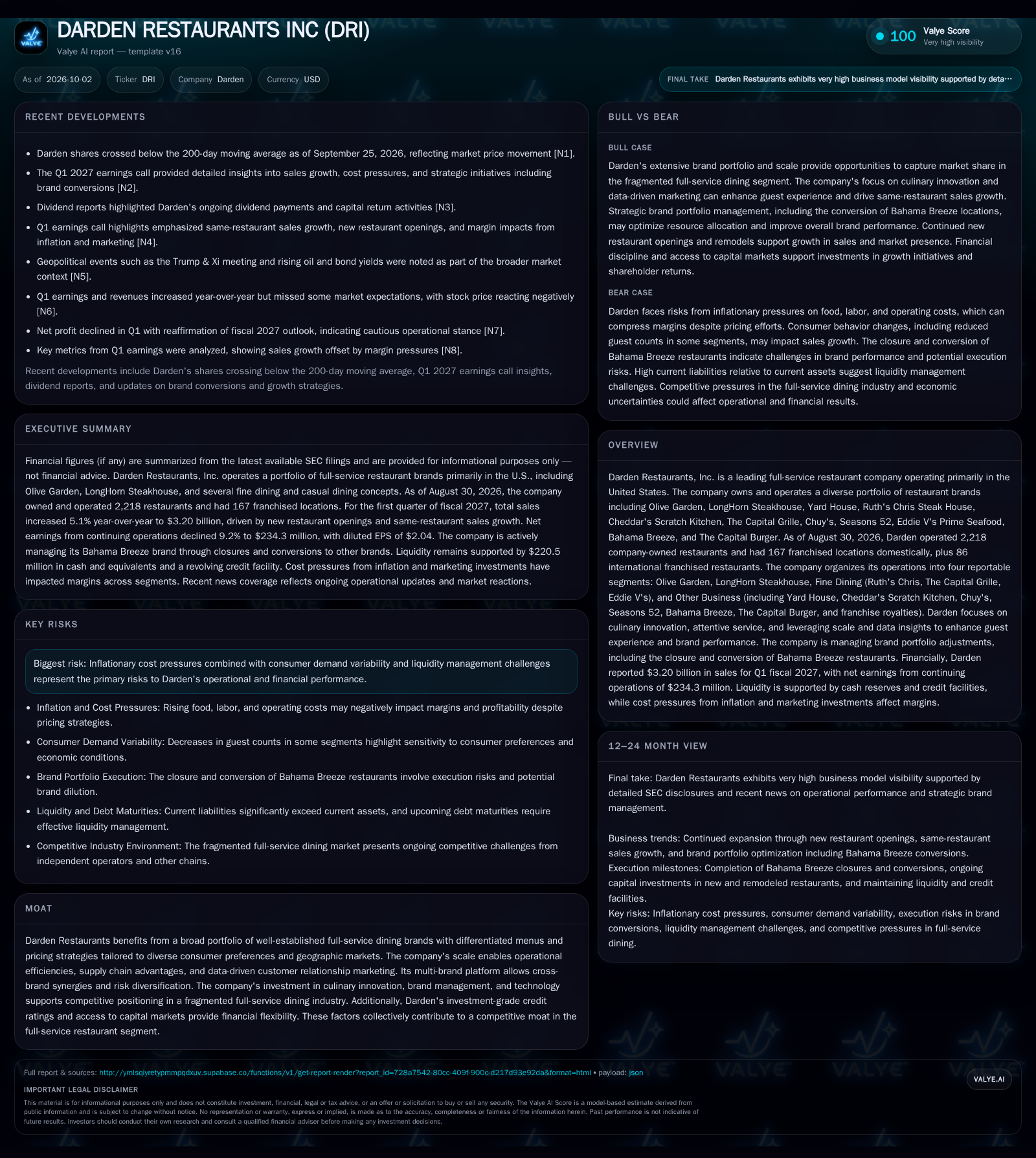
Darden Restaurants reported Q1 fiscal 2027 sales growth of 5.1% year-over-year, driven by new openings and higher average checks, but faced lower guest counts in some segments and rising costs from inflation and marketing. The company is converting or closing half of its Bahama Breeze locations, reflecting challenges in certain brands. With a current ratio of 0.3 and $500 million in debt due May 2027, liquidity and execution on brand transitions will be critical watchpoints. Darden continues to invest in new restaurants and technology, leveraging its multi-brand scale in a highly competitive sector. [S2]
Darden Restaurants enters fiscal 2027 with a mix of operational momentum and margin headwinds. The company’s recent sales gains have come from higher average checks and new restaurant openings, even as guest traffic lags in parts of the portfolio. Brand-level challenges—most visibly at Bahama Breeze, where closures and conversions are underway—underscore the need for agile portfolio management. Meanwhile, inflation-driven cost increases and an upcoming $500 million debt maturity test Darden’s financial agility. As the largest player in a fragmented dining sector, Darden’s scale and data-driven approach remain strengths, but the company’s ability to navigate consumer shifts and margin pressures will define its next chapter. [S2]
Recent Sales Gains, Brand Closures, and Rising Costs Define Darden’s 2027 Starting Point
Darden Restaurants reported total sales of $3.20 billion for Q1 fiscal 2027, up 5.1% from the prior year, with blended same-restaurant sales increasing 3.1%. This growth was primarily the result of higher average checks, as guest counts declined in some segments. Notably, the company is permanently closing about half of its Bahama Breeze restaurants and converting the remaining units to other Darden brands over the next 12–18 months, with two conversions already completed. This portfolio adjustment reflects both underperformance in that brand and Darden’s willingness to redeploy assets toward higher-return concepts. On the cost side, inflation in food, beverage, and marketing has increased expenses as a percentage of sales, eroding margin gains from operational productivity and sales leverage. Liquidity as of August 30, 2026, included $220.5 million in cash, a $1.25 billion undrawn revolver, and $480 million in commercial paper outstanding, but Darden’s current ratio remains low at 0.3, with a notable $500 million debt maturity due in May 2027. [S2]
How Darden’s Model Scales: Volume, Check, and Capital Intensity
Darden’s economic engine relies on a high-volume, multi-brand full-service dining platform, where revenue is driven by a combination of guest traffic (volume) and average check (mix and pricing). Recent sales growth has leaned more on price/mix, as indicated by higher average checks offsetting lower guest counts in some brands—a dynamic that raises questions about long-term traffic resilience. Operating leverage is central to Darden’s model: fixed costs for labor, occupancy, and corporate overhead are spread over a large unit base, and incremental sales typically deliver outsized margin gains. However, the current inflationary environment has compressed this leverage, as food, labor, and marketing costs have risen faster than sales. The company’s capital requirements are significant: $875 million in planned capex for fiscal 2027 will fund new restaurants, remodels, and technology upgrades. While scale enables some procurement and marketing efficiencies, Darden’s ability to offset cost inflation with productivity and pricing will be an ongoing test. Franchise and international royalties are a small but relatively high-margin contributor compared to the core company-owned business.
Multi-Brand Scale vs. Fragmentation: Darden’s Edge and Its Limits
Darden’s principal advantage lies in its scale and broad brand portfolio, spanning value-oriented to fine-dining segments. This breadth allows risk diversification, cross-brand insights, and supply chain leverage. In a highly fragmented U.S. full-service dining market, Darden competes with both national chains and thousands of independent operators. The company’s data-driven marketing and menu innovation aim to build loyalty and optimize local performance. However, independent restaurants and regional chains can be more agile in responding to local trends or cost shifts. Substitution risk remains high: consumers can trade down to fast-casual, quick-service, or delivery options, especially when inflation pressures wallets. Darden’s fine-dining brands face competition from local steakhouses and upscale independents, while Olive Garden and LongHorn contend with both national peers and independent casual dining. The company’s moat is partly protected by brand recognition and operational know-how, but pricing power is ultimately limited by consumer elasticity and competitive menu alternatives.
Margin Recovery and Brand Conversion Success Could Drive Outperformance
A favorable outcome for Darden would involve successful execution on Bahama Breeze conversions, with redeployed assets generating higher traffic and margins under other Darden brands. If inflation moderates and labor markets stabilize, the company could recapture lost margin through operating leverage as sales grow. Continued positive same-restaurant sales, driven by both traffic and check growth, would signal robust consumer demand for Darden’s concepts. Productivity initiatives, such as technology-driven kitchen and front-of-house improvements, could further offset cost pressures. Confirmation would come from sequential improvement in operating margins, accelerated same-store sales at converted locations, and sustained new-unit returns above cost of capital. Evidence of reduced guest count declines or a return to traffic growth would bolster the case for Darden’s brand and marketing strategy.
Steady Expansion with Ongoing Margin Volatility Remains Most Probable
The likeliest trajectory is continued modest sales growth, primarily from new restaurant openings and incremental average check increases, while guest traffic remains flat or incrementally down in certain segments. Darden will likely continue to face margin pressure from food, labor, and marketing inflation, partially offset by productivity initiatives and scale. Bahama Breeze conversions are executed as planned, but the uplift from redeployment is gradual and not transformative in the short term. The company maintains its investment-grade credit rating and continues to return capital via dividends and buybacks, but with a cautious approach to leverage. Evidence supporting this scenario would be moderate same-restaurant sales growth, stable or slightly compressed margins, and successful but non-dramatic brand conversions.
Intensifying Cost Pressures and Failed Brand Conversions Could Erode Returns
A negative scenario would see inflation persist or accelerate, compressing margins further as Darden is unable to pass through higher costs without sacrificing guest traffic. If brand conversions from Bahama Breeze underperform—either failing to attract traffic or incurring higher-than-expected conversion costs—returns on invested capital could deteriorate. A slowdown or reversal in same-restaurant sales, particularly if both average check and guest count decline, would signal waning brand relevance or consumer trade-down. Liquidity could become a concern if cash flow weakens and refinancing the $500 million debt due in 2027 proves costly or dilutive. Evidence would include declining or negative same-restaurant sales, worsening margin trends, underperformance at converted locations, and any signs of credit rating pressure or restricted access to capital.
Milestones to Gauge Darden’s Portfolio Evolution and Margin Trajectory
Quarterly same-restaurant sales trends by brand, with a focus on the mix of average check versus guest count—would help parse the sustainability of sales growth and brand health. [S2]
Conversion performance at former Bahama Breeze locations, including traffic, sales, and margin uplift post-conversion—a key test of Darden's portfolio optimization strategy. [S2]
Unit-level margin trends, especially in segments facing the most cost inflation—would help evaluate the effectiveness of pricing and productivity initiatives. [S2]
Progress on new restaurant openings and remodels versus planned capital expenditure—would indicate whether growth investments are proceeding as targeted. [S2]
Updates on refinancing or repayment of the $500 million debt maturing in May 2027—would signal Darden’s potential financial flexibility and capital allocation discipline. [S2]
If disclosed, churn or retention rates among loyalty program members—would inform the stickiness of Darden’s customer base.
Competitive pricing and promotional activity among peer full-service and fast-casual chains—would help assess Darden’s ability to maintain average check and traffic.
Disclaimer: This is research-only, informational analysis and not investment advice. It may include AI-generated interpretation and general industry context. Always verify important details using primary sources.

Comments