
CID Holdco: AI-Driven Asset Tracking at a Crossroads of Innovation and Financial Strain
The company’s future now hinges on converting technical differentiation into a diversified, recurring revenue base before capital pressures force strategic change.
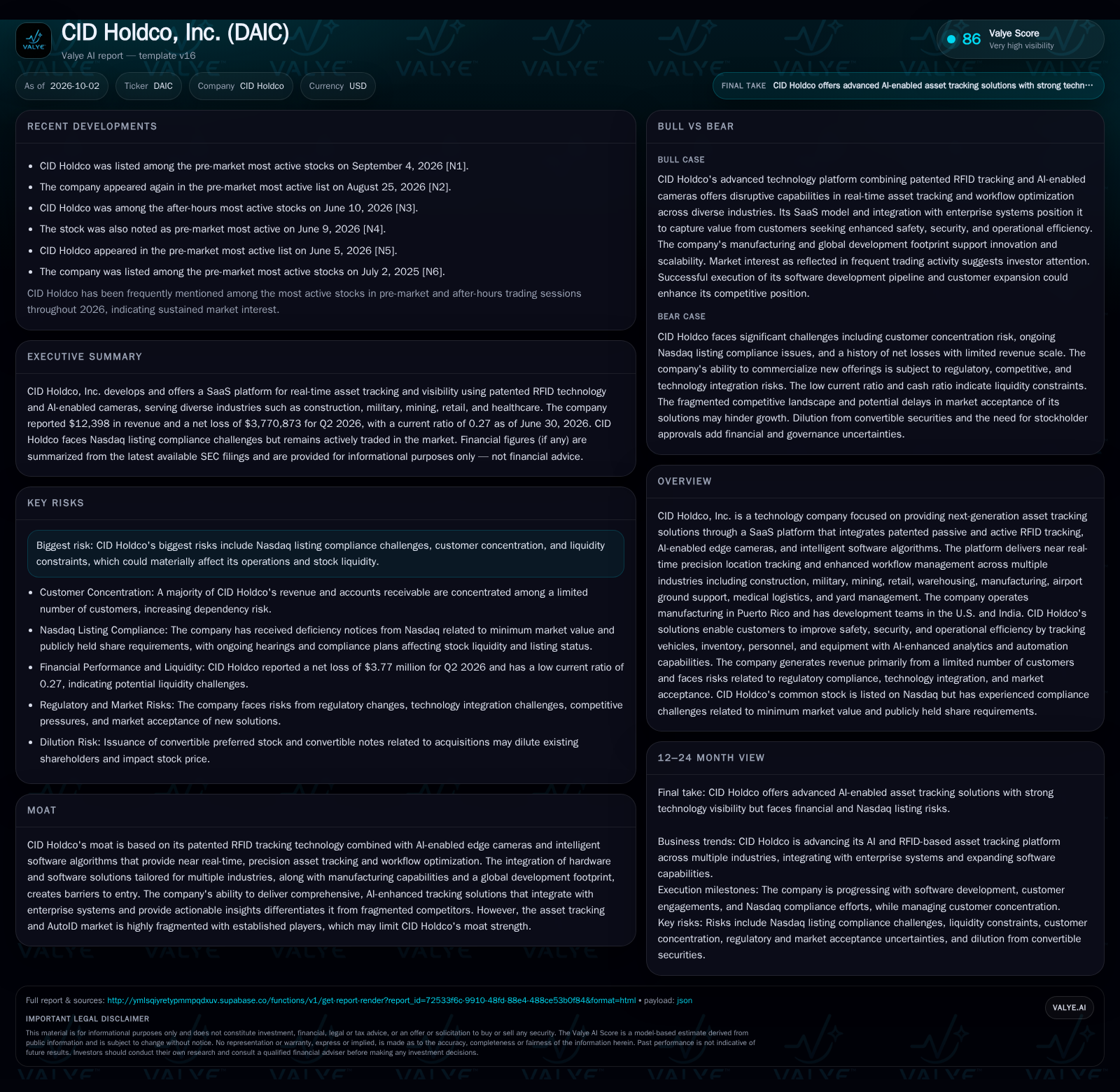
CID Holdco delivers a SaaS asset tracking platform using patented RFID and AI-enabled edge cameras, positioning itself as a precision solution for diverse sectors. Despite strong technology and active market attention, the company faces a stark mismatch between innovation progress and financial runway, with a single customer dominating revenue and critical Nasdaq listing compliance at risk. The next phase depends on broadening the customer base and demonstrating commercial traction before liquidity pressures intensify.
CID Holdco, Inc. stands at the intersection of technical ambition and financial stress. Its AI-powered, patented RFID platform promises to transform asset tracking and workflow optimization for industries ranging from construction to medical logistics. Yet, beneath this innovation lies a business struggling to achieve commercial scale: Q2 2026 saw minimal revenue, heavy net losses, and near-absent liquidity. With a single customer dominating receipts and Nasdaq listing status in jeopardy, CID Holdco’s next moves will determine whether its technology can become a sustainable business—or remain a niche solution under existential financial pressure.
Recent Financials and Structural Realities Shape the Strategic Landscape
As of June 30, 2026, CID Holdco reported revenue of $12,398 and a net loss of $3,770,873 for the quarter, translating to a per-share loss of $2.68 [S2]. The company’s current assets stood at $3.6 million against $13.1 million in current liabilities, resulting in a current ratio of just 0.27 and a cash ratio of zero [S2]. This acute liquidity shortfall is compounded by Nasdaq listing compliance issues, with the company subject to deficiency notices for minimum market value and public float requirements [S2]. In addition, revenue is highly concentrated, with one customer representing a significant portion of total receipts [S1]. These facts underscore an urgent need for strategic and operational pivot if CID Holdco is to transition from technical innovator to viable commercial enterprise.
How the Platform Could Deliver Profitable Growth—If Commercial Hurdles Are Cleared
CID Holdco’s business model is built on a SaaS platform that combines patented passive and active RFID technology, low-power AI edge cameras, and workflow software to deliver real-time asset tracking and analytics [S1]. If successfully commercialized, this model could generate recurring software revenues layered atop hardware sales or leases—potentially yielding high gross margins and attractive operating leverage as the installed base grows. However, the current financials indicate negligible revenue and ongoing high fixed costs, particularly in software development and commercialization. Key costs are tied to human capital (R&D, sales, and customer success) and infrastructure, while hardware manufacturing is centralized in Puerto Rico [S1].
The economics of such platforms typically rely on scaling the customer base to amortize R&D and fixed costs, with the SaaS layer offering margin expansion as usage increases. However, CID Holdco’s acute liquidity constraints and customer concentration mean it lacks the potential financial flexibility to absorb slow adoption or delays in enterprise integration. Without rapid expansion beyond its dominant customer, the company risks negative operating leverage—where incremental costs outpace revenue growth—especially as ongoing software development, compliance, and support costs remain high.
Fragmented Market, Technological Differentiation, and the Challenge of Entrenched Players
CID Holdco’s competitive position is rooted in its combination of patented RFID tracking, AI-enabled edge analytics, and platform integration capabilities. This approach targets pain points in asset-intensive industries—offering improved safety, real-time visibility, and workflow automation. Integration with ERP, MES, and WMS systems could make the solution sticky for enterprise customers seeking to digitize and optimize physical operations [S1].
However, the asset tracking and AutoID landscape is highly fragmented, with established players offering barcode, RFID, IoT, and connected sensor solutions. Incumbents in warehousing, logistics, and industrial automation often bundle tracking with broader service contracts, creating switching friction for customers. CID Holdco’s moat depends on the perceived superiority of its AI-driven analytics and multi-modal tracking, but this is difficult to prove or monetize without reference deployments and demonstrable ROI. The lack of disclosed large-scale contracts or multi-year renewals limits evidence of durable competitive advantage at present.
Technology Adoption Triggers a Flywheel: From Customer Expansion to Margin Leverage
A favorable scenario for CID Holdco would see its platform gaining traction across multiple sectors—perhaps driven by a landmark enterprise win or regulatory tailwind favoring real-time asset traceability. Successful integration with large-scale ERP or WMS environments could create reference accounts, enabling the company to onboard additional customers and dilute its current concentration risk. As new customers adopt the SaaS platform, recurring revenue would scale, amortizing fixed development costs and unlocking operating leverage.
Confirmation of this scenario would require: (1) disclosure of new multi-customer contracts or pilot programs in sectors beyond the current dominant customer; (2) evidence of SaaS revenue mix increasing relative to hardware; (3) improvements in gross margin and reduction in customer concentration; and (4) progress toward Nasdaq compliance via increased market value or public float. Conversely, the absence of customer diversification or continued minimal revenue would falsify the flywheel thesis.
Incremental Progress Amid Capital Constraints and Heightened Execution Risk
The most plausible path forward is for CID Holdco to achieve modest expansion—securing incremental customer wins or pilot deployments in existing verticals, but struggling to scale revenue fast enough to offset ongoing net losses and capital needs. The company may continue to invest in R&D and commercialization, but persistent liquidity constraints could force management to pursue dilutive financings, strategic partnerships, or cost reductions.
Evidence supporting this base case would include slow but steady growth in quarterly revenue, periodic customer announcements, and continued Nasdaq compliance efforts without a transformative commercial breakthrough. Confirmation would also come from recurring news of active trading and speculative interest, but without a clear shift in the underlying revenue mix or customer base. A reversal—such as a large, diversified contract win, or a marked improvement in liquidity—would challenge this scenario.
Liquidity Squeeze and Customer Churn Force Strategic Retreat or Restructuring
A negative trajectory would see CID Holdco unable to diversify its revenue base or attract additional capital before liquidity pressures become existential. If its primary customer reduces or terminates business, or if regulatory/compliance setbacks accelerate, the company could be forced into emergency financing, asset sales, or even delisting from Nasdaq. Should technology integration hurdles or market resistance slow adoption further, fixed costs would remain unaddressed, deepening net losses.
Confirmation of this downside would come from further deterioration in current ratio, failure to resolve Nasdaq listing deficiencies, or disclosures of going concern warnings. A lack of new customer wins, shrinking revenue, or sudden management/board changes would also validate this scenario. Only a rapid shift in commercial or financial momentum would provide an off-ramp from this path.
Testing the Thesis: Commercial Gains, Potential Financial Flexibility, and Platform Adoption
Quarterly revenue growth and customer count expansion—especially evidence of new enterprise or multi-customer contracts—would help confirm commercial traction beyond current concentration.
Gross margin trends and SaaS versus hardware revenue mix would indicate whether the company is achieving operating leverage and margin improvement.
Progress on resolving Nasdaq listing deficiencies, including public float and minimum market value, will signal continued access to public capital markets.
Disclosures of customer retention rates, contract durations, or reference deployments would provide tangible evidence of platform stickiness and value.
Announcements of strategic partnerships or integrations with major ERP, MES, or WMS vendors would validate the platform’s interoperability and market relevance.
Board or management changes, or pursuit of asset sales/strategic alternatives, would indicate escalating financial or operational stress.
Material regulatory changes or industry mandates that increase demand for real-time asset traceability could serve as external catalysts for adoption.
Disclaimer: This is research-only, informational analysis and not investment advice. It may include AI-generated interpretation and general industry context. Always verify important details using primary sources.

Comments