
Ferrovial SE: Diversified Infrastructure Momentum and the Realities of Concession-Driven Growth
Ferrovial SE’s 2025 results highlight robust revenue expansion across highways, airports, and construction, underpinned by long-term concession contracts and active risk management. Sustained performance hinges on traffic trends, regulatory stability, and the company’s ability to deliver large-scale projects on budget and on schedule.
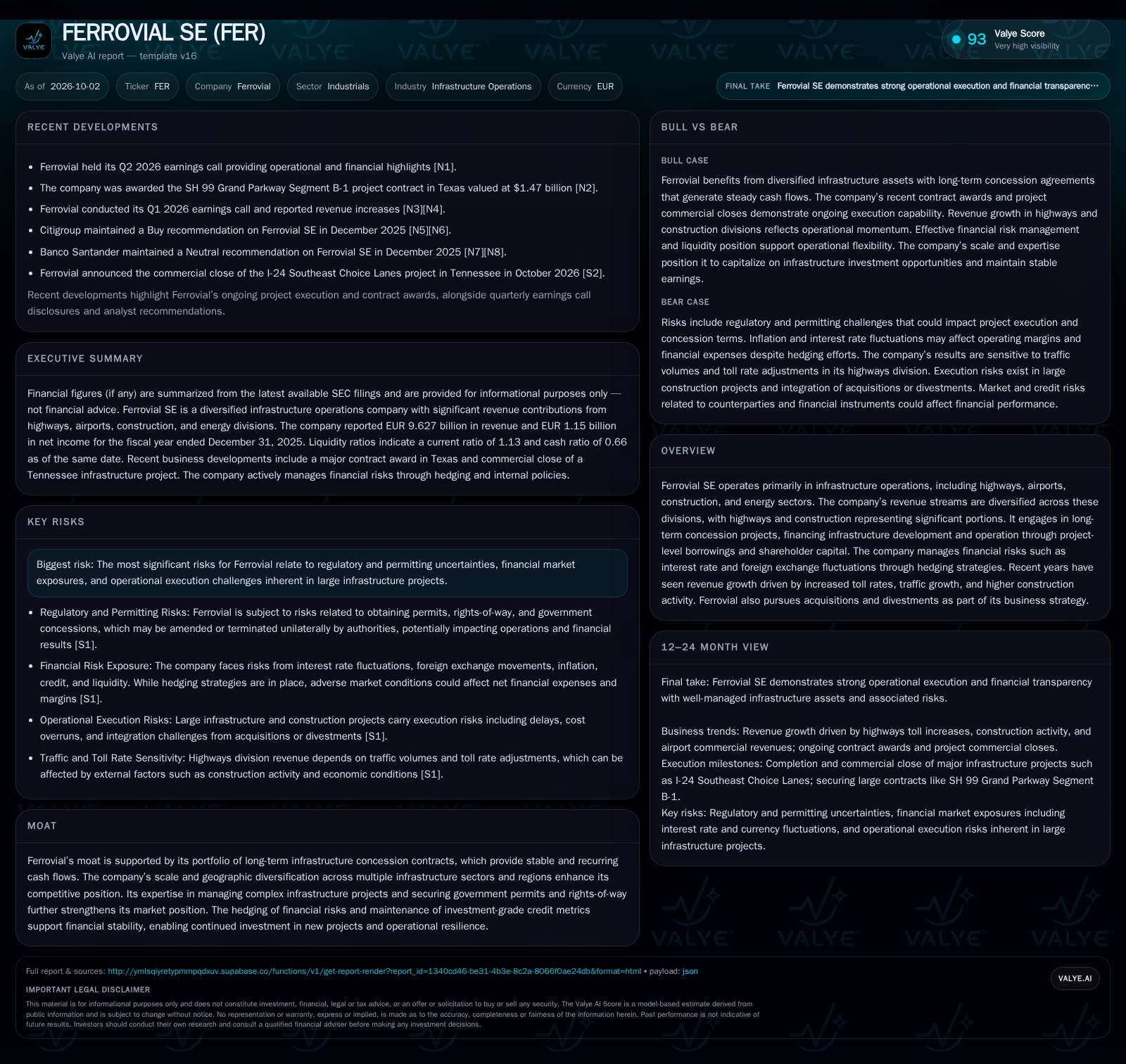
Ferrovial SE delivered EUR 9.627 billion in 2025 revenue with significant gains in highways and airports, supported by higher toll rates, growing traffic, and positive commercial results. Its business model is anchored in long-term concession assets, but future growth will depend on stable regulatory environments, continued demand for managed lanes and airport services, and the company’s ability to manage execution and financial risks effectively. [S1]
Ferrovial SE’s 2025 financials confirm the company’s prowess in operating and expanding large-scale infrastructure assets across highways, airports, and construction. Growth in core divisions stems from higher toll rates, increased traffic, and successful project execution, particularly in North America. Yet, the company’s future performance will be shaped by its ability to navigate regulatory complexity, deliver on major project milestones, and manage macroeconomic and operational risks inherent to the infrastructure sector.
Recent Performance Anchored by Toll, Traffic, and Project Delivery
Ferrovial SE reported EUR 9.627 billion in full-year 2025 revenue and EUR 1.15 billion in net income. The highways division grew revenue by 9.4%, fueled by higher toll rates and traffic volumes—particularly in Texas managed lanes. Airports revenue jumped 22.0% on strong commercial activity at Dalaman airport, while construction revenue rose 5.8% due to major contract completions in Sydney and California. The company’s liquidity position at year-end included EUR 4.271 billion in cash, a current ratio of 1.13, and a cash ratio of 0.66. In October 2026, Ferrovial achieved commercial close on the I-24 Southeast Choice Lanes project in Tennessee, reinforcing its U.S. infrastructure footprint. [S1] [S2]
Concession Model Economics: Cash Flow Stability and Capital Intensity
Ferrovial’s business is anchored in long-term concession agreements for highways and airports, generating relatively predictable, often inflation-linked, cash flows over multi-decade horizons. Revenues depend on a combination of regulated toll rates, traffic volumes, and commercial revenues from airport concessions. The concession model typically involves substantial upfront capital outlays—often financed through project-level debt and shareholder equity—followed by a long payback period. Operating leverage is inherent: incremental traffic growth or toll increases can significantly boost returns once fixed costs are covered, but downside risk emerges if traffic falls short or if costs escalate unexpectedly.
Construction division economics are more variable, with revenue recognition tied to project milestones and contract structures (e.g., fixed-price vs. cost-plus). The company reported cash and liquidity metrics for the period; these figures do not by themselves establish operating runway, investment capacity, financial flexibility, or financing capacity. Ferrovial’s financial risk management includes extensive hedging of interest rates (with 97% of debt hedged) to smooth expenses and protect project returns. While the company maintains significant liquidity, the capital intensity of its business—particularly for new greenfield concessions—necessitates ongoing access to debt and equity markets, and disciplined capital allocation remains critical.
How Ferrovial’s Scale, Concession Portfolio, and Expertise Shape Its Edge
Ferrovial’s competitive position is built on its portfolio of long-term, often exclusive, infrastructure concessions—providing recurring cash flows and a barrier to entry for new operators. Scale enables the company to bid for large projects, leverage procurement, and attract international partners. Geographic diversification across North America, Europe, and emerging markets reduces dependency on single jurisdictions and regulatory regimes.
However, competition for new concessions and major infrastructure contracts remains intense, with global infrastructure operators, pension funds, and sovereign wealth funds all seeking exposure to similar assets. Substitution risk exists in the form of alternative transportation modes, evolving mobility patterns, and potential regulatory intervention (e.g., toll caps or concession renegotiations). Ferrovial’s ability to manage complex permitting, financing, and construction processes is a differentiator, but ongoing execution discipline and regulatory acumen are required to sustain its moat.
Unlocking Value Through Traffic Outperformance and Efficient Project Delivery
An upside scenario for Ferrovial would see sustained above-forecast traffic growth on key toll roads—especially in high-growth U.S. markets like Texas—combined with successful delivery and ramp-up of new managed lanes and airport concessions. If commercial revenues at airports continue to expand, and if the company can complete new projects (such as the I-24 Southeast Choice Lanes) on schedule and budget, operating leverage could drive earnings and cash flow materially higher. Additional upside could come from value-accretive acquisitions or successful bids for new concessions, further extending the company’s growth runway.
Evidence supporting this scenario would include reported traffic volumes and toll revenues consistently exceeding guidance, strong commercial performance at airports, a robust pipeline of awarded projects, and margin expansion in the construction division. Confirmation would also come from new contract wins in target geographies and positive revisions to earnings guidance.
Sustained Growth Amid Regulatory and Execution Discipline
The most plausible trajectory sees Ferrovial delivering steady, low-to-mid single-digit revenue and earnings growth, underpinned by its existing concession portfolio and incremental expansion. This path assumes stable traffic volumes, modest toll rate increases, and continued success in winning and delivering new projects—balanced by operational and regulatory risks that are managed but not eliminated.
Support for the base scenario would be quarterly results in line with recent trends, stable or gradually improving margins, and no major regulatory or execution setbacks. Falsification would come from significant project delays, cost overruns, or regulatory interventions that materially affect concession economics.
Adverse Outcomes: Project Delays, Traffic Shortfalls, and Regulatory Headwinds
A negative scenario could unfold if macroeconomic weakness, regulatory changes, or mobility shifts lead to lower-than-expected traffic volumes and toll revenues, especially in key U.S. corridors. Construction or permitting delays on major projects could drive cost overruns, tie up capital, and erode margins. Regulatory or political intervention—such as toll caps, concession renegotiations, or contract terminations—could undermine cash flow visibility and asset values.
Confirmation of this scenario would be persistent traffic shortfalls, negative project updates (delays, cost overruns, or legal disputes), downward earnings revisions, or significant regulatory actions affecting core assets.
Milestones and Metrics That Will Shape Ferrovial’s Long-Term Concession Performance
Quarterly and annual reported traffic volumes and toll revenues on key U.S. and European highway concessions—especially in Texas and other high-growth corridors.
Progress updates and budget adherence for major construction projects, including the ramp-up and operational performance of the I-24 Southeast Choice Lanes and SH 99 Grand Parkway Segment B-1.
Commercial revenue trends and passenger growth at airports, with a focus on Dalaman and any new airport concessions.
Reported operating margins in the construction division, as a gauge of project execution and cost control.
Regulatory developments affecting concession terms, tolling policies, or project permitting in major jurisdictions.
Liquidity position and refinancing activities, especially if project cash flows are weaker than expected or if new large projects are undertaken.
Disclosure of new contract wins, concession awards, or asset divestments, which could alter the growth and risk profile.
If disclosed, updates on hedging strategies and the proportion of debt protected against interest rate and currency volatility.
Disclaimer: This is research-only, informational analysis and not investment advice. It may include AI-generated interpretation and general industry context. Always verify important details using primary sources.

Comments