
Ennis, Inc.: Managing Industry Contraction Through Scale, Acquisitions, and Operational Focus
Ennis, Inc. faces a shrinking traditional business forms market, but leverages a large manufacturing footprint, distributor network, and recent acquisitions to buffer volatility. Profitability has wavered, with Q2 2026 results showing a downturn and lease litigation adding uncertainty.
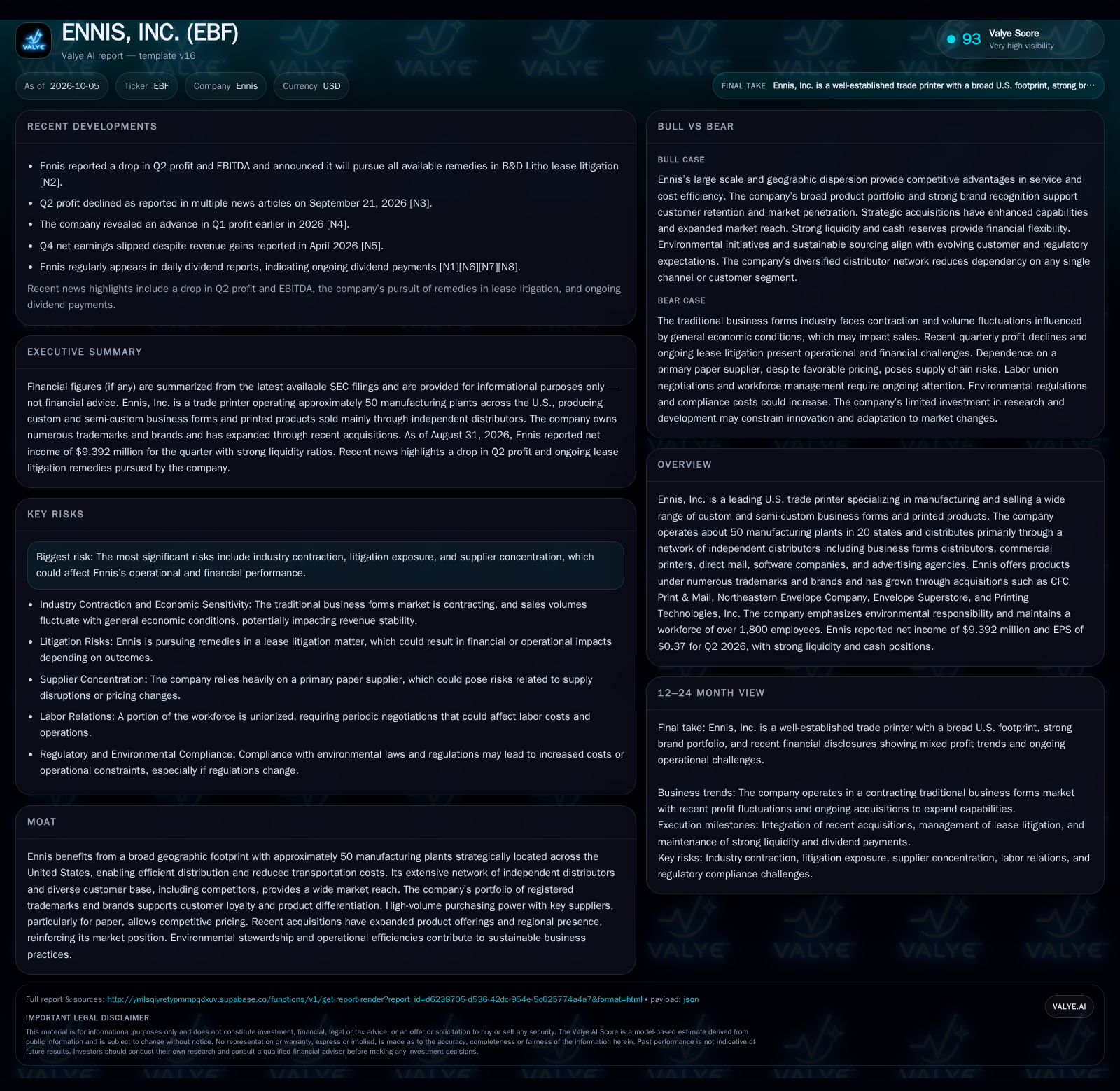
Ennis, Inc. reported Q2 2026 net income of $9.392 million and maintains reported liquidity position, but faces declining profit and EBITDA amid a contracting business forms market and ongoing lease litigation. Recent acquisitions have broadened its product portfolio and geographic reach. The company’s ability to sustain earnings will depend on integrating acquisitions, managing cost pressures, and adapting to shifting demand for printed business products. [S2] [N2]
Ennis, Inc. stands as a leading U.S. trade printer, operating a large network of manufacturing plants and distributing a diverse range of business forms and printed products through independent distributors. Despite its scale and ongoing acquisition strategy, the company faces the dual challenges of industry contraction and recent profit declines. Understanding Ennis’s ability to defend margins, integrate acquisitions, and adapt to shifting demand will be critical for assessing its future earnings power and market relevance.
Recent Profit Declines and Litigation Shape the Current Operating Landscape
Ennis, Inc. reported net income of $9.392 million for the quarter ended August 31, 2026, with an EPS of $0.37. However, both profit and EBITDA declined in Q2 compared to previous quarters, as confirmed by recent news reports [S2] [N2] [N3]. This profit downturn comes at a time when the company is also engaged in pursuing legal remedies related to a lease litigation matter, adding a layer of operational and financial uncertainty [N2]. Backlog stood at $24.6 million as of February 28, 2026, slightly down from $25.7 million a year earlier, reflecting ongoing volume and mix pressures [S1]. Despite these headwinds, Ennis maintains a reported liquidity position, with $54.011 million in cash and equivalents, and robust current and cash ratios of 3.79 and 1.37, respectively [S2].
Ennis’s Economic Model Benefits from Scale and Product Diversity
Ennis’s core business revolves around manufacturing custom and semi-custom printed products—such as forms, labels, tags, and envelopes—for resale by independent distributors. The company’s scale, with about 50 plants across 20 states, creates fixed-cost leverage and allows for more efficient production and distribution, potentially lowering per-unit costs. However, the business is exposed to significant variable costs, primarily for paper and labor, and these costs can be volatile or subject to supply disruptions.
Pricing in the traditional business forms market is typically competitive, with limited ability to pass through cost increases unless supported by differentiated product offerings or service. Ennis’s broad product portfolio and numerous trademarks may allow selective pricing power in niche or custom segments, but commoditized products likely see margin pressure. The company’s acquisition strategy aims to expand product mix and geographic reach, which could help offset organic volume declines but may introduce integration costs and dilution if synergies are not realized.
Operating leverage is present but constrained by the mature, slow-to-decline nature of the industry: modest increases in volume can improve margin, but sustained declines—such as those seen in recent quarters—can quickly erode profitability. The cited source reports dividend-related activity; that disclosure alone does not establish dividend-policy continuity, management confidence, or a material constraint on capital flexibility.
Maintaining Market Share Amid Digital Shift and Industry Consolidation
Ennis’s competitive advantages stem from its geographic dispersion, established distributor relationships, and recognized brands. Its ability to serve a wide range of customers—including competitors—offers some insulation from customer concentration risk and allows the company to capture demand across market segments. The scale of its operations supports purchasing power, particularly for paper, which can be a margin lever in times of supply constraint.
However, the business forms industry faces structural decline as digital workflows, e-signatures, and document management systems continue to substitute for paper-based processes. Competitors include other trade printers, integrated commercial printers, and digital document solution providers. Recent acquisitions may have expanded Ennis’s addressable market and filled geographic or product gaps, but the question is whether these additions can offset the broader market contraction.
Brand equity and product breadth could support retention in the custom and semi-custom segments, where switching costs are higher due to design and workflow integration. Nevertheless, in commoditized forms and envelopes, price sensitivity remains high and barriers to entry are limited.
Earnings Strengthened by Acquisition Synergies and Product Expansion
A favorable outcome for Ennis would involve successful integration of recent acquisitions—such as CFC Print & Mail and Envelope Superstore—leading to cross-selling, improved asset utilization, and cost synergies. If the company can leverage its expanded product portfolio to deepen relationships with distributors and capture higher-margin, value-added business, overall margins could stabilize or even improve despite industry contraction.
Confirmation of this scenario would come from a reversal in the recent profit decline, evidence of sustained or growing backlog, and commentary from management highlighting successful integration and incremental revenue from acquired entities.
This outcome would be falsified if integration costs escalate, if acquired operations fail to deliver incremental earnings, or if volume declines outpace the benefits of diversification, leading to further margin compression.
Volume Declines Offset by Cost Management and Targeted Growth
The most plausible trajectory is that Ennis experiences ongoing, modest declines in core business forms volume, offset in part by incremental growth from recent acquisitions and disciplined cost management. Margins may remain under pressure, given the inability to fully pass through cost increases in a competitive landscape and the slow but steady substitution of digital alternatives.
Operating results are likely to be choppy, with quarterly profit variability driven by product mix, input costs, and the timing of large orders.
Evidence supporting this scenario would include gradual backlog declines, stable but not growing earnings, and continued emphasis on environmental and operational efficiency initiatives. It would be challenged by either a sharp acceleration in volume declines or a major disruption from litigation or supplier issues.
Accelerated Decline from Industry Contraction, Litigation, and Supply Issues
A more adverse scenario envisions a faster-than-expected decline in demand for printed business forms, exacerbated by aggressive digital adoption among key customer segments. If input costs—particularly for paper—rise or supply becomes constrained, and Ennis is unable to pass these through, gross margins could compress sharply.
Should the lease litigation result in meaningful financial penalties or operational disruption, this could further erode profitability and potentially force the company to curtail dividends or delay capital investments. Supplier concentration risk, especially if the primary paper supplier faces issues, could lead to production bottlenecks or unfavorable pricing.
Evidence for this scenario would include a pronounced drop in backlog, consecutive quarters of negative EBITDA, dividend reductions, and disclosures of material adverse outcomes in litigation or supply chain. Conversely, any resilience in volume, cost pass-through, or favorable litigation resolution would weaken this downside thesis.
Factors Influencing Ennis’s Resilience Against Industry and Operational Challenges
Quarterly net income and EBITDA trends—especially the trajectory following recent declines—will be critical for gauging earnings resilience.
Backlog levels and order intake, if disclosed, will indicate whether acquisitions and product diversification are offsetting core volume erosion.
Updates on the status, costs, and resolution of the B&D Litho lease litigation will directly affect financial and operational outlook.
Gross margin trends, particularly in relation to paper and labor cost fluctuations, will reflect the company’s pricing power and operational efficiency.
Progress and commentary on the integration of recently acquired businesses—including synergy realization and revenue contribution—would help test the acquisition strategy.
Disclosures regarding supplier relationships or disruptions, especially with the primary paper supplier, would signal potential input cost or availability risks.
Environmental compliance costs and operational changes, if highlighted, could impact capital allocation and margin structure.
Disclaimer: This is research-only, informational analysis and not investment advice. It may include AI-generated interpretation and general industry context. Always verify important details using primary sources.

Comments