
RPM International: Diversification, Brand Strength, and Execution Risks in a Fragmented Global Chemicals Market
RPM International’s broad specialty chemicals portfolio and strong brand network have driven positive earnings and global reach, but integration demands and cyclical end-markets pose ongoing challenges. The company’s ability to convert its recent acquisition and segment strengths into durable growth will hinge on execution and market dynamics.
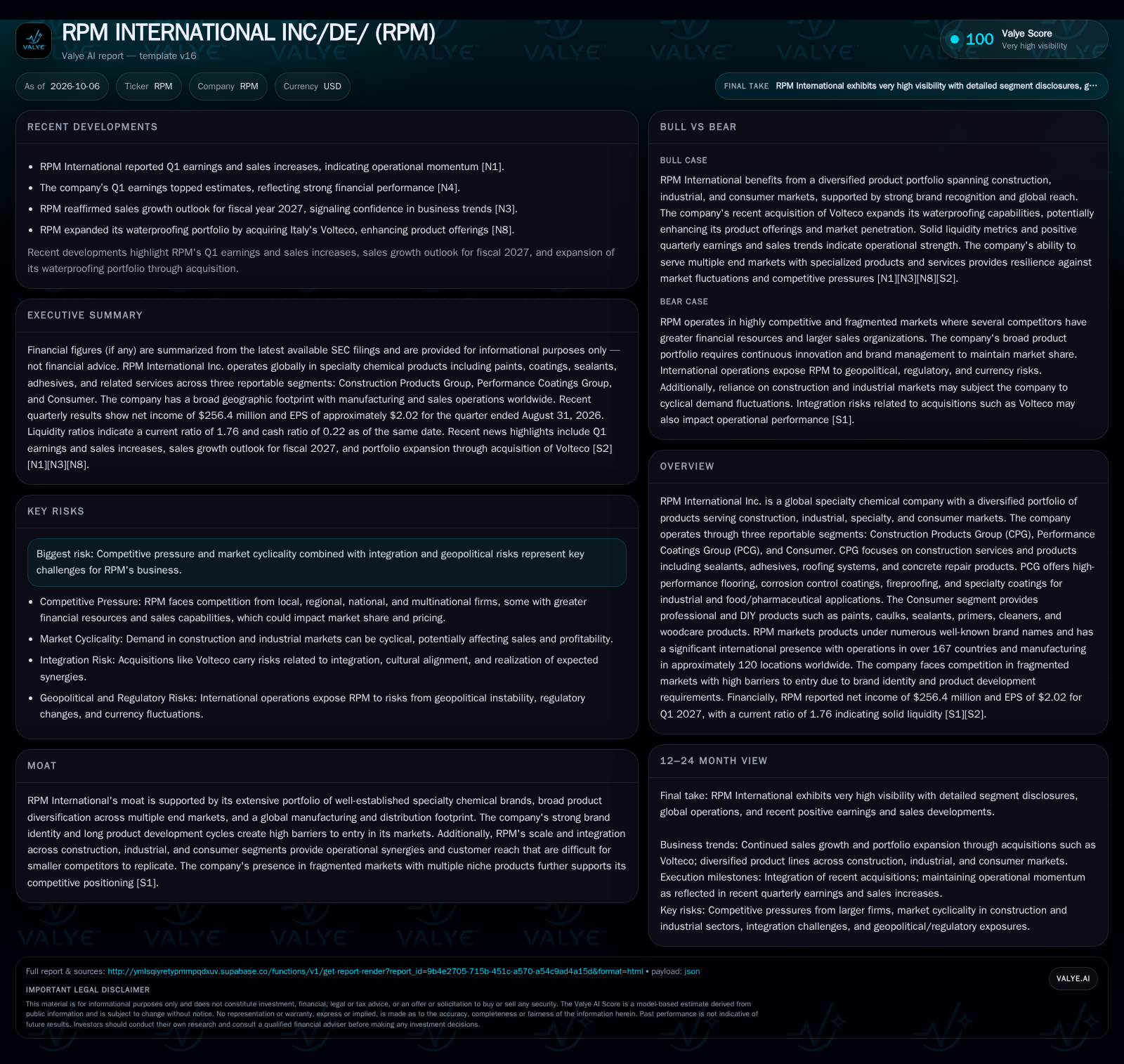
RPM International’s Q1 2027 net income of $256.4 million and EPS of $2.02 reflect continued operational strength across construction, industrial, and consumer chemical segments. The recent Volteco acquisition expands waterproofing offerings, while global diversification supports resilience. However, execution risks, integration challenges, and exposure to cyclical markets remain key variables for future performance. [S2] [N1] [N8]
RPM International’s latest quarterly results highlight the company’s operational momentum and the advantages of its diversified specialty chemicals portfolio. With global reach, well-known brands, and recent expansion into waterproofing through the Volteco acquisition, RPM is positioned to serve multiple end-markets. However, the company’s future trajectory is shaped by the challenges of integrating new businesses, navigating cyclical construction and industrial demand, and maintaining competitive differentiation in a fragmented landscape.
Recent Results, Portfolio Expansion, and Global Reach Define the Current Picture
RPM International reported Q1 2027 net income of $256.4 million and basic EPS of $2.02, exceeding expectations and signaling continued operational strength [S2] [N1]. The company’s acquisition of Italy-based Volteco in September 2026 expands its waterproofing solutions, especially within the Construction Products Group, and marks a strategic step in portfolio enhancement [N8]. RPM’s global footprint is extensive, with operations in 167 countries and 120 manufacturing sites, and roughly 31% of sales generated internationally, underscoring its geographic diversification [S1]. These developments position RPM to further leverage its brand portfolio and scale, but also introduce integration and execution complexity.
How RPM’s Diversified Model Drives Revenue and Margin Dynamics
RPM’s business model is built on a multi-segment approach: construction products (39% of net sales), performance coatings (27%), and consumer products (34%) [S1]. Each segment serves distinct end-markets—ranging from infrastructure and industrial clients to DIY consumers—helping to balance cyclical swings in any single category. Revenue is generated through a mix of branded products, technical services, and, in some cases, project-based solutions. Pricing power varies: well-known brands like Rust-Oleum and DAP may command premium pricing and higher margins, while industrial and construction segments are more exposed to project-based or negotiated pricing, which can be sensitive to input costs and competitive pressure.
The company’s global manufacturing base allows for scale efficiencies, but also increases fixed costs and complexity. Operating leverage is present, particularly when higher volumes can be pushed through existing facilities. However, specialty chemical production can be capital-intensive, with ongoing investment needed for regulatory compliance, R&D, and production upgrades. Working capital requirements are significant, especially given broad geographic reach and the need to carry inventory across multiple end-markets. The company reported cash and liquidity metrics for the period; these figures do not by themselves establish operating runway, investment capacity, financial flexibility, or financing capacity. [S2]
The interplay between RPM’s diversified segments also necessitates nuanced capital allocation decisions. Capital-intensive segments such as performance coatings may require sustained investment in specialized equipment and regulatory compliance, potentially limiting free cash flow available for consumer product innovation or acquisitions. Conversely, the consumer products segment, with its brand-driven pricing power, might generate steadier cash flows that can subsidize more volatile construction projects. Balancing these internal capital demands is critical, especially when external market conditions impose constraints on borrowing or equity issuance. The company’s ability to prioritize investments that yield the highest incremental returns across segments will influence its overall margin trajectory and growth sustainability.
Currency fluctuations and geopolitical risks also bear on RPM’s revenue and margin dynamics, given its substantial international operations. Exchange rate volatility can compress reported earnings or inflate input costs, particularly when raw materials are sourced globally but sales are denominated in diverse local currencies. Moreover, trade policies or tariffs affecting chemical imports and exports may alter supply chain costs or market accessibility. Effective hedging strategies and flexible sourcing arrangements become essential to mitigate these risks. The firm’s geographic diversification, while a strength, introduces complexity that requires sophisticated financial and operational management to preserve margin stability amid macroeconomic uncertainties.
Brand Portfolio, Product Breadth, and Barriers to Entry Counter Fragmented Market Risks
RPM’s competitive position is anchored by its extensive portfolio of recognized brands (e.g., Rust-Oleum, Tremco, DAP, Carboline, Zinsser) and its ability to serve both broad and niche market segments [S1]. Strong brand identity, especially in consumer and specialty trade channels, creates customer familiarity and stickiness, while long product development cycles and regulatory requirements raise barriers to entry for potential new entrants.
Nevertheless, the specialty chemicals sector is highly fragmented, with competition from local, regional, national, and multinational players—some of which possess greater financial resources and sales scale [S1]. In construction and industrial coatings, global conglomerates and specialized regional firms offer alternatives. Product innovation, supply chain reliability, and responsive customer service are crucial differentiators. While RPM’s scale and breadth confer some procurement and distribution advantages, the company must continually invest in R&D and marketing to maintain its edge, particularly as commoditization and price-based competition remain persistent threats.
If Integration Delivers and End Markets Stabilize, Margin Expansion and Growth Could Accelerate
A favorable scenario for RPM would see the Volteco acquisition and other recent investments delivering meaningful revenue synergies and cross-selling opportunities, especially in waterproofing and infrastructure segments. If global construction and industrial markets stabilize or return to growth, RPM could benefit from higher volumes and improved pricing power, leveraging its brands and technical expertise to win higher-margin business.
Further, if RPM leverages its global manufacturing footprint to achieve better fixed-cost absorption and supply chain optimization, operating margins could expand. Confirmation of this scenario would come from sustained sales growth above end-market averages, margin improvement in the Construction Products Group, successful new product launches or cross-segment innovation, and evidence of smooth integration with minimal disruption to existing operations.
In addition to integration and end-market improvements, leveraging digital transformation could enhance RPM’s competitive positioning. Advanced data analytics and automation in manufacturing and supply chain management might reduce costs and improve responsiveness to customer demand. Enhanced customer relationship management systems could facilitate tailored product offerings and faster innovation cycles, deepening customer loyalty. If RPM successfully harnesses technology to streamline operations and accelerate product development, it could unlock incremental margin expansion and revenue growth beyond traditional levers. This would require focused investment and cultural adaptation but could provide a sustainable advantage in a fragmented and competitive specialty chemicals landscape.
Sustained Diversification and Incremental Gains Remain Most Likely
The most plausible path is for RPM to continue benefiting from its diversified exposure to construction, industrial, and consumer markets, with organic growth supplemented by bolt-on acquisitions like Volteco. While cyclical end-markets may fluctuate, the breadth of RPM’s portfolio and geographic reach should allow for steady, if unspectacular, top-line growth, with periodic margin fluctuation as input costs and competitive dynamics shift.
Incremental improvements in operational efficiency, ongoing brand investment, and selective product innovation are likely to drive modest but consistent value creation. Confirmation would be seen in stable segment contributions, continued international sales growth, and manageable integration costs with no significant operational or financial disruptions.
Execution Missteps or Prolonged Market Weakness Could Pressure Margins and Growth
Downside risk centers on the possibility that integration of new acquisitions proves more challenging than anticipated—leading to operational disruptions, cost overruns, or dilution of brand equity. If RPM fails to realize expected synergies or faces cultural misalignment, the benefits of portfolio expansion could be offset by inefficiencies or lost market share.
Additionally, if construction and industrial end-markets enter a prolonged downturn, demand could soften, pricing pressure could intensify, and inventory write-downs or underutilized capacity could erode margins. Confirmation of this scenario would include rising SG&A or integration costs, declining segment margins, missed sales targets, or evidence of customer attrition in core brands.
Another potential risk lies in the evolving regulatory environment governing specialty chemicals, which could increase compliance costs or restrict certain product formulations. Failure to anticipate or adapt to stricter environmental, health, and safety standards might result in product recalls, litigation, or reputational damage, all of which could impair financial performance. Additionally, if RPM’s innovation pipeline lags behind competitors in developing eco-friendly or high-performance solutions, it may lose market share in segments increasingly driven by sustainability criteria. The cumulative effect of regulatory pressure and innovation shortfalls could exacerbate margin erosion and limit growth opportunities, especially in markets with heightened environmental scrutiny.
What Will Clarify RPM’s Ability to Sustain Growth and Defend Its Competitive Edge?
Progress and early financial contribution from the Volteco acquisition, including revenue and margin impact if disclosed.
Segment-level margin trends, particularly in Construction Products Group and Performance Coatings Group, as indicators of integration success and end-market health.
Organic sales growth rates in international markets versus domestic operations.
R&D and product innovation cadence—new product launches or technology upgrades would help test RPM’s ability to defend its brand and pricing power.
Working capital and inventory management, especially given global supply chain complexity and exposure to cyclical demand.
SG&A and integration expense trends as a measure of execution efficiency post-acquisition.
Customer retention or churn rates in key brands (if disclosed), as a proxy for competitive stickiness and brand health.
Updates to capital allocation policy, particularly around further M&A activity or investment in manufacturing capacity.
Disclaimer: This is research-only, informational analysis and not investment advice. It may include AI-generated interpretation and general industry context. Always verify important details using primary sources.

Comments