
Axil Brands: Retail Channel Gains and Supplier Reliance Shape the Next Phase for Hearing Protection Leader
Axil Brands’ sharp retail expansion and double-digit revenue growth in hearing enhancement position it for broader market access, but concentrated supplier and customer dependencies, plus margin volatility, remain central to the risk-reward equation.
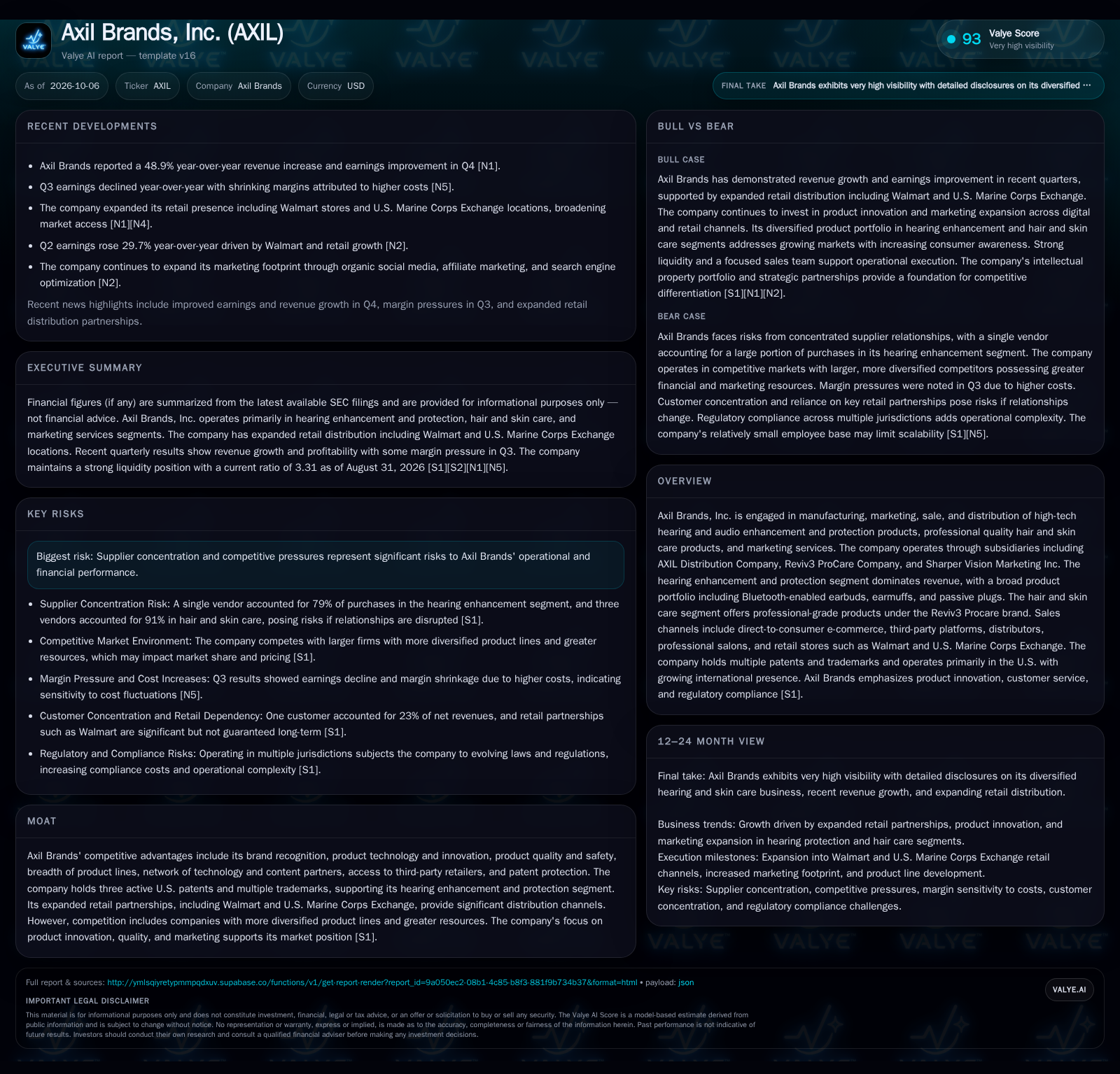
Axil Brands, Inc. reported a 48.9% year-over-year revenue jump and improved earnings in Q4 2026, driven by expanded retail partnerships—including Walmart and U.S. Marine Corps Exchange—in its hearing enhancement segment, which now supplies 96% of total revenue. The company’s supplier and customer concentration, however, leaves it exposed to disruptions, while margin pressures and competitive intensity add further complexity to its outlook [S1] [N1] [N5].
Axil Brands, Inc. has emerged as a high-growth contender in the hearing enhancement and protection market, buoyed by a bold retail channel expansion and a sharply focused product strategy. Its 48.9% year-over-year revenue surge in Q4 2026 underscores the momentum from new retail partnerships, notably with Walmart and the U.S. Marine Corps Exchange. Yet, beneath this headline growth, the company’s fortunes remain closely tied to a handful of key customers and suppliers—exposing it to concentrated risk. As Axil seeks to convert channel access and product innovation into durable earnings power, its ability to mitigate margin swings and diversify commercial dependencies will be tested.
Retail Expansion and Revenue Growth Define Axil’s 2026 Inflection Point
Axil Brands’ fiscal 2026 was marked by a decisive push into major retail channels, most notably Walmart and the U.S. Marine Corps Exchange, which has significantly broadened its access to both mass-market consumers and military-affiliated buyers [S1] [N1]. This channel expansion coincided with a 48.9% year-over-year revenue increase and a return to positive net income in Q4 2026 [N1] [S2]. The overwhelming revenue contribution from hearing enhancement and protection products—96% of total—makes Axil’s fortunes highly dependent on this segment [S1]. However, the company’s reliance on a single customer for 23% of revenue and a single supplier for 79% of purchases in its core segment underscores a persistent vulnerability to external shocks [S1].
Revenue Concentration, Channel Mix, and Margin Leverage in Focus
Axil’s economics are dominated by its hearing enhancement and protection segment, which likely features a mix of mid- to high-margin consumer electronics and safety products. The company’s pivot from primarily direct-to-consumer (DTC) distribution—65% of revenue in 2026, down from 80% in 2025—to a heavier retail and distributor mix suggests a strategic tradeoff: broader reach and higher volume at the potential expense of per-unit margins, given typical retailer and distributor markups [S1].
The company’s Q3 margin contraction, attributed to higher costs, raises questions about its ability to maintain profitability as its channel mix shifts and as input costs fluctuate [N5]. Supplier concentration could amplify cost volatility, especially if the dominant vendor leverages its position. The hair and skin care segment, while a small revenue contributor, operates via third-party co-packers, introducing additional margin and supply risks if scale remains limited.
Operating leverage is plausible as fixed SG&A and R&D costs are spread over a growing revenue base, but the company’s lean workforce (13 full-time, 2 part-time employees) may limit scalability and absorption of complexity without incremental hiring [S1]. Capital needs appear moderate for a product company of this scale, but investments in inventory, compliance, and marketing are likely to rise as channel breadth increases.
Intellectual Property, Brand Access, and the Reality of Larger Rivals
Axil Brands’ competitive positioning rests on a blend of product innovation (three active U.S. patents, multiple trademarks), brand recognition, and expanded retail access [S1]. This IP portfolio provides some defensibility in hearing enhancement, but is unlikely to erect insurmountable barriers in a market that also features entrenched consumer electronics and safety gear manufacturers with far greater R&D, marketing, and channel resources.
The company's recent retail wins—especially Walmart—suggest that its products meet mass-market standards for quality, safety, and price. However, such access is double-edged: shelf space and contract terms can change rapidly, and larger competitors may compete aggressively on price or co-op marketing to defend share.
Switching costs for end-users are likely low in the absence of proprietary integrations or ecosystem lock-ins, particularly in the Bluetooth-enabled hearing device category. However, Axil’s focus on customer service and product quality could support repeat purchases and brand loyalty, especially among tactical, recreational, and military users who value reliability.
Channel Diversification and Innovation Drive Durable Growth
A favorable trajectory for Axil would see its expanded retail footprint converting into sustained volume growth, with new product launches in hearing protection and enhancement maintaining ASPs and supporting gross margin stability. If Axil successfully diversifies its supplier base, the risk of input cost shocks could diminish, allowing for more predictable cost of goods sold.
Further, if Axil can reduce customer concentration—either by broadening its retail partner roster or deepening DTC engagement—it could smooth revenue volatility and could support premium pricing through direct brand relationships. Confirmation of this scenario would come from consecutive quarters of double-digit revenue growth, stable or improving gross margins, and a declining share of revenue from any single customer or supplier.
Falsification would be evident if revenue growth stalls after the initial retail rollout, margins compress further due to higher retailer take rates or supply chain issues, or if customer/supplier concentration metrics remain static or worsen.
Retail Gains Offset by Margin Pressure and Concentration Risks
The most plausible near-term outcome is that Axil sustains mid-to-high single-digit revenue growth as its products gain shelf space and awareness through Walmart and military channels, but per-unit margins trend lower due to retailer and distributor economics. Supplier and customer concentration remain risk factors, but are not immediately disruptive if current relationships hold steady.
Margins may fluctuate as Axil absorbs higher costs from suppliers or promotional activity required by retailers, and the company will need to invest in sales, marketing, and compliance to support a larger channel presence. The DTC channel, still representing a majority of revenue, could provide some buffer if retail relationships become less favorable.
Evidence supporting this scenario would include steady (but not accelerating) sales growth, stable or modestly declining gross margins, and concentration metrics that remain within current historical ranges.
Supplier or Customer Disruption Triggers Volatility and Margin Compression
In an adverse scenario, Axil’s dependence on a single supplier for 79% of hearing enhancement purchases or a single customer for 23% of revenue becomes acute: a supply chain disruption, vendor price hike, or loss of a major retail account could lead to inventory shortages, lost sales, or margin collapse [S1].
Competitive responses—such as aggressive discounting or retailer delisting by larger players—could further erode channel access and pricing power. Additionally, if Axil is forced to source from less efficient suppliers or offer steeper discounts to maintain shelf space, gross margins could rapidly deteriorate.
This scenario would be confirmed by a sudden drop in quarterly revenue, a spike in cost of goods sold, warnings about supply or customer losses in management commentary, or adverse changes in concentration metrics.
Milestones That Will Clarify Axil Brands’ Ability to Scale and Defend Margins
Changes in the percentage of revenue derived from the top customer—declining concentration would suggest improved diversification and risk reduction.
Movement in supplier concentration metrics, especially the share of purchases from the top vendor in hearing enhancement; a decrease would indicate improved supply chain resilience.
Gross margin trends on a quarterly basis, particularly as retail and distributor channels become a larger share of sales.
Quarterly revenue growth rates post-retail expansion, to test whether the channel gains are translating into durable top-line momentum.
Direct-to-consumer (DTC) revenue as a percentage of total sales—if disclosed—since a rising DTC mix could support higher per-unit profitability.
Inventory turnover and days sales outstanding, which would indicate how well Axil is managing working capital as its distribution model evolves.
Any new product launches in core segments and early sales data, as evidence of innovation-driven growth.
Disclosures or commentary on contract terms or shelf space commitments from major retailers, which would clarify sustainability and risk.
Disclaimer: This is research-only, informational analysis and not investment advice. It may include AI-generated interpretation and general industry context. Always verify important details using primary sources.

Comments