
Cavitation Technologies, Inc.: Persisting Through Severe Liquidity Constraints and Unproven Commercialization
The company’s ability to realize any commercial value from its intellectual property hinges on urgent restructuring, credible market traction, or external funding.
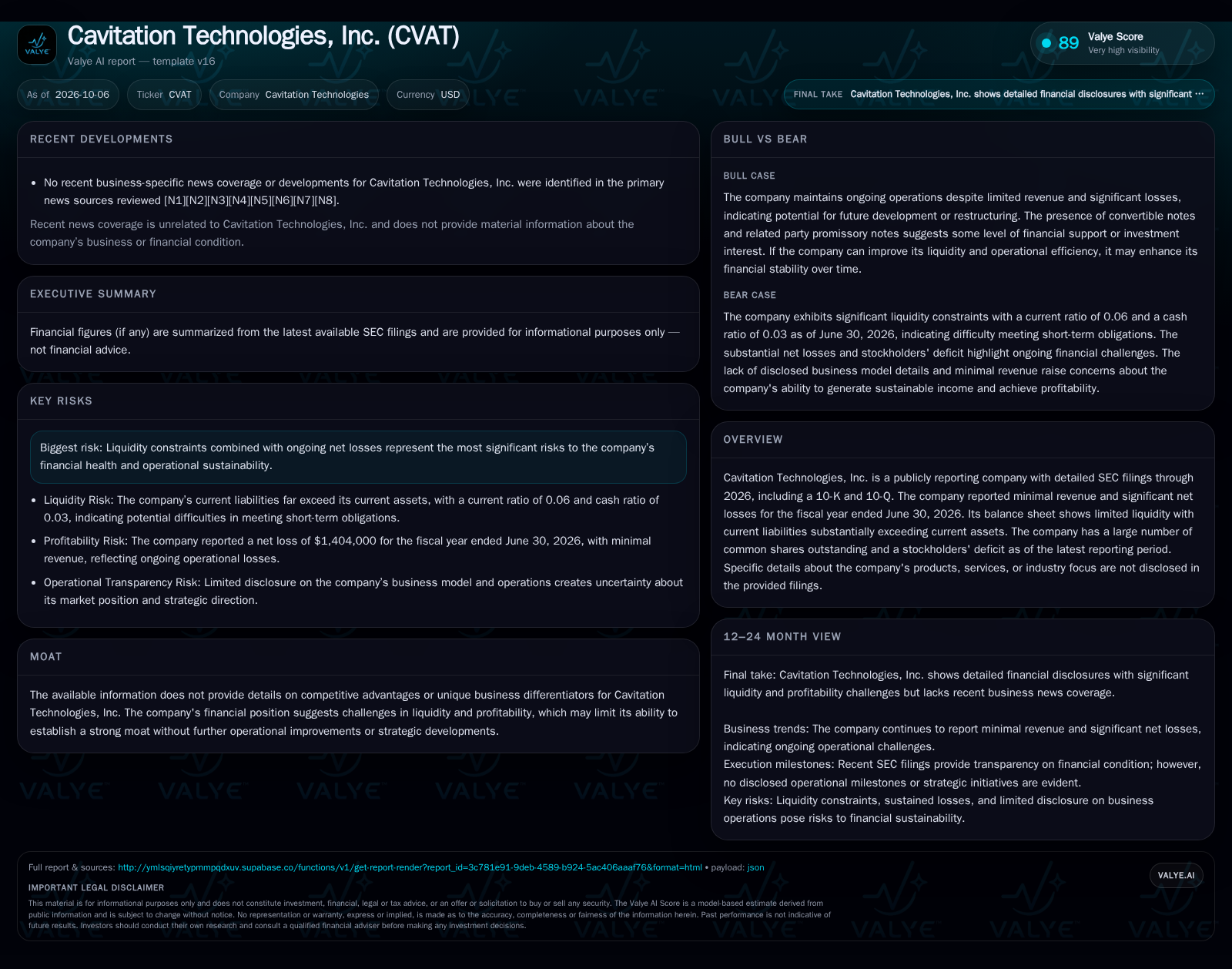
Cavitation Technologies, Inc. faces existential financial risk, with current liabilities dwarfing assets and minimal revenue generation. While it possesses patented liquid processing technology targeting sectors like renewable fuels and water treatment, the company has not demonstrated commercial or operational momentum. Survival depends on securing new funding, restructuring obligations, or achieving a breakthrough in revenue generation, none of which are currently evidenced in public filings. [S1] [S2]
Cavitation Technologies, Inc. presents a striking contrast between its claimed proprietary liquid processing technologies and its financial reality: as of June 2026, the company is operating with minimal cash, a sharply negative current ratio, and nearly nonexistent revenue. While its SEC filings mention patents and applications in markets like renewable fuels and water treatment, there is no evidence of commercial adoption or scalable business activity. The company’s future hinges on urgent financial intervention or a credible operational breakthrough—neither of which is substantiated in recent disclosures. [S1] [S2]
Acute Liquidity Pressure and Lack of Commercial Traction Define Current State
As of June 30, 2026, Cavitation Technologies, Inc. reported just $17,000 in cash and equivalents, with total current assets of $34,000 against $588,000 in current liabilities. For the fiscal year ended June 30, 2026, the company generated only $3,000 in revenue while posting a net loss of $1,404,000. The company’s balance sheet also shows a stockholders’ deficit and no preferred stock outstanding. These facts underscore ongoing existential risk, as the business has not demonstrated the ability to generate meaningful revenue or cover operational losses through internal means. [S1] [S2]
Beyond the financials, the only operational specifics disclosed are the company’s continued lease of a 5,000 square foot facility for approximately $7,000 per month on a month-to-month basis. There is no evidence of material customer contracts, backlog, or recent product launches. The persistence of convertible notes and related party loans suggests continued, but possibly limited, external support. [S1] [S2]
How the Business Could Make Money—And Why It Hasn’t
Cavitation Technologies claims to have developed and patented systems (such as the Nano Reactor® and LPN™) designed to process industrial liquids more efficiently for applications in renewable fuels, water treatment, and other sectors. In theory, such IP could be monetized through direct equipment sales, technology licensing, or recurring service contracts. The target markets—industrial processing, water treatment, and renewable fuels—are large and regulated, with customers who may value efficiency gains, yield improvement, and environmental benefits.
However, the company’s near-zero revenue and persistent losses suggest that it has not succeeded in commercializing its technology. Potential explanations include lack of demonstrated performance at scale, insufficient customer validation, or inability to navigate long industrial sales cycles. Fixed costs (including R&D, facility lease, and G&A) appear to overwhelm the minimal variable cost base, leaving no path to operating leverage at current scale. The company’s capital needs are acute: without new funding or a material revenue uptick, it is unable to cover even basic obligations.
If the technology is proven and accepted by industrial customers, the business model could evolve toward higher-margin licensing or recurring service revenue. But in the absence of disclosed contracts or pipeline, these remain hypothetical outcomes.
Competitive Realities: Barriers, Substitutes, and the Cost of Invisibility
Cavitation Technologies operates—at least in ambition—within sectors that are both highly competitive and conservative: industrial processing, water treatment, and renewable fuels. These markets are dominated by large, established engineering and technology firms with deep customer relationships, robust service networks, and proven track records. Switching costs for industrial customers can be significant, given capital intensity, regulatory compliance, and integration risk.
The company’s only apparent potential advantage is its claimed proprietary technology. However, without evidence of commercial adoption, third-party validation, or published performance data, this intellectual property does not translate into a tangible moat. There is also the risk of technology substitution: customers may prefer incremental process improvements from incumbent suppliers, or alternative technologies that offer clearer ROI or less operational risk.
The lack of revenue and customer disclosure means Cavitation Technologies is invisible in competitive tenders and may lack the credibility to displace entrenched providers. Until it demonstrates customer wins or partnerships, the company’s competitive position remains speculative.
What a Commercial Breakthrough Would Look Like—and What Would Prove It
A plausible bullish scenario requires Cavitation Technologies to secure a material contract or partnership with a recognized player in one of its target industries. Such a breakthrough could take the form of a pilot deployment, a licensing agreement, or a multi-year supply contract, ideally accompanied by public disclosure or customer endorsement.
Confirmation would come from a sharp increase in reported revenue, backlog, or signed agreements, as well as evidence of follow-on orders or customer retention. Additional validation could arrive in the form of industry awards, regulatory approvals, or third-party performance studies. If the technology delivers on its efficiency or environmental claims, recurring revenue streams could emerge, improving operating leverage and attracting new funding on better terms.
Falsification of this scenario would be the continued absence of revenue growth, lack of customer announcements, or further dilution through distressed financings without associated operational milestones.
Persistence Without Progress: The Most Likely Trajectory Absent New Capital or Contracts
Given the lack of evidence for commercial traction, the most plausible near-term scenario is continued financial distress. The company may attempt to raise additional capital via convertible debt or equity, potentially at punitive terms that further dilute existing shareholders. Without new funding, it may be forced to curtail operations, delay R&D, or default on obligations.
Operationally, the company is likely to remain in a holding pattern—maintaining its intellectual property, minimizing expenses, and seeking strategic partners or acquirers. Any incremental revenue is likely to be non-recurring or insufficient to cover fixed costs. Confirmation of this scenario would be additional small capital raises, further increases in liabilities, and continued net losses without substantive operational updates.
A deviation from this base case would require a disclosed customer win, licensing deal, or credible evidence that the technology is gaining real-world traction.
Cascading Financial Strain: The Road to Insolvency or Forced Sale
In the absence of immediate external funding or a dramatic operational turnaround, Cavitation Technologies faces a high risk of insolvency. The acute mismatch between current assets and liabilities, combined with ongoing cash burn, could result in default on payables, loss of lease, or inability to retain key personnel.
This scenario could force the company into a distressed asset sale, liquidation, or bankruptcy filing. Intellectual property might be sold under duress, likely at a steep discount given the lack of proven commercial value. Shareholders would be at risk of severe dilution or total loss.
Confirmation would include missed payments, legal proceedings related to creditor claims, or the announcement of a formal restructuring process. A reversal of this trajectory would require clear evidence of new capital or an operational lifeline.
What Would Demonstrate Commercial Validation or Imminent Distress for Cavitation Technologies
A disclosed material customer contract, pilot program, or partnership with a recognized player in one of the target industries—if disclosed—would signal commercial traction.
Quarterly revenue growth above historical levels (e.g., >$100,000 per quarter) would be a strong indicator of operational progress.
Public disclosure of a licensing or recurring revenue agreement, with details on contract duration and customer identity, would help test the thesis.
Third-party validation: published performance data, regulatory approvals, or industry awards supporting the efficacy and adoption of the technology.
Evidence of new funding—equity, debt, or strategic investment—on terms that avoid severe dilution or punitive interest rates.
Notice of default, missed payments, or legal proceedings related to creditor claims would confirm downside risk.
Changes in management, board composition, or strategic direction (if disclosed) could signal an impending restructuring or asset sale.
Progress or setbacks in securing a long-term lease or maintaining access to R&D facilities would indicate operational continuity or fragility.
Disclaimer: This is research-only, informational analysis and not investment advice. It may include AI-generated interpretation and general industry context. Always verify important details using primary sources.

Comments