
Black Hawk Acquisition Corp: SPAC Liquidity Strain Meets Vesicor Deal Execution Test
Black Hawk Acquisition Corp faces a severe liquidity crunch as it seeks to close its $70 million Vesicor merger, testing both its financial maneuvering and the viability of SPAC structures in a tightening capital environment.
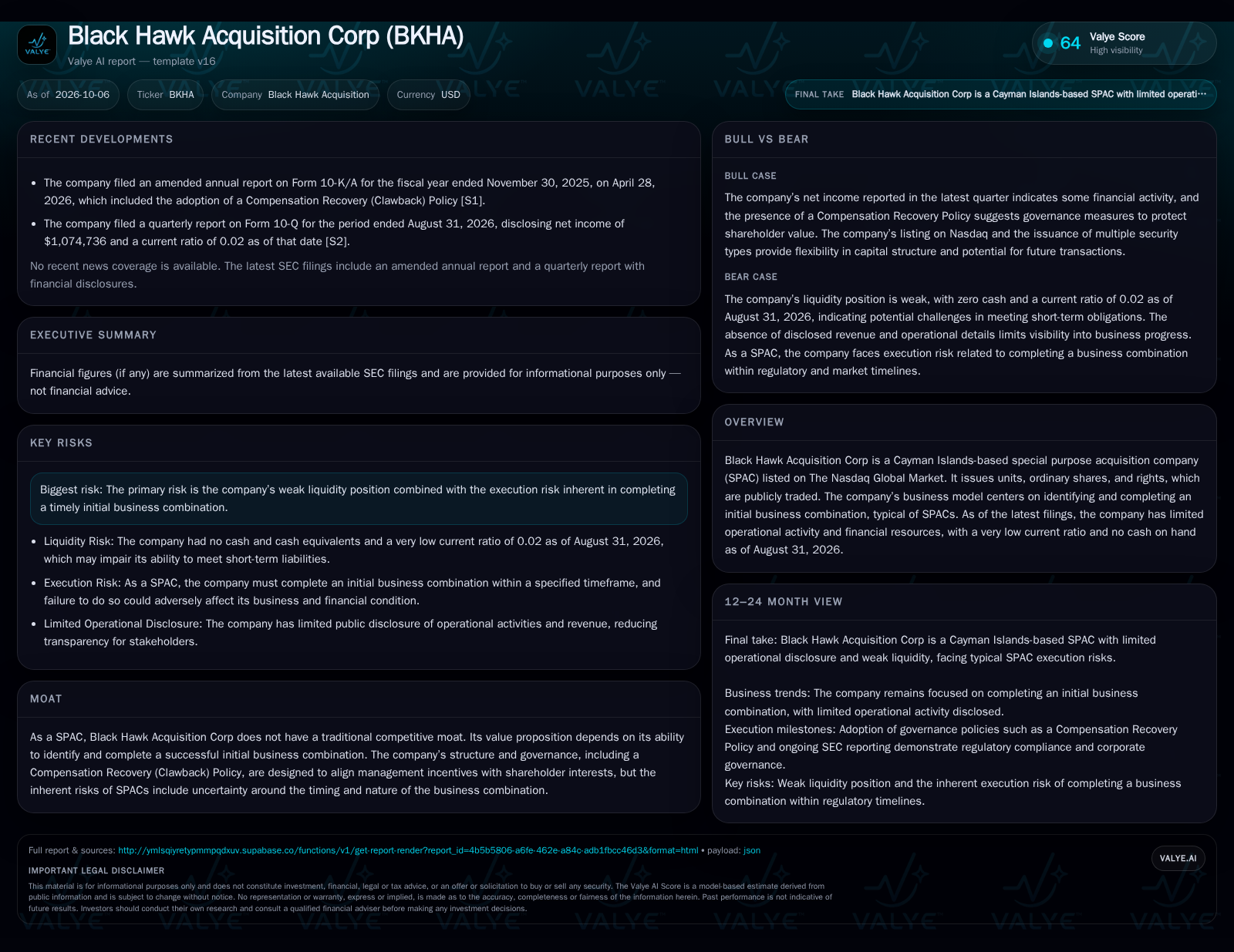
Black Hawk Acquisition Corp, a Cayman Islands-based SPAC, reported zero cash and a current ratio of 0.02 as of August 31, 2026, even as it pursues a $70 million merger with Vesicor. The ability to close and integrate the Vesicor deal will determine whether Black Hawk transitions from a shell to an operating entity or faces dissolution pressures in a challenging SPAC market. [S2]
Black Hawk Acquisition Corp stands at a critical juncture: its only material business activity is the pursuit of a business combination with Vesicor, a transaction that would see Vesicor shareholders roll their entire equity into the new entity. Yet, with zero cash as of the most recent reporting period, a current ratio of just 0.02, and no operating revenue, Black Hawk’s ability to bridge the gap between SPAC shell and viable operating company is in question. The outcome of the Vesicor deal—and the company’s ability to manage its acute liquidity shortfall—will define whether it can deliver shareholder value or succumb to the well-documented pitfalls of the SPAC model in a less forgiving capital market. [S2]
Liquidity Crisis Overshadows Vesicor Deal Prospects
Black Hawk Acquisition Corp’s most recent financial disclosures paint a stark picture: as of August 31, 2026, the company held no cash or cash equivalents, with current assets of only $41,367 against current liabilities of $2,335,491—a current ratio of 0.02. [S2] Despite reporting net income of $1,074,736 for the quarter, this figure likely reflects non-operating items typical for SPACs pre-merger, rather than sustainable business activity. The company’s only substantive forward step is a business combination agreement to acquire Vesicor at a $70 million pre-money equity valuation, with Vesicor’s shareholders rolling all their equity into the combined entity and no cash proceeds changing hands. [S2] This deal structure places the burden of future value creation on post-merger execution, while the current balance sheet raises immediate concerns about Black Hawk's ability to meet near-term obligations and close the transaction.
SPAC Economics: Trust Proceeds, Deal Fees, and the Post-Merger Transition
Like most SPACs, Black Hawk’s pre-combination economics are defined by the capital raised in its IPO and the preservation of those proceeds in a trust account—originally $69.3 million—intended for a subsequent business combination. [S2] The company does not generate operating revenue until a merger is completed; any net income reported is typically the result of interest income on trust assets, offset by administrative and deal-related expenses. Once a merger closes, the combined entity inherits the target’s operations and must manage a new cost structure, including public company expenses and potential integration costs.
A significant capital need arises from transaction costs, sponsor reimbursements, and deferred underwriting fees, which only become payable upon deal completion. In Black Hawk’s case, transaction costs have already run into the millions, with little cash left outside the trust to cover ongoing expenses. [S2] If the Vesicor deal closes, the merged company may face immediate pressure to access additional capital—through PIPE financing, debt, or secondary offerings—to fund operations and growth initiatives. The economics hinge on the combined entity’s ability to rapidly transition from a capital-consuming shell to a cash-generative business, a process that is both capital- and execution-intensive.
SPACs in a Crowded Market: Value Proposition and Structural Headwinds
Black Hawk’s competitive positioning is largely a function of its ability to deliver an attractive public listing to a private target—in this case, Vesicor. In a market crowded with SPACs and characterized by increased regulatory scrutiny, tighter PIPE markets, and diminished investor enthusiasm, the ability to close a deal and ensure post-merger trading liquidity is no longer a given. The lack of a sector focus further limits any thematic differentiation, making the success of the Vesicor transaction the sole driver of future relevance.
SPACs face substitution risk from traditional IPOs, direct listings, and private capital alternatives. In the current environment, only targets with compelling growth stories, mature operations, or clear paths to profitability are likely to attract investor interest and post-merger trading support. Black Hawk’s adoption of a Compensation Recovery (Clawback) Policy aligns management incentives with shareholders, but does little to offset the structural headwinds facing all SPACs: execution risk, dilution from sponsor shares and warrants, and the challenge of creating sustainable post-merger value.
If the Vesicor Merger Unlocks Operational Scale and Market Interest
The most favorable scenario for Black Hawk is a successful close of the Vesicor merger, followed by rapid operational ramp-up and positive investor reception. If Vesicor’s business model proves robust—delivering revenue growth, margin expansion, and a credible path to profitability—the combined entity could command a premium valuation and gain access to additional growth capital through secondary offerings or PIPEs. Confirmation would come from timely SEC filings showing deal close, post-merger financial disclosures indicating meaningful revenue and cash flow, and trading volumes that suggest sustained market interest.
Falsification of this scenario would be signaled by delays in closing, failure to secure necessary approvals or financing, or weak post-merger financial performance. If Vesicor is unable to scale or if the combined entity struggles to attract analyst coverage and institutional investors, the initial optimism could quickly erode.
Navigating a Tightrope: Deal Completion Followed by Operational Growing Pains
The most plausible path is that Black Hawk completes the Vesicor merger, but the combined company faces near-term financial and operational challenges. Investor sentiment could remain skeptical until Vesicor demonstrates commercial traction and the ability to absorb public company costs.
Evidence confirming this scenario would include successful deal close, but with subsequent disclosures of tight liquidity, going-concern warnings, or efforts to raise additional capital under less favorable terms. If the company reports incremental revenue and operational milestones but struggles to generate positive cash flow, this would reinforce a scenario of ongoing transition risk rather than immediate value creation. Falsification would occur if the deal fails to close or if post-merger results show rapid, unexpected improvement in financial health.
Deal Failure or Dissolution: Liquidity Crunch Forces Unwinding
The adverse outcome is one in which Black Hawk is unable to close the Vesicor transaction—due to regulatory, financing, or execution hurdles—or the merged entity fails to secure sufficient operating capital, forcing a wind-down or liquidation. In this case, shareholders could see value eroded by sponsor dilution, transaction fees, and the lack of a viable business combination. The current absence of cash and the reported current ratio already signal a precarious financial position that could quickly become untenable if further delays or setbacks occur.
Confirmation would come from SEC filings announcing deal termination, failure to secure shareholder or regulatory approvals, or disclosures of intent to liquidate and return remaining trust funds (net of costs) to shareholders. Falsification would require clear evidence of successful deal closing and a credible, funded operating plan post-merger.
What Will Determine Black Hawk’s Fate Post-SPAC Merger?
Progress toward closing the Vesicor business combination, including regulatory approvals and shareholder votes, as evidenced in SEC filings.
Any disclosed PIPE, bridge financing, or secondary capital raises to address immediate post-merger liquidity needs.
Post-close financial disclosures: revenue, cash flow, and working capital trends for the combined entity, if disclosed.
Public float and trading liquidity in BKHA (or successor ticker) shares after deal close, as a signal of ongoing investor support.
Integration milestones and operational updates from Vesicor, particularly any customer wins, partnerships, or product launches.
Adoption and enforcement of the Compensation Recovery (Clawback) Policy in response to post-merger performance outcomes.
Disclosures regarding deferred underwriting fee payments and their impact on near-term cash needs, if provided.
Disclaimer: This is research-only, informational analysis and not investment advice. It may include AI-generated interpretation and general industry context. Always verify important details using primary sources.

Comments